Reels and Rumors of Truth
A Marriage Nearly Lost to a Question Neither One Asked
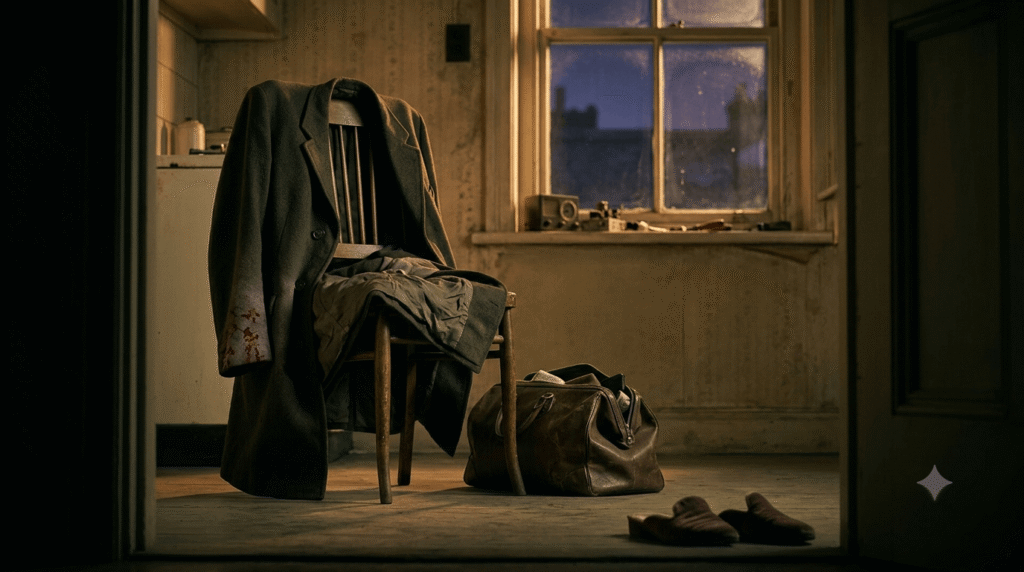
Eddie Collins comes home bruised and bandaged, and his wife assumes the worst thing she can imagine: that he has been in a bar fight while she was in labor with their first child.
He had not been drinking. He had been boxing, secretly, at night, for money — trying to pay for the best obstetrician he could find, a cost far above what a radio-shop clerk could normally afford. He never told her why. She never asked why not. By the time the truth surfaces, she has already packed a bag.
Bad Girl (1931) won Frank Borzage the Academy Award for Best Direction and Edwin J. Burke the award then called Best Adaptation (5th Academy Awards). What it is actually about is two people whose protective silences — each meant to spare the other some pain — quietly manufacture the exact suspicion both were trying to prevent.
Twenty-six years earlier, O. Henry had already explored a related but different version of this problem in “The Gift of the Magi” (1905). Della and Jim are not hiding bad news from each other. They are hiding identical acts of generosity — each secretly selling the one possession that mattered most, to buy a gift the other’s sacrifice has now made useless. O. Henry’s narrator calls them the wisest of gift-givers, and most readers have taken that as a straightforward tribute to sacrificial love. It reads just as easily as gentle irony: two people so intent on giving that neither thought to ask what the other might actually need. The story never quite resolves which reading is correct, and it may not want to.
The two silences differ in what they conceal. Della and Jim are hiding matched acts of romantic generosity — a silence born of surprise, not fear. What Eddie and Dorothy hide from each other is closer to shame: the fear of admitting they cannot yet afford the life the other believes they are building. A turn-of-the-century tale about poverty and a Depression-era film about it are telling two different kinds of story with a similar shape — one where the withheld truth is a gift, and one where the withheld truth is an inadequacy.
Bad Girl runs the harsher version. Eddie and Dorothy are concealing what they believe the other cannot bear to hear, under the specific pressure of a household where a hospital delivery with a qualified obstetrician was itself a financial stretch for a man in Eddie’s position. Borzage shoots their private scenes in tight, intimate close-ups, then cuts to wider, more anonymous shots of stairwells and waiting rooms whenever the story moves into public view — a visual seam between what the couple actually feels and what the world outside their apartment can see. The novel and play behind the film, both by Viña Delmar, supplied the plot; the direction supplies the sense that privacy itself, however loving its intentions, is exactly where the worst explanation finds room to grow (AFI Catalog).
The oldest account of a related kind of silence belongs to a carpenter, not a boxer. Matthew’s Gospel reports that Mary, betrothed to Joseph, was found to be pregnant before the two had come together, and tells its reader — though not yet Joseph — that the child’s origin was the Holy Spirit. What the text says Joseph decided, on the information available to him at that moment, is this:
“Then Joseph her husband, being a just man, and not willing to make her a publick example, was minded to put her away privily.” (Matthew 1:19)
Interpreters read “a just man” more than one way — as a man determined to follow the law precisely, or as a man choosing mercy inside it — and the Gospel does not spell out how a quiet first-century betrothal separation would actually have worked. Some readers connect Joseph’s restraint to the penalty Mosaic law prescribed for exactly this circumstance — death by stoning (Deuteronomy 22:23–24) — though whether that penalty was still being carried out under Roman rule in first-century Judea is itself disputed among historians. If that backdrop is even partly right, Joseph’s quiet divorce was not simply tact. It may have been the one option available to him that kept Mary from an accusation with far graver consequences than embarrassment — which would make his silence and Eddie’s late-night boxing come from a related place: each a private, bodily risk taken to absorb a cost the other person never has to see.
“Joseph, thou son of David, fear not to take unto thee Mary thy wife: for that which is conceived in her is of the Holy Ghost.” (Matthew 1:20)
Joseph does not weigh new evidence and change his mind. The narrative simply reports what he does next:
“Then Joseph being raised from sleep did as the angel of the Lord had bidden him, and took unto him his wife.” (Matthew 1:24)
This is not offered here as a method for resolving uncertainty in an ordinary marriage, and Scripture is not holding Joseph’s obedience up as a technique transferable to households with no angel in them. What the account does preserve, more modestly, is the shape of the moment just before a private plan takes effect — the same moment Eddie and Dorothy each pass through, without a messenger, once a silence has produced its own explanation and no one has yet said otherwise.
Marriage researchers have a name for part of what happens between Eddie and Dorothy: “negative sentiment override,” John Gottman’s term for the point at which a couple has accumulated enough unresolved hurt that even neutral or well-meant behavior starts getting read through a hostile default (Gottman and Levenson, 1992). Silence, in that state, stops behaving like a neutral gap in a conversation. It behaves like open ground, and whatever explanation fear reaches first is the one that tends to grow there. A related and often oversimplified finding from the same research tradition is that couples heading toward stability tend to sustain a markedly higher ratio of positive to negative interactions during conflict than couples heading toward separation — a pattern worth reading as a lens, not a formula, and one Gottman’s own writing has cautioned against treating as a fixed prescription.
Borzage’s film reaches a related observation by entirely different means. Eddie cancels his own plan to open a shop, without explaining why, because he misreads an offhand comment as a request. Dorothy hides her pregnancy because she assumes his silence about the shop means a child would be an unwelcome expense. Neither is lying to the other. Both are reading a silence through whatever explanation the accumulated pressure makes easiest to reach for first.
The Bruises
By the end of Bad Girl, the bruises get explained, the baby gets a name, and a marriage that came close to ending over an unasked question survives it — resolved the way most real misunderstandings are resolved, by one person finally saying the thing out loud. Joseph’s story ends differently: not through a conversation between two people, but through a revelation neither of them produced on their own. Joseph’s silence was broken from outside, by a messenger neither he nor Mary summoned. Everyone else is left with a plainer, less dramatic instrument for the same job: the willingness to ask a question before the silence finishes writing its own answer.
We’ve examined the other side of this exact moment before — what it costs to be the one who finally confesses, rather than the one left waiting to hear it. In the previous installment, we looked at what a shortened life still had time to complete; this one is about a different kind of time — how long an unspoken truth can be left standing before it starts doing its own damage.
Paul once described love to a divided church as something that “believeth all things, hopeth all things” (1 Corinthians 13:7) — not, on its own, a rule for how much doubt a person owes an unexplained silence, and not a case for choosing trust over real evidence of harm. Read alongside patience and hope, it describes a posture rather than a technique: a willingness to hold the more generous explanation open for as long as the facts allow it, without pretending that willingness settles every case.
That is a narrower claim than silence usually gets credit for. Della and Jim’s silence produced a story readers still argue about a century later. Eddie and Dorothy’s silence very nearly produced a divorce. The difference was never how much either couple loved. It was whether, and when, someone finally asked.
1 Gottman, John M., and Robert W. Levenson. “Marital Processes Predictive of Later Dissolution: Behavior, Physiology, and Health.” Journal of Personality and Social Psychology, vol. 63, no. 2, 1992, pp. 221–233.
New essays every week. Delivered quietly.