Hook
How Would Anyone Know
How long could you go missing from your own life before someone noticed?
Not a dramatic disappearance — nothing anyone would call an emergency at first. Just silence. A porch light left on. A newspaper nobody picked up.
For someone who lives alone, the first person to notice that something is wrong may be someone who was never supposed to be watching — not a relative, not a friend, but whoever happens to show up at the door often enough to know what normal looks like.
In January 2021, in a quiet stretch of Chicago’s Dunning neighborhood, that person was a mail carrier named Shonda Lemon. Stories like hers tend to produce a quick, comfortable response: what a kind woman. That response skips past the more interesting question underneath it — not whether kindness exists, but what makes it possible for anyone to notice in time.
Historical Case
Dunning is a neighborhood of modest brick two-flats and narrow gangways, the kind where a delivery route repeats itself so precisely that a carrier can predict, block by block, whose porch light will be on and whose mail will already be gone. Lemon had worked the same route for eight years, and for four of those years, one stop belonged to Helen Iwanski, an 89-year-old woman who lived by herself (CNN, 2021).
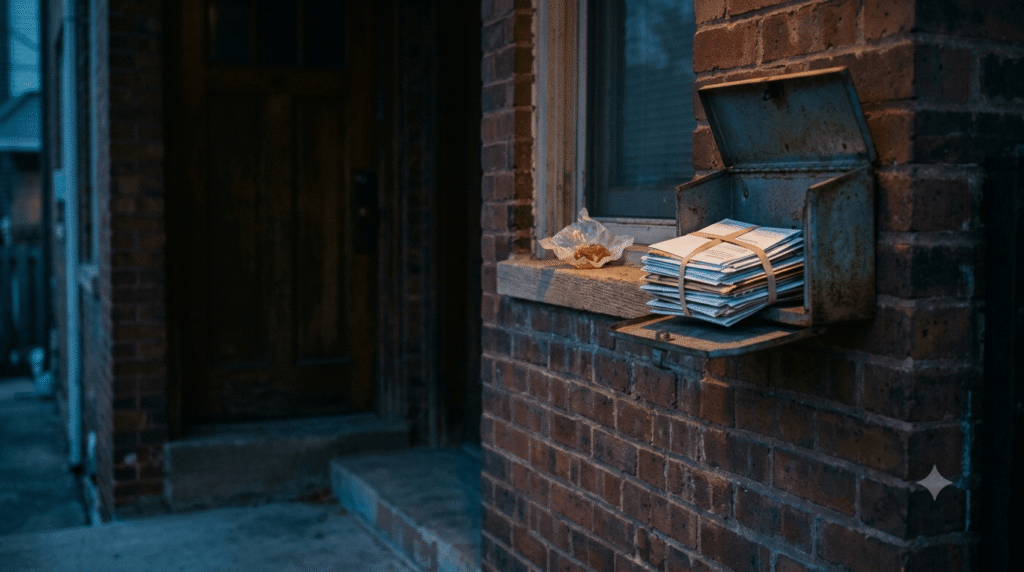
Their exchanges were never long — a greeting, a few sentences on the porch, nothing either woman would have called significant at the time. But habits accumulate meaning. Lemon began wrapping Iwanski’s mail in rubber bands so the older woman could grip the bundle more easily, a small adjustment nobody asked her to make. Iwanski, in turn, sometimes taped candy to her outgoing mail as a thank-you. Neither gesture was announced. Both were simply repeated until they became expected.
That pattern is what made the break so legible. Lemon knew Iwanski lived alone, had no children nearby, and rarely traveled. So when three consecutive days passed without a single piece of mail leaving the box, the absence read less like coincidence and more like a message (NBC Chicago, 2021).
A habit interrupted was the only signal she had, and she trusted it enough to act on it.
Lemon called police for a wellness check on January 14. When officers finally forced the door, they found Iwanski on the floor of her own home, where she had been for several days after a fall, without food or water. She was taken to Advocate Lutheran General Hospital and later moved to a rehabilitation facility, where she recovered (Fox 5 DC, 2021).
When an officer called to confirm Iwanski was alive, Lemon said the relief broke over her all at once. “I began to cry,” she recalled, “because it was a rejoicing moment for me” (Fox 5 DC, 2021). Iwanski’s niece, Mary Mason, later met Lemon in person to thank her, telling reporters simply, “She’s our angel” (NBC Chicago, 2021).
Biblical Lens
We tend to assume that responsibility begins where drama does — with a rescue, a diagnosis, a crisis large enough to require heroism. Scripture, in this instance, begins somewhere much smaller: with what a person is willing to keep seeing, day after ordinary day.
“Son of man, speak to your people and say to them, ‘If I bring the sword upon a land, and the people of the land take a man from among them, and make him their watchman, and if he sees the sword coming upon the land and blows the trumpet and warns the people… but if the watchman sees the sword coming and does not blow the trumpet… his blood I will require at the watchman’s hand.'” (Ezekiel 33:2–3, 6)
The watchman was not given the power to control the danger. He was given the responsibility to see it, and to warn others before it was too late for the warning to matter.
“You have been faithful over a little; I will set you over much” (Matthew 25:21) — “one who is faithful in a very little is also faithful in much” (Luke 16:10).
Together, these smaller texts suggest that responsibility rarely announces itself as something large. It begins with paying attention to what is already, quietly, in front of you — and it is rarely owed to family, or to anyone with a formal claim on our concern. More often it belongs to the people who circle back to us out of habit rather than duty: a mail carrier, a neighbor, a bus driver, a pharmacist, a cashier who remembers a face.
Pattern Insight
Lemon’s attentiveness was not an isolated event so much as a rare echo of an older civic habit. In 1982, the U.S. Postal Service and the National Association of Letter Carriers formalized that habit into a nationwide program called Carrier Alert, training carriers to read exactly the kind of signal Lemon read — an accumulating mailbox, a porch light left on past noon — as a language of its own (NALC, 2012).1 Coverage has thinned since; where it survives, it depends on whichever carrier or local agency still bothers to keep it running.
Britain, facing the same erosion of casual contact, answered it differently — appointing a government minister with loneliness as an explicit portfolio in 2018 (UK Government, 2018), a solution that assumes what an earlier, more improvised American system once assumed for free: that someone, somewhere, has to be organized to notice.
Nearly a quarter of community-dwelling Americans aged 65 and older — an estimated 7.7 million people — live in a state of measurable social isolation, according to a 2020 National Academies of Sciences, Engineering, and Medicine report.2 The number does not explain what Lemon did. It measures how much ground a habit like hers now has to cover largely alone.
We live, of course, with more signals than any previous generation: doorbell cameras, health monitors, a phone that can sense a fall before a body hits the floor. But a signal only becomes information to someone who already knows what it means. Technology is good at announcing an event. It is still human attention that notices a pattern breaking. We may have never had more signals. We may simply have fewer people positioned to read them.
In its own modest way, Iwanski’s mailbox became a post from which her absence could be seen — not a system built to save her, just a point of contact precise enough that its silence could still be read as a warning.
Closing
The Post Nobody Assigned Her
No one had assigned Lemon that post. Nothing in a route description asks a carrier to memorize who lives alone, who has children, who has traveled and who has not. That noticing came from somewhere else — from choosing, day after day, to treat an ordinary stop as more than a delivery.
Routines teach us, without our noticing, what to notice — and, just as quietly, whose absence they have trained us not to see.
1. National Association of Letter Carriers, “Carrier Alert: 30th Anniversary of a Joint NALC-USPS Initiative,” 2012.
2. National Academies of Sciences, Engineering, and Medicine, Social Isolation and Loneliness in Older Adults: Opportunities for the Health Care System (Washington, D.C.: National Academies Press, 2020).
New essays every week. Delivered quietly.