Hook
Party of One
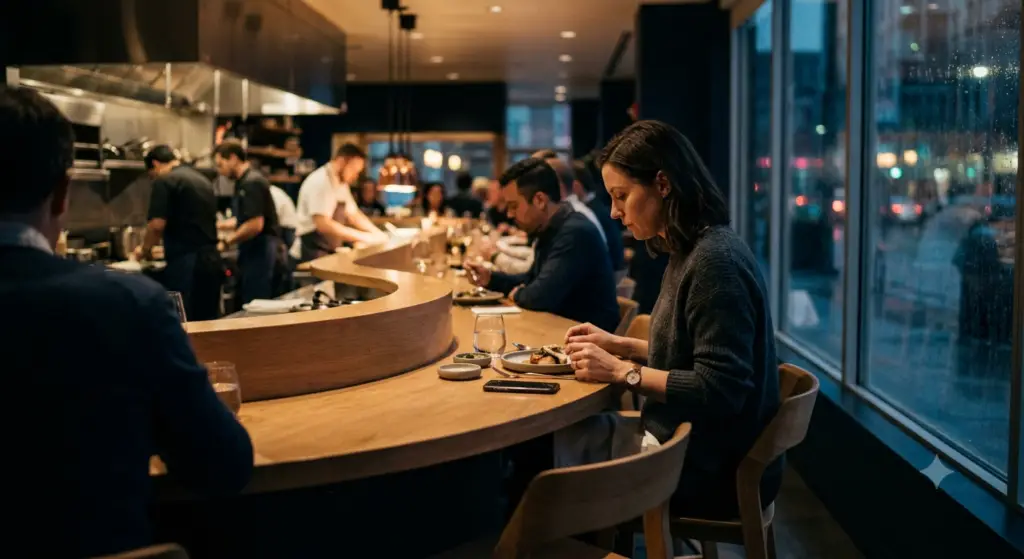
The hostess podium at a mid-size restaurant chain now has a field most didn’t have five years ago: party size, one. In the third quarter of 2025, reservation platform Toast recorded a 22% year-over-year jump in single-diner bookings. OpenTable’s global data showed something similar — solo reservations rising faster than any other party size, with breakfast slots and quiet weekday afternoons becoming the new prime time for eating alone. Restaurants have started designing around it: counter seating angled toward the kitchen instead of the room, tasting menus sized for one, servers trained not to ask whether “someone else is joining.”
There is a difference between a table emptied by loss and a table engineered for absence. The Table Where Everyone Left was the first kind — a family table that emptied out chair by chair over the course of a slow unraveling, until the place settings were the only evidence anyone had ever sat there. This is the second kind: absence that gets designed for — engineered, accommodated, made comfortable enough that no one has to name it.
The industry calls it a trend. The data underneath it calls it something closer to a condition.
Historical Case
The Automat and the Table That Waited
Solo dining is not new. What’s new is the scale, and the speed with which an entire industry has learned to serve it.
In 1902, Horn & Hardart opened the first Automat in Philadelphia — a restaurant with no waiters at all. Diners fed nickels into slots, opened small glass-and-chrome compartments, and carried their food to a marble-topped table alone. By the 1950s there were dozens across New York and Philadelphia, feeding office workers, widows, and new immigrants who had nowhere in particular to be and no one in particular to sit with.
Historians of the Automat have noted something the founders may not have set out to build: it became, almost by accident, one of the only respectable places in a major American city where a woman could eat unaccompanied without comment, or a stranger could sit at a shared marble table without owing anyone conversation. The machine did not solve loneliness. It simply removed the friction — the ordering, the waiting, the social performance — that made eating alone feel exposed.
Three decades later, the same instinct found the home. Swanson’s frozen “TV dinner,” launched in 1953, was engineered for a household that increasingly ate meals scattered across different rooms, different schedules, in front of different screens. The product didn’t cause that scattering. It arrived to serve a change that had already happened.
The pattern repeats now with digital reservation systems and solo-friendly counter seating. An industry is not creating a new appetite. It is noticing an old one — the appetite to eat without the vulnerability of being seen doing it alone — and building infrastructure around it, the way a river eventually gets a bridge once enough people are already finding their own way across.
Biblical Lens
What the Table Was Always For
Scripture treats the table as something more than a place where food happens to be consumed. It shows up, again and again, as the place where recognition happens — where people are known, or fed, or both at once.
“And Boaz said unto her, At mealtime come thou hither, and eat of the bread, and dip thy morsel in the vinegar. And she sat beside the reapers: and he reached her parched corn, and she did eat, and was sufficed, and left” (Ruth 2:14, KJV).
Boaz owes Ruth nothing beyond the letter of the gleaning law — she is a foreign widow entitled, at most, to whatever grain his workers leave behind. He invites her to his own table instead, hands her roasted grain himself, and the text notes almost as an aside that she ate until full and still had some left over. The verse doesn’t dwell on the size of the meal. It dwells on the invitation — an insider making room, unasked, for someone with no claim to be there.
“And it came to pass, as he sat at meat with them, he took bread, and blessed it, and brake, and gave to them. And their eyes were opened, and they knew him; and he vanished out of their sight” (Luke 24:30–31, KJV).
Two disciples walk seven miles with a stranger and don’t recognize him until he breaks bread at their table. The recognition doesn’t happen on the road, in conversation, or in the retelling of Scripture — it happens specifically at the meal. The table is where the unseen becomes seen.
“And he lift up his eyes and looked, and, lo, three men stood by him: and when he saw them, he ran to meet them from the tent door… Let a little water, I pray you, be fetched, and wash your feet… And I will fetch a morsel of bread, and comfort ye your hearts” (Genesis 18:2–5, KJV).
Abraham owes these three strangers nothing — no covenant between them, no shared history, no obligation to interrupt the heat of the day. He runs toward them anyway, and the “morsel of bread” he promises turns out, a few verses later, to be a full feast. The weight of the passage doesn’t sit in the size of the meal. It sits in the running — Scripture pairs hospitality here with speed and personal cost, not convenience.
Scripture does not require that every catastrophe be interpreted as divine judgment; it does, however, insist that societies eventually reveal the moral conditions under which they have chosen to live.
None of these passages argue that eating alone is sin, or that a solo reservation is a spiritual failure. Scripture never asks readers to feel guilty over a Tuesday lunch eaten at a desk. What it does is hold up a consistent pattern: in three very different settings, someone with standing made room, unasked, for someone without it. That pattern is worth noticing against a culture that has become remarkably skilled at removing the need for the invitation altogether.
Pattern Insight
The Numbers Behind the Reservation
The 2025 World Happiness Report, produced by researchers now based at Oxford’s Wellbeing Research Centre, found that 26% of American adults reported eating every single meal alone the previous day — a figure that has risen by more than half since 2003, drawn from two decades of the federal government’s American Time Use Survey. The same report found that how often people share a meal predicts life satisfaction more strongly than income or employment status does, holding true across age groups, genders, and countries.
Cigna and the Evernorth Research Institute, surveying more than 7,500 U.S. adults in 2025, found 57% now classify as lonely by validated measures — with younger adults, despite constant digital contact, scoring lonelier than older generations. Solo dining and general loneliness are not the same measurement, and the industry data doesn’t claim they are. But laid side by side, they describe the same decade: a country eating alone in record numbers, at the same moment researchers are recording record loneliness — and an entire hospitality industry has responded by making that arrangement easier.
The trend is not the cause. It is the accommodation. Nobody at Toast or OpenTable set out to normalize solitary eating; they noticed where the reservations were already going and built a smoother path to it. That is worth sitting with for a moment, because it means the discomfort was already there before the counter seating was.
A Table Is Not a Sacrament by Accident
The early church did not eat together because meals were logistically necessary — they could have handled food distribution far more efficiently by household. They ate together because the shared table was doing something individual meals could not: it kept people known to each other in a city, Rome, that was otherwise extraordinarily good at letting a person disappear into anonymity. Historians of the period note that Roman urban life, much like modern urban and digital life, offered abundant proximity to other people and very little actual acquaintance with them.
The Automat solved friction. The early church’s table solved isolation. Those are not the same achievement, and the difference matters here. A restaurant that makes a solo diner comfortable has done something genuinely kind — it has removed shame from an ordinary act. But comfort with eating alone and freedom from loneliness are not the same outcome, and an industry optimizing for the first should not be mistaken for a culture that has resolved the second.
The Ruth narrative offers a useful test. Naomi could have released Ruth to eat and glean separately — it would have made economic sense, possibly even improved both women’s prospects individually. The text insists on the opposite choice, and treats that insistence as the beginning of restoration rather than an inefficiency to be optimized away.
Underneath the sociology sits a plainer question worth naming directly: why does eating with another person make someone feel more accounted for than eating the identical meal alone? The difference isn’t the food. It’s witness — the plain fact of being seen mid-bite, unguarded, laughing without performing the laugh, and having that be permitted rather than rehearsed. Solo dining doesn’t remove that hunger to be witnessed. It relocates it — from a fear of the empty chair across the table to a preference for the counter seat facing the kitchen instead of the room.
Closing
The Seat That Waits for Someone Else
None of this argues that a solo reservation is a small tragedy, or that eating alone at a counter seat needs defending against. Sometimes a quiet meal is exactly what a person needs, and no biblical pattern exists to shame that.
The harder question isn’t why so many Americans are choosing to eat alone. Comfort explains that easily enough — no waiting, no small talk, no risk of being stood up. The harder question is what happened to the instinct Abraham had at the tent door: the readiness to run toward a stranger and set an extra place before anyone asked for one. That instinct doesn’t vanish because a culture gets efficient. It weakens from disuse, the way any capacity does once a society builds enough infrastructure that it never has to be exercised.
A few weeks ago, the empty chairs in The Table Where Everyone Left stood as evidence of a family that had stopped sitting down together. Tonight’s party of one is a smaller, quieter version of the same evidence — not that someone left the table, but that fewer of us still keep the habit of pulling out the extra chair before we’re asked to.
[1] Data by Toast, “Restaurant Trends Report,” Q3 2025.
[2] World Happiness Report 2025, Wellbeing Research Centre, University of Oxford, using data from the U.S. Bureau of Labor Statistics’ American Time Use Survey.
[3] The Cigna Group and Evernorth Research Institute, “Loneliness in America 2025.”
New essays every week. Delivered quietly.