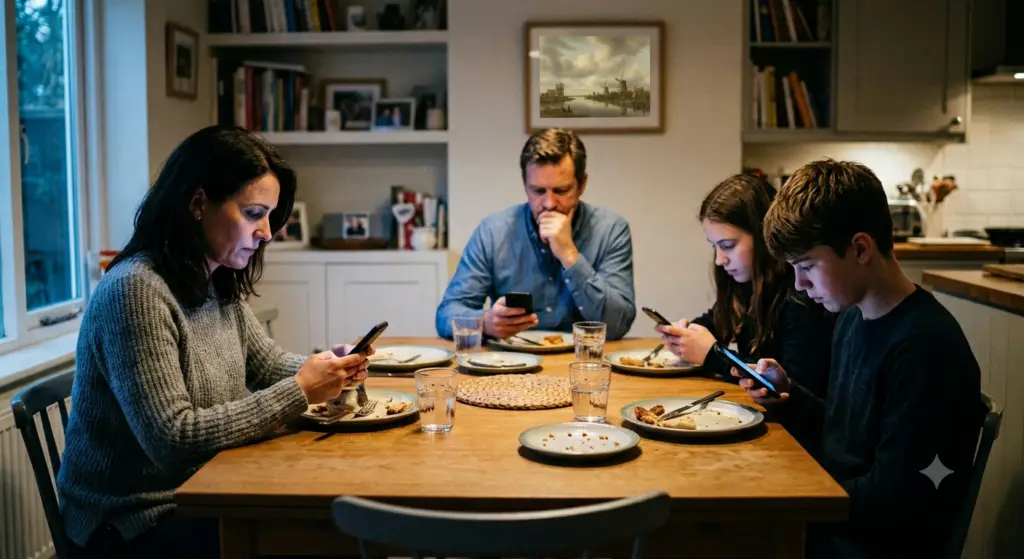
The Camera in the Kitchen
On June 18, 2026, a study published in JAMA Pediatrics did something almost nobody had thought to do before: it put cameras on real family dinners and simply counted what happened. Researchers tracked more than 350 households through an ordinary evening meal, logging every phone, tablet, television, and book that entered the frame. The finding that made headlines was not subtle. Seventy-seven point six percent of parents used some kind of screen at the table — more than three out of every four adults present. In over two-thirds of the households observed, parent and child were on devices at the very same time, each looking at a different glowing rectangle a few inches from the other’s plate.
What makes this study worth pausing on is not the raw number. Screen time studies have been arriving for a decade now, and most readers have grown practiced at nodding along and closing the tab. What makes this one different is who researchers found holding the phone. It was not, in the majority of cases, the child. Parent-only device use during the meal outpaced child-only use by roughly four to one. The grownups were not confiscating anyone’s attention. They were the ones who left first.
A Pew Research Center report released the previous October, built from focus groups of American parents, captured the same pattern from the inside rather than from a camera. One mother described her own habit candidly: she tries to tell her children to put their devices away at dinner, she said, and then admitted, in the same breath, that she is often the one who forgets to put hers away first. Another parent described switching a phone to airplane mode during homework time specifically to keep from being pulled away by a notification while sitting directly beside a child.
Researchers who study parental burnout have offered one plausible reading of this pattern, and it is worth stating carefully rather than as verdict: for an exhausted parent, a screen at the table may function less as neglect than as a brief, involuntary retreat — five minutes of not being needed, borrowed from the one hour of the day when everyone is finally sitting still. That reading does not excuse the pattern. It does relocate the fault line. This is not, on the available evidence, a story about parents who stopped caring. It is a story about a room that used to protect attention by accident, now asking something of tired adults that the room itself no longer supplies for free.
The One Meeting Nobody Had to Schedule
For most of the twentieth century, the shared evening meal held a peculiar status in American family life: it was the one point in an ordinary day that did not require planning. School let out, work ended, and — with rare exception — a household converged at roughly the same hour around the same table, whether or not anyone had discussed it in advance. The sociologist Robert Putnam, tracing the broader collapse of American communal life, noted that the shared family meal declined by roughly a third over the closing decades of the twentieth century, following almost exactly the same downward curve as bowling leagues, union halls, and church suppers — evidence, he argued, that the dinner table was never a private habit so much as one local branch of a much larger, and largely unnoticed, national withdrawal from shared tables of every kind.3
The philosopher Albert Borgmann gave this kind of object a name worth borrowing here: a focal thing — something that gathers a scattered household around a single, shared, effortful center, the way a hearth once gathered a household around warmth and light rather than around any one person’s individual preference.4 A dinner table functioned as exactly this kind of focal thing for most of American history, not because eating was sacred, but because eating required everyone’s hands and eyes to be occupied by the same object at the same time, with nothing else in the room competing seriously for either.
That guarantee did not depend on anyone being especially devoted to family closeness. It depended on the table being, for that half hour, the only thing in the room capable of holding attention. Television changed this first, and slowly — a set in the next room, then a set at the table itself. What the smartphone changed is the geometry entirely. The competing attention no longer sits across the room. It sits in the hand, an inch from the fork, indistinguishable at a glance from someone simply pausing between bites.
Remove the accident of undivided proximity, and the guarantee disappears even when every body at the table remains exactly where it was. The chairs are still full. The meeting the chairs used to force into existence is not.
The Meal That Opened Their Eyes
Shared eating is among the oldest instruments of trust human societies possess. Long before two parties sealed an agreement in writing, they very often sealed it by eating together — several ancient Near Eastern covenant ceremonies were themselves built around a shared meal, the eating serving as the binding act rather than a decoration around one. What made a meal capable of that work was never the food. It was the fact that eating physically requires setting down whatever else occupies the hands, and lifting the eyes, at intervals, toward the person across the table. Recognition was never a byproduct of the meal. It was the meal’s oldest function.
Scripture’s clearest account of that function is not a teaching about hospitality but a scene — two disciples walking the road to Emmaus beside a stranger they do not recognize, until the meal itself becomes the moment recognition arrives.
“And it came to pass, as he sat at meat with them, he took bread, and blessed it, and brake, and gave to them. And their eyes were opened, and they knew him; and he vanished out of their sight.” — Luke 24:30–31 (KJV)
The text is specific about the sequence. Jesus had walked beside these two men for miles and opened the Scriptures to them at length, and none of it produced recognition. What opened their eyes was the shared, physical, undistracted act of a meal — bread broken, handed across a small space, received by two people looking at the same thing at the same moment. Recognition, in Luke’s account, does not arrive through information. It arrives through attention held in one place long enough for the person already present to actually be seen. The two disciples had received teaching for miles without recognition; they received presence for a few seconds and recognized everything.
The early church appears to have taken the pattern as instruction rather than accident.
“And they, continuing daily with one accord in the temple, and breaking bread from house to house, did eat their meat with gladness and singleness of heart.” — Acts 2:46 (KJV)
The word worth noticing is daily. This was not an occasional feast. It was an ordinary rhythm, repeated often enough that its power came from repetition rather than ceremony — the same undivided attention Luke describes, deliberately scheduled rather than left to accident.
A Room With Everyone Present and No One There
Set the Emmaus table beside the JAMA Pediatrics dinner cameras, and the contrast sharpens into something closer to a diagnosis than a coincidence. Two disciples recognized someone because their eyes, for one unhurried moment, had nowhere else to go. Three out of four American parents, observed on an ordinary weeknight in 2026, gave their eyes somewhere else to go — not out of the room, not even out of arm’s reach of the people they loved, but sideways, to a screen resting a few inches from a plate they were still, technically, sharing.
This is a quieter form of the isolation this series has traced in other rooms. The earlier installment on caregiver isolation described a household where the absence was structural and visible — the neighbors who used to relieve a caregiver’s watch had simply stopped existing, and everyone involved could, in principle, name what was missing.6 The dinner table study describes something harder to name precisely because nothing is visibly missing. The chairs are full. The plates are out. By any measure that could be observed from the street, the family had dinner together. What the cameras caught was a room performing the old ritual’s shape while quietly forfeiting the thing the shape was built to produce.
There is a name researchers have already given this state in a different context: technology strategist Linda Stone once called it “continuous partial attention” — present enough to seem available, without ever fully arriving anywhere.5 It is worth noticing where that phrase was coined. Stone was describing office workers and remote employees, not parents at dinner. What the dinner-table data suggests is that the condition has migrated out of the workday and into the one room in the house that used to be architecturally immune to it — carried home, quite literally, in the same device that produced it at the office in the first place.
None of this is offered here as an indictment of any particular parent’s evening. The pattern is structural, repeating across three-quarters of the households a research team happened to observe, which suggests it is closer to a condition of the current moment than a private failing belonging to any one family. What has changed is not how much parents love their children at the table. What has changed is how much competition the table now has to survive in order to do what it has always done.
Daily, Not Occasionally
What Acts insists on, and what the Emmaus road confirms, is that the shared table was never meant to function as a rare event dressed up for the occasion. It was meant to function daily — an unremarkable rhythm repeated so often that its power came from repetition rather than ceremony. A family does not need a special dinner to recover what the JAMA Pediatrics cameras found missing. It needs, more plainly, an ordinary one: thirty minutes with the furniture stripped back down to what it was originally built to hold — food, and the undivided eyes of the people eating it.
The table was never the miracle. The undivided attention was.
The table did not create that attention. It only protected it, for as long as the meal lasted, from everything else competing to take its place.
For the reader who recognizes their own kitchen more than they’d like to in a set of research statistics, the invitation embedded in Luke’s account is not complicated, even if it is not easy. It does not ask for a bigger table, a longer meal, or a more elaborate ritual. It asks for one thing the disciples on that road had by simple accident and modern households now have to choose on purpose: eyes with nowhere else to go, for as long as the bread is on the table.
A civilization does not lose its family dinners the way it loses a war — in a single visible collapse. It loses them the way the disciples on the road nearly lost their chance to recognize who was walking beside them: one distracted, ordinary evening at a time, attention resting somewhere just short of the person already there. The disciples did not fail to know Christ because he was absent. They very nearly failed because, for a while, their eyes were somewhere else — and every shared meal since has quietly asked the same thing of whoever sits down at it.
1. JAMA Pediatrics (2026), family mealtime device-use observational study; reported in phys.org, June 18, 2026.
2. Pew Research Center, “How Parents Manage Screen Time for Kids” (October 8, 2025).
3. Robert D. Putnam, Bowling Alone: The Collapse and Revival of American Community (Simon & Schuster, 2000).
4. Albert Borgmann, Technology and the Character of Contemporary Life (University of Chicago Press, 1984) — concept of “focal things and practices.”
5. Linda Stone, coined term “continuous partial attention,” technology strategist and former Apple/Microsoft executive.
6. Watchman Insight, “The Shift Nobody Relieves” (2026).
New essays every week. Delivered quietly.