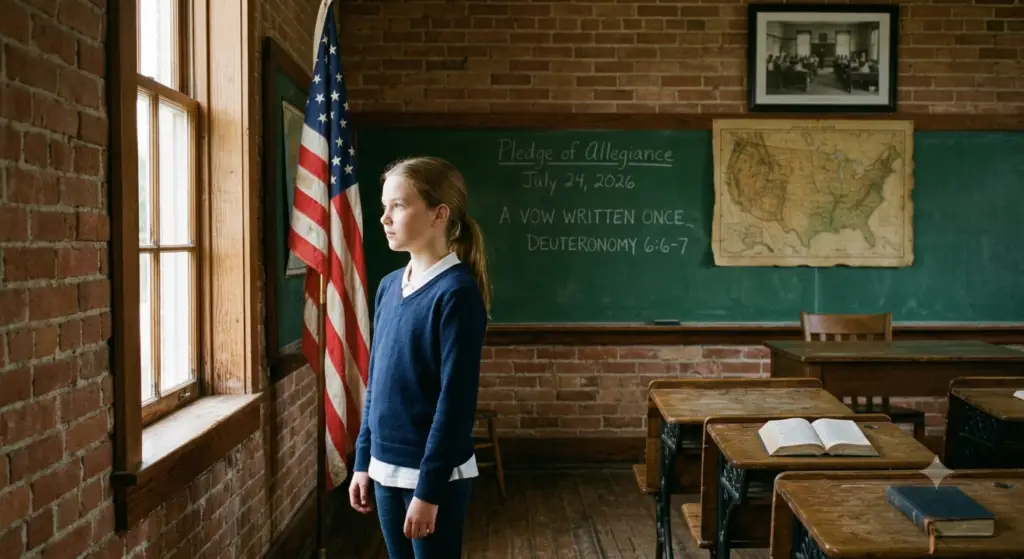
A vow written once, and the argument over what makes anyone go on keeping it
A bill has been sitting in the House Committee on Education and Workforce this year, drawing fresh attention as recently as July 24, that would require every federally funded public school to open each day with the Pledge of Allegiance, flag mounted in every classroom. The particular bill matters less than the mood it belongs to: a country marking its 250th birthday, Congress reaffirming “under God” in June, a pledge most Americans have already said several thousand times without examining a single syllable of it. Roughly forty-five states already require some form of regular recitation. What the bill is really chasing is not new legislation so much as an old American instinct — the belief that saying a thing often enough, out loud, in unison, is itself a form of keeping faith with it. A text called Deuteronomy tried to settle that exact belief three thousand years earlier, and its answer was more complicated than the instinct assumes.
Not everyone found the mood reassuring. A column making the rounds in Catholic commentary that same month pushed back on other writers who had worried aloud that the Pledge asks more of a citizen than most people realize, arguing that the critics were overthinking thirty-one familiar words most Americans say on autopilot, without any real intention behind them. Perhaps. But autopilot is precisely the part worth sitting with. A pledge is a small, specific kind of promise — a person swears loyalty, out loud, to something larger than themselves. Enforced recitation can guarantee the sound of that promise. It cannot, on its own, guarantee the thing a promise is actually supposed to contain: a person who still means it. What happens to a vow when the mouth keeps making it long after the mind has stopped listening to what it is saying?
Three thousand years before there was a House committee, a flag, or a printed Pledge, an old man stood in front of an entire displaced nation and put something close to the same question to them — except he put it to people who had never actually heard the words the first time they were spoken.
His name was Moses. The camp stretched across the plains of Moab, tents and cookfires and dust settling over everyone as the light went gold and then gray, the last stop before a river none of them had crossed yet. Almost nobody standing there had been alive at Horeb, forty years earlier, when this law was first given on a mountain that had shaken and smoked. The parents who heard it then were dead — the text does not soften this — and their children, grown now, were about to inherit a country they had only heard described. What Moses does next takes up most of the book of Deuteronomy, and it begins with a decision stranger than it usually gets credit for: he says the commandments again, essentially word for word, to a generation that was not there for the first telling. Nothing here is a filing error or an editorial redundancy. It is a leader, with limited time left and no illusions about how quickly memory degrades between generations, choosing to spend his last recorded words not on new material but on making sure the old material lands a second time, with people who need it to land for the first time.
In the previous installment, we watched Moses build the frame for a farewell address — the retrospective, the warning, the transfer of trust. This time we stay inside the address itself, at the point where he stops summarizing the last forty years and starts repeating, verse by verse, the law that started them.
The Pledge fight now sitting in committee is not new, and it has never really been about the flag. It has always been an argument about what repetition is allowed to demand of a person who no longer feels the words the way the first generation felt them. A constitutional challenge to “under God” reached the federal courts more than two decades ago, and Congress answered, in part, with a bill that would have stripped federal courts of jurisdiction to hear any future case touching the Pledge at all — on the theory that some formulas should simply be placed beyond argument. That particular bill never became law, but the instinct behind it is worth noticing: when a repeated vow starts to wobble in the public mind, the reflex of the people who value it most is rarely to ask whether it still means what it once meant. The reflex is to make the wobbling itself illegal to discuss.
Rome had its own version of this problem, centuries before anyone called it civic education, and its own blunt answer to it.
By the time Cicero was old enough to reminisce about his schooling — the 90s and 80s BC, roughly — Roman boys of his generation were made to learn the Twelve Tables, the foundational law code of the early Republic, in a manner closer to memorizing a chant than studying a text. Cicero used a specific word for it in his dialogue On the Laws: carmen, something recited, rhythmic, closer to a nursery formula than an ordinary lesson.1 Schoolboys did not so much study the Twelve Tables as absorb them into the part of memory that holds a tune — the part that does not require understanding in order to keep working.
The Tables themselves dated to 451–450 BC: a commission of ten men set down what had previously been unwritten custom, interpreted at the discretion of a closed class of priests, and had it engraved on bronze and posted in the Forum where any citizen, patrician or plebeian, could in principle read it for themselves. That act of public posting was already an argument, whether or not the men who ordered it fully intended it as one — that law belongs to a people, not to the interpreters who happen to hold it. But posting the law in bronze did not, by itself, keep it alive in the mind of the next generation walking past the Forum on their way to market. Someone still had to make children say it aloud, on a schedule, until they could no longer remember a time before they knew it by heart.
And then, within Cicero’s own lifetime, the chant simply stopped. He mentions it almost in passing, in the middle of a longer discussion of funeral law: the practice his generation grew up under was no longer being taught to the boys coming after them.1 The bronze tablets were presumably still standing somewhere in the Forum. The statutes had not been repealed. What had quietly disappeared was the repetition — and Cicero, writing as a grown man looking back during the last, most violent decades of the Republic he loved, clearly believed something real had drained out of Roman civic life in that gap. He does not connect the dots explicitly, but the timing does it for him: the generation that stopped chanting the Twelve Tables by heart is the same one that watched the Republic’s unwritten norms collapse into civil war within a few decades of his own death.
America’s own formula is far younger and considerably more contested, but the underlying mechanism is nearly identical. Francis Bellamy, a Baptist minister, wrote the Pledge of Allegiance in 1892 for a boys’ magazine, timed to the four-hundredth anniversary of Columbus’s landing. Congress formally folded it into the U.S. Flag Code fifty years later, in 1942, and inserted the words “under God” in 1954 — a pledge that, for its first sixty-two years, had made no reference to God at all. The wording has been fought over in court more than once since. In 1943, at the height of a war fought partly in the name of compelled conformity abroad, the Supreme Court ruled that no American student could be forced to say the Pledge, reasoning that no official could prescribe what is orthodox in matters of belief.4 That protection exists precisely because the country has never fully agreed on what compelling a child to repeat a formula does to the formula itself.
What Rome’s carmen necessarium and America’s Pledge share is not their content — one was private law about inheritance and funerals, the other a public vow of loyalty to a flag — but their method, and their vulnerability. Both tried to solve an identical structural problem: a founding text, however important on the day it is written, does not stay important on its own. It has to be re-said, out loud, by people who did not write it and often do not yet understand it, until the saying becomes a habit sturdy enough to outlast the generation that felt its full weight the first time. And both examples carry the same warning folded inside the solution — that the habit can survive for a very long time after the meaning has quietly walked out of it.
Neither Rome nor Washington invented this method. Both inherited it, whether they knew it or not, from a considerably older and more deliberate source: a leader standing at the edge of a desert who understood, well before either of them, that a law worth keeping has to be built to survive the death of everyone who first agreed to it. Where Rome had a bronze tablet and a rote-learned formula, and America has a printed pledge and a statute requiring it, this older source had something closer to an argument — a case made out loud, in full, to the exact generation that most needed to hear it made.
Deuteronomy opens with exactly this maneuver, attempted at a scale neither Rome nor any modern legislature has ever tried.
The people standing in front of Moses on the plains of Moab are, almost without exception, not the people who stood at the foot of Horeb forty years earlier when the covenant was first spoken. That earlier generation is dead. The text is unusually blunt about the reason: a failure of nerve at Kadesh-Barnea, when ten frightened scouts talked an entire camp out of trusting a promise they had already been given, and a generation was left to finish out its days in the wilderness rather than cross into the land it had refused to trust for. And yet Moses opens his address to their children with a claim that should stop a careful reader cold:
“The LORD our God made a covenant with us in Horeb. The LORD made not this covenant with our fathers, but with us, even us, who are all of us here alive this day.” (Deuteronomy 5:2–3)
Read plainly against the timeline, that is not accurate — most of the “us” standing there were toddlers, or unborn, when the mountain shook. It is a theological claim, made on purpose: Moses is not asking this new generation to admire a covenant their parents received on their behalf. He is folding them directly into it, closing the distance between the original event and this second audience by an act of speech rather than by memory they do not actually possess.2 It is the same move, in miniature, that every oath of citizenship and every reaffirmed constitutional text has to make ever since — treating people who were not present at the founding as though they had personally consented to it, because a covenant that only binds its original signers is not a covenant at all. It is a contract, and contracts expire with the parties who signed them.
Chapter six turns from claim to method — the practical mechanism by which a covenant is meant to survive contact with people who did not live through its founding:
“And these words, which I command thee this day, shall be in thine heart: and thou shalt teach them diligently unto thy children, and shalt talk of them when thou sittest in thine house, and when thou walkest by the way, and when thou liest down, and when thou risest up.” (Deuteronomy 6:6–7)
This is the Shema’s instruction for transmission, and on close reading it functions less like a devotional suggestion than an engineering specification. Notice what it does not prescribe: no single annual festival, no one dramatic reenactment staged once a year for maximum effect. Instead, conversation is woven into the plain architecture of an ordinary day — the doorway of the house, the dust of the road, the moment of lying down at night, the moment of rising in the grey half-light before the heat sets in. The commandment is not meant to be memorized once and filed away. It is meant to become the kind of thing a household simply breathes, the way woodsmoke settles into the fabric of a tent whether anyone notices it or not. That is also why Moses will not let the coming warnings read as a threat of punishment for punishment’s sake:
Scripture does not require that every catastrophe be interpreted as divine judgment; it does, however, insist that societies eventually reveal the moral conditions under which they have chosen to live.
By chapter eight, the instruction sharpens into something closer to a specific prediction, aimed at a danger that is neither war nor famine but its opposite — comfort:
“Beware that thou forget not the LORD thy God… lest when thou hast eaten and art full, and hast built goodly houses, and dwelt therein… then thine heart be lifted up.” (Deuteronomy 8:11–14, abridged)
Moses is not primarily worried that this generation will stage some dramatic public rebellion against the covenant. He is worried about something quieter and considerably more likely: that they will simply stop noticing it once the wilderness ends, once there is shade instead of sun on the neck and a door to shut instead of a tent flap pulled back, in the same way a chant stops being sung the moment nobody insists on it anymore.
He has reason to worry. Deuteronomy nine turns back to Horeb and recounts, without softening, how the first generation broke the covenant almost immediately — building a golden calf while Moses was still on the mountain holding the tablets God had just finished writing. Reminding this new audience of their parents’ worst failure, in the middle of asking them to trust more completely than their parents did, is a strange rhetorical choice, but perhaps the only honest one: repeating the law is no guarantee against repeating the failure, and the text refuses to pretend otherwise.
Chapter ten answers with a demand aimed past the mouth and into the body: “Circumcise therefore the foreskin of your heart, and be no more stiffnecked” (Deuteronomy 10:16). The covenant sign that once marked Israelite men physically, in infancy, is reapplied here as work that has to happen again and again, internally, in people already marked — the outward ritual pointing toward an inward reality rather than replacing it. Chapter eleven closes by laying blessing and curse side by side, deliberately unresolved: not a prophecy about which one Israel would choose, but a mirror held up to the fact that the choice was always going to be theirs to make and remake.
Here is the uncomfortable pattern sitting underneath both the Pledge debate and Moses’ warning: repetition and comprehension are not the same achievement, and institutions keep rediscovering that gap the hard way.
Roughly forty-five states currently require some form of regular Pledge recitation in public schools — a striking rate of compliance for a country that disagrees about nearly everything else touching its civic life. And yet the Annenberg Public Policy Center’s annual Constitution Day civics survey, which has tracked basic public knowledge of American government for close to two decades, found in its most recent published results that roughly three in ten adult Americans still could not name all three branches of the government whose flag they had likely saluted, by rote, in a classroom for at least twelve years of their childhood.3 The number has moved up and down from year to year, sometimes dropping well below half, but it has never once tracked the recitation rate. The chant, in other words, has survived considerably better than the comprehension it was supposedly built to carry along with it.
A formula recited without friction tends to become furniture — present, familiar, and almost entirely unexamined. That is not a modern discovery, and it is exactly the failure mode Moses spends eleven chapters trying to head off, which is why his instructions in chapter six are not really instructions about memorization at all. Talk of these words when you sit, when you walk, when you lie down, when you rise — the repetition he prescribes is relentlessly conversational, worked into the texture of an ordinary day on purpose, precisely because a formula recited once each morning by rote is exactly the kind of repetition that produces Cicero’s problem two generations later: children who can say the words perfectly, and grandchildren whose own teachers have quietly stopped bothering to make them learn it at all.
Cicero never explains why the Roman chant stopped. He simply notes, with something between nostalgia and resignation, that it had — that the boys of his own school days were the last cohort to learn the Twelve Tables that way, and that no one thought to ask, at the time, whether anything ought to replace it. That silence in the record is worth sitting with longer than the debate over any single bill working its way through a committee room. Institutions rarely die from one dramatic vote to repeal them. They die from three or four generations in a row who kept the ceremony faithfully and let the substance drain out from beneath it, one distracted recitation at a time, until the ceremony is the only thing left standing.
There is a version of this pattern that shows up closer to home than either Rome or a congressional hearing room. It shows up in a household where grace is said before every meal until the words wear a groove so deep that no one at the table hears them anymore, or in a congregation that recites a creed every Sunday until the recitation becomes something closer to a group exhale than a shared confession. None of this is evidence that repetition itself is the enemy. Moses does not tell Israel to stop saying the words. Commentators on this section of Deuteronomy have long noted that its instructions are addressed to households, not to priests or officials — the transmission of the covenant is designed as domestic work from the outset, not a ceremony administered from above.2 He tells them to keep saying the words while doing something considerably harder — staying awake inside the saying, teaching a child not just the sentence but the reason the sentence still matters on an ordinary Tuesday, at the gate, on the road, nowhere near a mountain that ever shook.
Moses seems to have understood, watching a nation that had already lost one generation to a failure of trust, that the next danger was never going to be a single loud apostasy on a single afternoon. It would be the slow kind — the kind that happens quietly, in houses that have grown comfortable, to people who have simply forgotten they were ever a nation standing at the edge of a river with nothing but a promise and the clothes on their backs.
The Chant That Has to Mean Something Each Time
A law posted in a forum, or printed in a school flag code, or spoken twice into the record at the edge of a desert, survives the moment it is written down or first spoken. What does not survive automatically is whether the next generation says the words and means them, or says the words because everyone standing around them is saying the words too.
Moses could not force that choice, and neither could Cicero’s Rome, and neither will a bill sitting in a House committee room this year. He could only build the conditions that make the choice possible — a covenant re-offered rather than merely inherited by rumor, instructions folded into doorposts and dusty roads rather than filed away in an archive nobody reopens. Whether any of it worked was not decided that evening on the plains of Moab. It would be decided later, in kitchens, at gates, on roads, one ordinary repetition at a time — the same quiet decision now sitting inside a committee room, or inside a Pledge said by rote in forty-five states’ worth of classrooms, whether or not anyone drafting the bill has thought of it in those terms.
1. Cicero, De Legibus 2.23.59 — describing the Twelve Tables as learned by Roman schoolboys “ut carmen necessarium” (“as a required chant”), a practice Cicero says was no longer taught to boys of the following generation.
2. On Deuteronomy 5–11 as a deliberate act of covenant renewal for a new generation, see Jeffrey H. Tigay, Deuteronomy, The JPS Torah Commentary (Philadelphia: Jewish Publication Society, 1996).
3. Annenberg Public Policy Center, Annenberg Constitution Day Civics Survey, 2025 edition (University of Pennsylvania).
4. West Virginia State Board of Education v. Barnette, 319 U.S. 624 (1943).
New essays every week. Delivered quietly.