The Word the Report Doesn’t Use
There’s a word the International Crisis Group’s December report on Haiti never once uses, though every page of it describes the thing itself: toll.
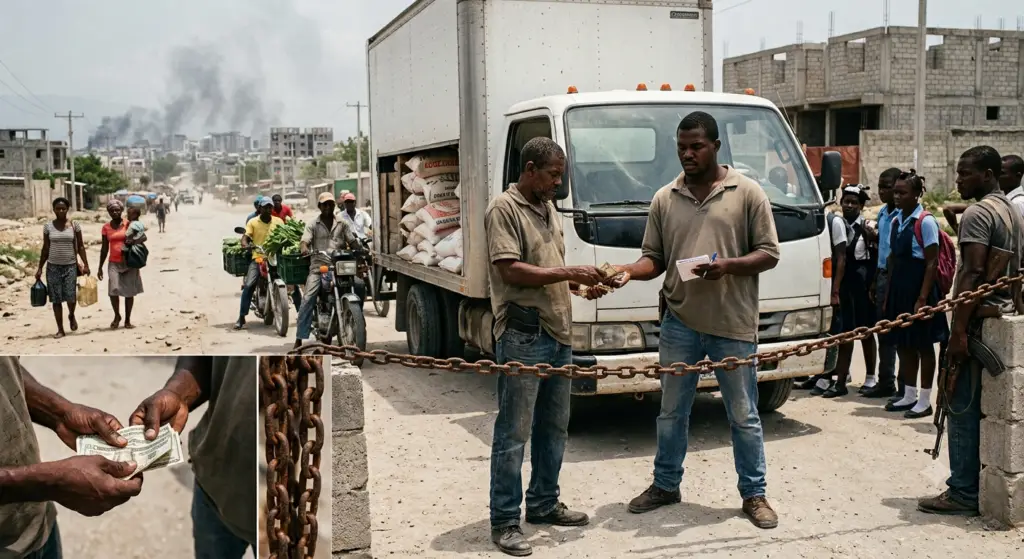
Along the national highways ringing Port-au-Prince, and inside the capital itself, the Viv Ansanm gang coalition has built something that behaves less like a siege and more like a tax authority with better weapons. A commercial truck pays roughly $1,500 a month simply to keep operating on a given route. Cargo coming up from the southern ports pays another $190 a trip — a fixed price of passage that exists nowhere in Haitian law. Pedestrians pay. Farmers pay.
In Kenscoff, the hillside region that grows most of the vegetables sold in the capital, armed men arrived in early 2025 for one stated reason — control of the road, and the fees that come with controlling it. A siege aims for an ending; an economy aims for continuation.
One vendor who works the route into the capital was quoted describing how she now sets aside a fixed sum before she even leaves — not for spoilage, not for fuel, but for the men at the gate. The toll gets folded into the price of everything before it ever reaches a customer.
Nobody paints a sign that says toll booth. Nobody has to. The road decides who eats either way, and in Port-au-Prince it has decided that eating now carries a price no government ever set.
By the time a sack of rice or a case of cooking oil reaches a stove in the capital, it may have crossed a dozen of these unmarked gates. Close to 5.8 million Haitians — over half the country — are facing crisis-level food insecurity this year. The harvest did not fail this season. The road got expensive.
The Castles on the Rhine
Six centuries before anyone thought to extort a rice truck outside Port-au-Prince, German lords worked out the same math along a different river. By the fourteenth century, boats moving grain, wine, and salt down the Rhine passed through dozens of toll stations between Mainz and Cologne alone — many run not by kings but by minor lords who had simply built a tower at a narrows in the river and dared anyone to pass without paying.
Historians sometimes call these lords Raubritter — “robber knights” — though the title slightly flatters the arrangement. They weren’t robbing travelers outright. They were doing something more patient: taxing the right to keep trading at all, repeatedly, at every bend where a chain could be stretched across the water.
The distinction matters, and it’s the distinction that separates this piece from the one before it. A siege wants a city to fall. A toll wants the traffic to keep coming — just at a price the toll-taker sets. Sudan’s siege of El Fasher aimed at exhaustion: cut the road, starve the town, force surrender. The Rhine’s robber lords wanted the opposite. They needed the grain boats sailing forever, so there would always be another toll to collect.
It took the Rhenish League of 1254 — dozens of cities banding together against the toll lords — and several more centuries after that before the practice was meaningfully curbed, and even then only by an authority large enough to make the tolls not worth defending.
Haiti’s checkpoint economy resembles this second pattern far more than the first. Viv Ansanm has no evident interest in the capital’s total collapse — an economy with nothing left to move is an economy with nothing left to tax. What the gangs appear to want, like the toll lords on the Rhine, is a permanent corridor rent on the ordinary act of trying to eat.
Not a Foreign Army, But a Neighbor’s Ledger
Scripture has its own record of this particular arrangement, and it is almost startling how little it resembles a siege.
“And there was a great cry of the people and of their wives against their brethren the Jews… We have mortgaged our lands, vineyards, and houses, that we might buy corn, because of the dearth… we bring into bondage our sons and our daughters to be servants, and some of our daughters are brought unto bondage already: neither is it in our power to redeem them; for other men have our lands and vineyards.” — Nehemiah 5:1, 3, 5 (KJV)
Scripture does not require that every catastrophe be interpreted as divine judgment; it does, however, insist that societies eventually reveal the moral conditions under which they have chosen to live.
What’s easy to miss on a first read is who is doing the exploiting. This isn’t Babylon at the gates. Nehemiah 5 opens with “their brethren the Jews” — fellow countrymen lending grain to fellow countrymen at interest during a famine, then collecting the debt in land, in vineyards, and finally in children.
Nehemiah does not call this an act of war. He calls it a broken covenant between neighbors.
When he confronts the nobles in verse 7, he doesn’t accuse them of theft in the ordinary sense. He accuses them of exacting usury from their own brothers — of treating a famine everyone was suffering together as leverage against the people suffering it worst.
Nehemiah did not attempt a private settlement with the creditors. He convened a public assembly — shifting the issue from a private debt contract to a communal rupture.
There’s a detail worth pausing on: Nehemiah mentions, almost in passing, that he himself had been lending money and grain to the people — and had done it without interest. He isn’t calling for a standard the nobles couldn’t reasonably meet. He’s calling for the standard he’d already been keeping.
Haiti’s checkpoints are not Nehemiah’s moneylenders, and the equivalence shouldn’t be forced further than the text allows. But the structural kinship is hard to unsee once it’s named: in both cases the crisis was not caused by the toll-taker, and in both cases the toll-taker treated the crisis as an opportunity rather than an emergency. Drought forced Judah’s poor to borrow. State collapse forced Haiti’s transporters to pay. In both, someone already inside the community — not a foreign power — decided the emergency was billable.
The Ledger Behind the Ledger
By the numbers, Haiti’s checkpoint economy is not a rounding error. The International Crisis Group estimates the Viv Ansanm coalition clears $60 to $75 million a year from extortion — container fees on imports from the Dominican Republic, road tolls, port surcharges, and kidnapping ransoms, all folded into the same informal balance sheet as legitimate freight costs (ICG, 2025). Businesses that once shipped a container for a fixed price now budget the coercive tax as a separate, permanent line item, the way a company might budget for fuel or insurance.
None of this shows up as inflation in the ordinary sense. It shows up as a widening gap between what a farmer in Kenscoff earns for a crate of vegetables and what a household in Delmas pays for that same crate by the time it survives the checkpoints between them. It was not the harvest that failed, but the road.
Two months ago, this space traced a version of the same arithmetic in Sudan’s North Darfur, where a closed military road produced a malnutrition rate near 53 percent in a single locality within months. The mechanism in Port-au-Prince isn’t appreciably different in shape — a road, a gate, a population priced out of food it could otherwise afford. What differs is intention. Sudan’s siege wanted the road closed permanently. Haiti’s checkpoint economy wants it open, and taxed, forever.
Nehemiah’s resolution is the part of the story that rarely gets quoted, maybe because it asks something specific of the people who did the exploiting. In chapter 5, verses 10 through 12, Nehemiah doesn’t call for the nobles’ punishment. He calls for restitution — the lands, the vineyards, the houses, and the hundredth part of the money, grain, wine, and oil that had been extracted, all given back. And the nobles agree, on the spot, in front of the same assembly that had named the problem out loud.
Scripture doesn’t pretend that public accountability alone ended a famine. It records that the famine’s damage had been compounded by a solvable, human layer laid on top of an unsolvable, natural one — and that the human layer was the part that could still be reversed. Haiti’s crisis, if it can even be called a famine in the classical sense, is a governance collapse with no rainy season waiting to end it. But a checkpoint, unlike a drought, is a decision — one a community can still name, the way Nehemiah’s assembly once did.
What the Toll Decides
I don’t know whether the International Crisis Group avoided the word toll on purpose, or simply never needed it — extortion already carries the legal weight toll would soften. But toll may be the more honest word for what a family in Port-au-Prince actually experiences: not one dramatic seizure, but a recurring, almost bureaucratic fee attached to the ordinary act of getting food from a farm to a table.
Nehemiah’s nobles could have called their arrangement a loan. It had interest, terms, collateral — the full vocabulary of an unremarkable transaction. What made it something else was timing: they extended credit only because their neighbors had nowhere else to turn, and priced it accordingly. A toll built at the one road out of a starving town is not a business. It’s a diagnosis of what that town has been reduced to.
The checkpoints outside Port-au-Prince will likely still be standing by the time anyone reads this. So, probably, will whatever replaces them if these particular gates are ever dismantled. That’s not fatalism so much as what Nehemiah 5 already told us to expect — the exploitation is rarely permanent by design, but it is renewable by habit, and it took a named assembly, not a quiet hope, to end it the first time.
Societies rarely perish from a sudden lack of bread. They perish when someone learns to charge admission to the road that carries it.
Sources: IPC, Haiti Acute Food Insecurity Analysis (2026) · UN News, Security Council Update on Haiti (April 2026) · International Crisis Group, “Undoing Haiti’s Deadly Gang Alliance,” Report 110 (Dec. 2025) · UNODC, “Organized Crime and Gang Violence in Haiti” (Jan. 2026)
¹ International Crisis Group Report 110, based on over 300 interviews conducted between February 2022 and November 2025.
New essays every week. Delivered quietly.