HOOK
A Line I Had to Read Twice
There’s a line in the report I had to read twice — not because it was unclear, but because it was.
In December, nutrition teams working in Um Baru, a locality in Sudan’s North Darfur, recorded that 52.9 percent of children under five were acutely malnourished — nearly double the 30 percent acute-malnutrition threshold the IPC uses to classify famine in the first place. In neighboring Kernoi, the figure was 34 percent. Both localities had fallen into catastrophic hunger in the months after the regional capital, El Fasher, fell in October 2025, triggering a mass exodus of families with nowhere reliable to go (IPC, 2026).
I kept rereading the percentage, not the prose around it. The prose was the kind humanitarian agencies write when they need to be believed and can’t afford to sound alarmed. The number did the sounding for them.
HISTORICAL CASE
The Siege as a Weapon
Sudan’s war, which began in April 2023 between the Sudanese Armed Forces and the paramilitary Rapid Support Forces, has left nearly nine million people displaced inside their own country (FAO/WFP/UNICEF, 2026). But displacement is not what produced a 52.9 percent malnutrition rate in Um Baru. Siege did.
Researchers at Yale’s Humanitarian Research Lab documented that dozens of farming communities in North Darfur were deliberately attacked between March and June 2024 — fields burned, livestock enclosures destroyed, the agrarian villages that had fed El Fasher systematically dismantled (Yale HRL, cited in The Guardian, 2026). This was not famine as accident. It was famine as instrument.
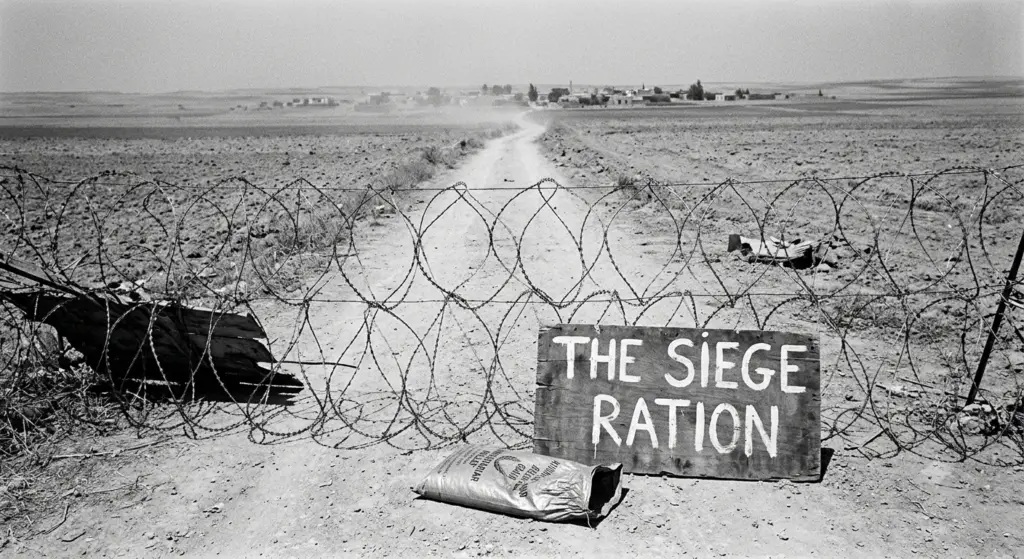
History has one long-running case study in this particular cruelty, and it does not involve drought at all. During the Siege of Leningrad, from September 1941 to January 1944, German forces did not primarily try to take the city by force — they tried to starve it into surrender. An estimated 800,000 to 1.5 million civilians died, most of them from hunger, in a siege that lasted nearly 900 days.
What made Leningrad different from a natural famine was intention. The rains had nothing to do with it. A supply line was cut on purpose, and a city was made to eat itself — first its pets, then its leather, then, in the documented worst months, things no one wants written down.
Return to Um Baru with that in mind, and the report reads differently. No one is claiming German artillery encircled North Darfur. But the underlying arithmetic is the same arithmetic: a road closes, and a population that was feeding itself yesterday cannot feed itself today. The mechanism in El Fasher and the mechanism in Leningrad are eight decades and five thousand miles apart. The mechanism is nevertheless the same mechanism — control the road, and you control who eats. In every siege, eventually, the whole catastrophe narrows to a single question: which road remains open?
BIBLICAL LENS
Not Weather, But a Gate
Scripture has already written this particular chapter, and it wrote it more than once.
“And there was a great famine in Samaria: and, behold, they besieged it, until an ass’s head was sold for fourscore pieces of silver… And the king said unto her, What aileth thee? And she answered, This woman said unto me, Give thy son, that we may eat him to day, and we will eat my son to morrow.” — 2 Kings 6:25, 28-29 (KJV)
“The tongue of the sucking child cleaveth to the roof of his mouth for thirst: the young children ask bread, and no man breaketh it unto them… The hands of the pitiful women have sodden their own children: they were their meat in the destruction of the daughter of my people.” — Lamentations 4:4, 10 (KJV)
“Son of man, behold, I will break the staff of bread in Jerusalem: and they shall eat bread by weight, and with care; and they shall drink water by measure, and with astonishment.” — Ezekiel 4:16 (KJV)
Scripture does not require that every catastrophe be interpreted as divine judgment; it does, however, insist that societies eventually reveal the moral conditions under which they have chosen to live.
What strikes me about all three passages is what they are not describing. None of them describe drought. Samaria’s famine in 2 Kings 6 came from an Aramean army camped outside the gates. Jerusalem’s famine in Lamentations came from Babylonian siege works. Ezekiel’s rationed bread was a prophetic sign-act about a city under blockade. In each case, the text locates the hunger in a human decision — a road cut, a gate sealed — rather than in the sky.
Scripture does also record famine caused by weather elsewhere — Joseph’s seven lean years, the famine that sends Naomi’s family to Moab. These three texts are not that kind of famine. They are the record of what happens when people, not rainfall, decide who eats.
The rabbinic tradition reads the Samaria narrative not as an account of what these women were, but as an account of what a sealed gate is capable of manufacturing in people who were, by every other measure, ordinary the week before. That distinction is not incidental to the passage. It may be the entire point of preserving something this hard to read.
PATTERN INSIGHT
The Absence of a Road
The 2026 numbers out of Darfur are not abstractions, and one pairing does more work than all the others combined: only 20 percent of Sudan’s humanitarian response plan had been funded as of April, against a projection of 800,000 children facing severe acute malnutrition this year (WFP, 2026). Everything else — the 4.2 million total malnutrition cases projected across the country, the rise over last year’s figures, the gap between a 4.8-million-person monthly aid target and the 3.13 million people actually reached in February — is the same fact, restated from a different angle. A road, and what happens when the road isn’t there.
The famine in these texts is never framed as the absence of food in the world. It is framed as the absence of a road.
This is also where the Ezekiel passage does something unexpected. The prophet doesn’t just predict that Jerusalem will starve. He acts it out — rationing his own bread and water to a fixed weight and measure, in public, for over a year, as a sign to people who could still walk past him and choose something else. The warning was not fatalism. It was a way of buying time — a window in which the road could still be reopened. The Hunger Hotspots report that flagged Sudan back in mid-2025 was doing something structurally similar: a measured warning, issued while there was still a window, about a road that could still be reopened.
CLOSING
What the Road Decides
In the previous installment, we looked at what Scripture means when it treats drought as a verdict rather than merely weather. Siege belongs to a different, harder category. Drought asks what a society does when the world withholds something. Siege asks what one group of people is willing to withhold from another — on purpose, with a gate, a checkpoint, or a burned field as the instrument.
That’s the distinction the Um Baru numbers kept pointing me back toward. Nothing about North Darfur’s soil failed this year. What failed was a road, an aid convoy’s clearance, a ceasefire that didn’t hold long enough for anyone to plant again.
I don’t know what becomes of Um Baru and Kernoi by the time anyone reads this. I know the line I read twice wasn’t unclear.
Sources: IPC, Sudan Acute Malnutrition Alert (Feb. 2026) · FAO/WFP/UNICEF Joint News Release, “Risk of Famine Persists” (May 15, 2026) · Yale Humanitarian Research Lab, cited in The Guardian (2026) · WFP, “Risk of Famine in Sudan” (2026)
New essays every week. Delivered quietly.