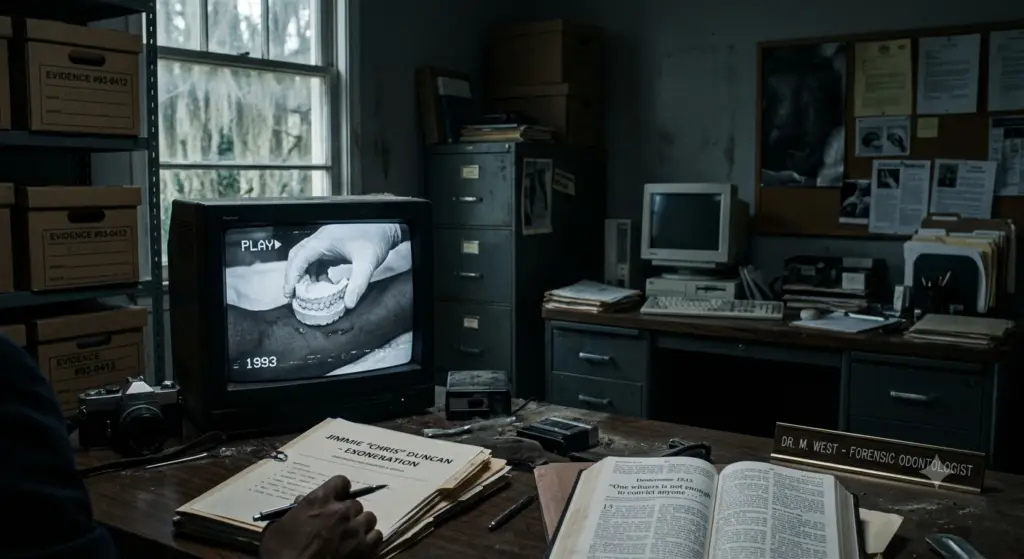
Hook
A Confidence Nobody Was Required to Check
There’s a question I can’t stop asking, and it isn’t the one the Louisiana Supreme Court was asked to answer.
The court’s question was whether a man’s conviction could stand on evidence a sitting justice would later call “scientifically indefensible” (Louisiana Supreme Court opinion, as reported by ProPublica and Verite News, 2026). My question is smaller, and it comes earlier. It’s about a room in Louisiana, decades ago, and a single expert’s certainty — and about how long it can take an entire legal system to stop believing something it was told with enough confidence.
Jimmie “Chris” Duncan spent twenty-seven years on Louisiana’s death row for the 1993 death of a toddler, Haley Oliveaux, who drowned in a bathtub while in his care.1 He was convicted in 1998 on evidence that came almost entirely from one man: a forensic dentist who examined Haley’s body and told the jury, with total certainty, that marks on her skin matched Duncan’s teeth. That certainty held for a very long time. It survived appeals. It survived a change of governors. It survived, for years, everyone whose job it was to double-check it.
What finally broke it wasn’t new evidence in the ordinary sense. It was old evidence — footage that had existed since the very first examination, sitting untouched in a file for decades. What it exposed wasn’t only one man’s methods. It was the blind spot in an entire system that had never once been required to check him.
This is, in a sense, a story about a broken promise — the same subject this series examined recently in a much smaller, more private key. A courtroom makes a far larger promise than any individual does: that the state will not take a life on the strength of a claim it has not tested. What follows is the story of exactly how, and for how long, that particular promise was allowed to be broken — and an ancient law that was written specifically to prevent it.
Historical Case
The Case That Should Have Ended This a Decade Earlier
To understand what finally undid Duncan’s conviction, it helps to look at what happened almost a decade into his sentence — in a different state, to different victims, at the hands of the same two expert witnesses.
In Noxubee County, Mississippi, in the early 1990s, two three-year-old girls were murdered eighteen months apart. Courtney Smith and Christine Jackson were both found in water, their bodies exposed to the elements for days before recovery. In both cases, the same forensic pair was called in: pathologist Dr. Steven Hayne, who performed the autopsies, and Dr. Michael West, who examined the bodies for bite marks — the same technique, and eventually the same witness, that would later be used against Duncan. West told one jury it could be “no one but” Levon Brooks who had bitten Courtney’s arm. He told another jury that marks on Christine’s body were, in his own words, made “without a doubt” by Kennedy Brewer.2 Neither man’s attorney had the tools, or the funding, to meaningfully challenge that certainty at trial. Brooks received a life sentence. Brewer was sent to death row.
Why did no one stop believing him?
Part of the answer is procedural: bite-mark analysis had never been validated by rigorous, independent study, but it also hadn’t been formally discredited yet, and juries in the 1990s had little reason to doubt a witness who spoke with a dentist’s calm authority. Part of the answer is structural. Hayne, at the peak of his career, was performing roughly three-quarters of all autopsies conducted in the state of Mississippi — a volume experts would later call professionally impossible to handle carefully.3 West had testified in at least nine states. Together they functioned less like two independent experts checking each other’s work than like a single, self-confirming authority: Hayne would flag a mark as possibly human, West would arrive to confirm it, and the confirmation arrived already dressed in the language of scientific certainty a jury had no training to question.
By then, this was no longer just about one dentist’s mistakes. It was about a system that had built a stable, repeatable role for a single unverified voice — and kept calling that voice back, case after case, because it had always worked before.
Both Mississippi men were innocent. In 2001, a man named Justin Albert Johnson — who had a documented history of similar crimes and lived in the same small community — was tied by DNA evidence to Christine’s murder and eventually confessed to killing both girls. He denied biting either child, and later forensic review found that what West and Hayne had identified as human bite marks were consistent with insect activity and the effects of prolonged submersion in water.4 Brooks and Brewer had, by then, spent a combined thirty-four years in prison. West was suspended by the American Board of Forensic Odontology — the first suspension in the organization’s history — years before Duncan’s own trial ever began.5 That suspension was a matter of public record. It did not stop a single prosecutor from calling him to the stand again, and it did not reach the twelve people who would decide, in a Louisiana courtroom not long after, whether Jimmie Duncan lived or died.
The footage that would eventually clear Duncan had already been sitting in a file for years by the time Brooks and Brewer finally walked free.
Biblical Lens
Ancient Israel’s law codes were not naive about what a single, confident voice can do to an accused person. Deuteronomy is explicit on the point:
“One witness is not enough to convict anyone accused of any crime or offense they may have committed. A matter must be established by the testimony of two or three witnesses.” (Deuteronomy 19:15)
This was not a procedural footnote. It was a structural refusal to let any one person’s certainty — however impressive, however confidently delivered — stand alone as the foundation of a verdict that could cost someone their life. The law assumed, correctly, that even a sincere witness could be wrong, and that an insincere one could do enormous damage if nothing required a second voice to check the first.
Modern courts complicate this in a way the ancient law never had to anticipate. A forensic expert’s opinion rarely reaches a jury framed as one person’s testimony, open to the same doubt any witness deserves. It arrives dressed as “scientific evidence” — a label that, in the public imagination, outranks anything a single human witness could claim on their own authority. The single-witness problem Deuteronomy warned against doesn’t disappear under that label. It becomes harder to see, wrapped in a credibility the law’s authors never had to plan for overriding.
The same suspicion of confident, unchecked testimony runs through Israel’s wisdom literature. Proverbs draws the line in blunt, almost clinical terms:
“A truthful witness gives honest testimony, but a false witness tells lies.” (Proverbs 12:17)
What’s notable is how little drama the verse assigns to the difference. It doesn’t treat a false witness as monstrous or rare — only as a category of person any community should expect to encounter, and must build its institutions to withstand. That assumption raises the harder question underneath this whole case: why does a confident voice work on us at all? Not because we’re careless people. It’s closer to the opposite — certainty is expensive to produce and cheap to consume, and a courtroom, like any human institution, will always be tempted to accept a specialist’s confidence as a substitute for its own harder work of verifying. The dentist’s tone in that Mississippi courtroom — “without a doubt,” “no one but” — wasn’t incidental to why juries believed him. It was the entire mechanism. Certainty doesn’t just report facts; it manufactures trust on its own, independent of whether the facts are true.
In 1 Kings 21, Scripture shows exactly what happens when that trust goes unexamined at the highest level:
“Then he sent letters in Naboth’s name… ‘Seat two scoundrels opposite him and have them testify that he has cursed both God and the king.'” (1 Kings 21:8–10)
Two men are hired to falsely accuse Naboth, their testimony uncontested and unverified, and Naboth is executed on the strength of it so his vineyard can be seized. The text does not linger on the false witnesses’ motives. It lingers on the fact that the town’s elders let two unexamined voices override a man’s life — proof that even the outward form of the two-witness standard, without real scrutiny, can be hollowed out and turned into exactly the weapon the law was written to prevent. Duncan’s case did not even reach that low bar. Naboth’s accusers, corrupt as they were, still had to produce two bodies in a room and coordinate a lie between them. West needed only himself.
Scripture does not treat the two-witness rule as an inconvenience to be worked around by expertise; it treats expert certainty as exactly the kind of voice the rule was written to check. A dentist with credentials is not exempt from the category “single witness.” If anything, the law reads as a direct anticipation of the danger a confident specialist poses — because confidence is precisely what makes an institution forget to ask for a second voice.
Pattern Insight
Here is what the long-buried footage from Duncan’s case actually showed, once someone was finally required to watch it: Dr. West, during his 1993 examination of Haley’s body, taking a plaster mold of Duncan’s teeth and pressing it directly into and across her skin — appearing, in the justices’ own later reading of the tape, to produce the very marks he would go on to testify he had simply discovered.6 Justice Cade R. Cole, writing for a unanimous seven-member court, noted that a defense expert had called it “scientifically indefensible” to attribute those marks to Duncan at all, and that the angles shown in the footage were physically impossible for an actual human bite.7 The video had been recorded at the time. It was never shown to the jury that convicted Duncan five years later, in 1998.
How many other files are sitting exactly like that one — untouched, unwatched, technically public?
The number is not small. Bite-mark analysis of the kind West practiced has been implicated in more than two dozen wrongful convictions or indictments nationwide, and no rigorous scientific study has ever established a reliable method for matching a mark on human skin — a material that bruises, swells, and distorts after death — to a specific set of teeth with the certainty jurors were routinely told to expect.8 The National Registry of Exonerations, which tracks wrongful convictions across the United States, has documented well over three thousand exonerations since 1989, a substantial share of them tied to flawed or fabricated forensic testimony rather than newly discovered facts about the crime itself.9 These are not, mostly, cases where the truth was unknowable. They are cases where the truth was on file, and nobody with the authority to look was required to.
The pattern is not that one dentist lied. It’s that an entire system built repeat-use permission for a single unchecked voice, long after that voice had already been shown to be wrong.
That is where the two-witness law stops being ancient trivia and starts functioning as a diagnosis. It was never really about doubting any one witness’s honesty. It was about refusing to let a system’s convenience — the speed and simplicity of trusting one confident source — substitute for the harder discipline of requiring confirmation. Licensing boards, expert-witness rules, appellate review: all of it exists, in principle, to do what the two-witness law did with far fewer resources. Duncan’s case shows what happens when every one of those modern safeguards quietly declines to function as a second witness, and defers instead to the first one’s certainty. Brooks and Brewer’s exonerations should have closed this chapter for good, years before Duncan’s own trial concluded. Instead the same method, the same witness, and the same unchallenged confidence stayed in use for nearly two more decades after that warning became public record.
Closing
The Room Nobody Was Required to Question
When Jimmie Duncan finally walked out of custody on bail, the first thing he did, by every account, was put his arms around his parents, Sharon and Bennie — an ordinary embrace that took twenty-seven years to become possible again.10 Prosecutors have signaled he may still face retrial; the state has not formally closed his case. Whatever comes next, those years cannot be returned to him, any more than the eighteen years Levon Brooks and Kennedy Brewer lost in Mississippi could be returned to them a decade earlier.
That’s the room I keep coming back to — not the courtroom, decades later, but the first one, where a single expert’s confidence was allowed to stand in for evidence, and nobody in a position to ask for a second witness did. Every year that followed was downstream of that.
The danger was never one dishonest expert. It was every institution that decided, over and over, that one confident voice was enough — and nothing about this case suggests it was the only room where that decision was made.
1. Richard A. Webster, ProPublica and Verite News, “Louisiana Supreme Court Frees Death Row Prisoner, Calling Evidence Against Him ‘Scientifically Indefensible,'” June 30, 2026.
2. The Intercept, interview with the authors of The Cadaver King and the Country Dentist, April 2018.
3. Radley Balko and Tucker Carrington, The Cadaver King and the Country Dentist: A True Story of Injustice in the American South (PublicAffairs, 2018).
4. Mississippi Free Press, “Dentist Michael West Denies Wrongdoing.”
5. Innocence Project, press statement on the Brewer and Brooks exonerations, February 2008.
6. Louisiana Supreme Court opinion, authored by Justice Cade R. Cole, as summarized by ProPublica/Verite News and the Death Penalty Information Center, June 2026.
7. Ibid.
8. The Intercept, April 2018.
9. National Registry of Exonerations, University of California Irvine, Michigan Law, and Michigan State University College of Law — cumulative case data, 2026.
10. Photo caption, Jamal Barnes for the Innocence Project, as published by Davis Vanguard and Louisiana Illuminator, June–July 2026.
New essays every week. Delivered quietly.