I · The Line
The Map That Outlived Every Empire
A line on paper is the quietest form of power — and the most patient. This month, remarks by Kathmandu’s mayor revived a two-hundred-year-old border dispute between Nepal and India (Al Jazeera, 2026)1: a boundary traced in 1816 under the seal of an empire that no longer exists, still capable of pulling two modern nations into an argument. The men who drew it are dust. The line is not.
Armies end wars; lines, more often than we admit, begin them — not when the shooting starts, but years earlier, in a quiet room, when someone far from the land decides where a border belongs. The map comes first. The country, and sometimes the grievance, comes after.
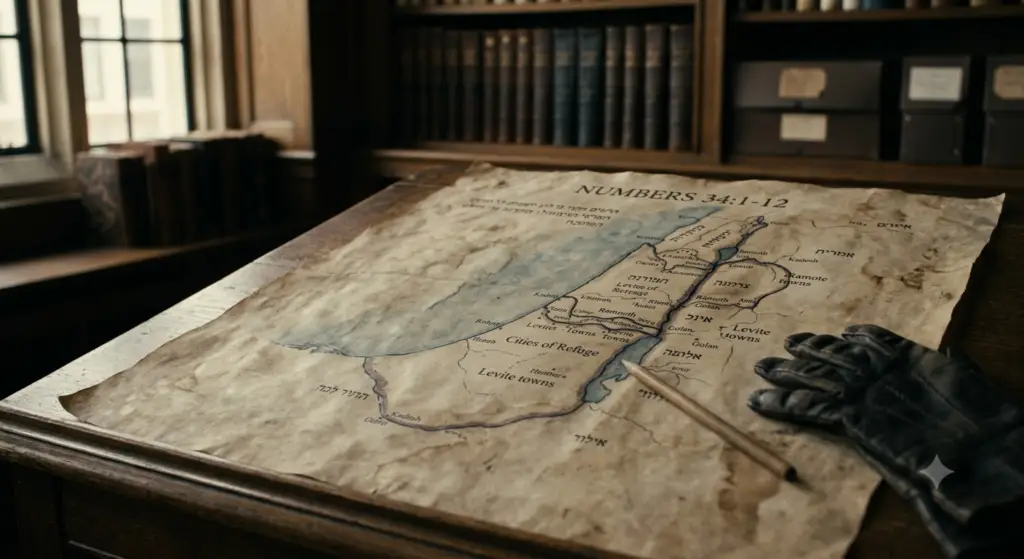
Scripture knows this order intimately, which is the strange fact this essay turns on. The book of Numbers — forty years of wilderness, rebellion, and wandering — does not end with a battle or a sermon. It ends with a map: a full boundary survey of a land Israel did not yet hold, dictated to people camped on the wrong side of the river, by a man who had just been told he would never cross it.
The map preceded the possession. Before Israel had a nation, it had borders. In the previous installment, we examined how five daughters forced an amendment to Israel’s inheritance law before a single field had been allotted. This final chapter of our Numbers journey asks the larger question behind theirs: what kind of society writes its map before it owns its land — and what does it choose to draw in?
A map is never only geography. It is a society’s confession of what it intends.
II · The Diplomats
Two Letters on a Map, One Century of Consequences
In the winter of 1915–16, while the First World War consumed Europe, an English aristocrat named Mark Sykes and a French diplomat named François Georges-Picot sat over a map of the Ottoman Middle East. Their task was to decide, in advance and in secret, how lands neither of their nations yet controlled would be divided once the empire holding them fell.
Sykes is remembered for a single sentence of breathtaking casualness — proposing, as historians of the period record, to run the partition “from the e in Acre to the last k in Kirkuk.” A straight line, anchored to two printed letters. The historian David Fromkin later argued that the settlement built on such lines produced not peace but its opposite — borders that ignored the watersheds, trade roads, and communities beneath the ink.2 The empires that drew them dissolved within decades. The frustrations organized around them are still generating headlines a hundred and ten years later.
The map preceded the reality it created — and then, with the patience of paper, outlived its makers. Nor was this an isolated case: at the Berlin Conference of 1884–85, European powers apportioned the interior of Africa in rooms where no African was present, and those lines hardened into the borders of more than forty modern states.
The pattern is worth naming precisely. These maps were drawn before possession, from outside the land, by men who would never live under their consequences. And here is the uncomfortable part, the reason this essay cannot be a simple sermon against imperial cartography: Numbers 34 checks every one of those boxes. A pre-possession map, dictated from across the river, recorded by a man barred from entry. If we want to understand what Scripture is doing in these chapters, we cannot pretend the resemblance away. We have to walk into it.
What separates the two maps, it turns out, is not when they were drawn but what they reserved space for — a difference the modern numbers will make brutally visible before we are done. First, the text itself.
III · The Text
What the Covenant Wrote Into Its Margins
The instruction opens with a claim of ownership that immediately complicates every modern analogy:
“Command the children of Israel, and say to them, ‘When you come into the land of Canaan (this is the land that shall fall to you for an inheritance, even the land of Canaan according to its borders)…’” — Numbers 34:2
Two details sit inside that verse like stones in a field. The land falls to Israel — the verb of the lot, of allotment, not of seizure by cleverness or strength. And it falls as an inheritance — something received, held in trust, answerable to the giver. The chapter then walks the boundary with a surveyor’s patience: the ascent of Akrabbim, the brook of Egypt, the shoulder of the Sea of Chinnereth. The rabbinic tradition preserves an entire genre of commentary on why these edges matter — why a land grant that names its own limits is teaching something about the nature of the grant itself.
Because that is the first difference from the diplomats’ line: this map limits its own beneficiary. Israel is not promised everything the eye can see. The borders are finite, specified, closed. A people fresh from forty years of landlessness is told, before it owns a single field: this far, and no farther. Sykes and Picot drew a line for an empire’s convenience; Numbers draws one as a covenant’s constraint.
The second difference occupies all of chapter 35, and it is the detail I find hardest to shake. Before Israel possesses one acre, the map reserves forty-eight towns for Levites — a tribe deliberately given no territory of its own — and then designates six of those towns for a stranger purpose:
“The cities shall be to you for refuge from the avenger, that the man slayer not die until he stands before the congregation for judgment… For the children of Israel, and for the stranger and for the foreigner living among them, shall these six cities be for refuge.” — Numbers 35:12, 15
Read that against any modern map. Israel’s charter reserved its most detailed cartographic attention not for its strongest tribe, but for the person who had killed and could not yet be fairly judged. The manslayer — responsible for a death but innocent of murder, one bad hour from a blood feud — is given an address before the king has a palace, before the temple has a foundation. And the refuge is explicitly extended to the stranger and the sojourner. Asylum, in this map, is not an emergency improvisation. It is infrastructure, drawn in before the crossing.
The third text closes the book, returning to the daughters of Zelophehad whose petition we followed last time. Their victory — daughters may inherit — is now bounded by a counter-provision:
“So shall no inheritance of the children of Israel remove from tribe to tribe; for the children of Israel shall all keep the inheritance of the tribe of his fathers.” — Numbers 36:7
To modern ears this sounds like a restriction, and it is. But notice what it restricts: accumulation. Land in this system cannot drift permanently toward whoever marries well or buys shrewdly. The map is designed to resist its own consolidation — to keep the allotment looking, generations later, something like it looked at the beginning.
Scripture does not require that every catastrophe be interpreted as divine judgment; it does, however, insist that societies eventually reveal the moral conditions under which they have chosen to live.
And then there is the man taking the dictation. Moses records every boundary of a country he has already been barred from entering — the sentence pronounced at the rock he should not have struck. He is, in the most literal sense, drawing the borders he will not cross. Whatever else these chapters are, they are not the work of a man mapping his own ambition.
IV · The Numbers
What Our Maps Reserve Space For
Hold that ancient blueprint next to our current map, and the contrast becomes stark. At the end of December 2025, 117.8 million people worldwide were forcibly displaced as a result of persecution, conflict, violence, or human rights violations (UNHCR, 2026).3 That figure exceeds the population of any European nation. And 58 percent of them are internally displaced — people who fled without ever crossing a border, trapped inside lines that no longer protect them.
Behind nearly every one of those numbers stands a boundary behaving badly: a line contested, closed, redrawn, or weaponized. The Sykes–Picot region alone accounts for a grim share of the century’s displacement. The lines drawn in that London winter did not merely fail to prevent this; in the judgment of many historians, they helped organize it.
Here is the transition the data forces on us. Modern cartography has become extraordinarily precise about one question — who is excluded — and almost silent about another: who, inside these lines, is guaranteed somewhere to run. Our maps mark borders to the meter. Very few of them mark refuge at all.
The map in Numbers inverts that ratio. Its external boundary is described in a single chapter, in language loose enough that scholars still debate the exact line.4 Its provisions for the vulnerable — the landless Levite, the fugitive manslayer, the resident foreigner, the daughter who inherits — consume two full chapters and receive the sharper legal drafting. The proportions are the theology. What a society maps carefully, it means to protect; what it leaves vague, it is prepared to lose.
That reading also explains the strangest feature of all: the timing. The borders were dictated before the crossing — the promise preceded the possession. A map drawn after conquest ratifies whatever the strong have taken; the shape of the land simply traces the reach of the sword. A map drawn before means the constraints were accepted in advance — refuge, limits, and anti-accumulation written into the deed while the deed was still only a promise. Israel would fail these provisions often and grievously in the centuries that followed; the prophets are one long audit of that failure. But the standard was on file before the first stone was moved, and the prophets could appeal to it precisely because no one could claim it was invented after the fact.
V · The Crossing
The Map Was a Promise Before It Was a Possession
Which returns us to that two-hundred-year-old line in the Himalayas, still generating headlines drawn by hands long buried. Lines outlive their makers; that much the empires and the covenant have in common. The difference lies in what the lines carry. One kind of line carries only a claim — mine, not yours — and so every generation must re-fight it. The other carries obligations that bind the owner: this far and no farther, room for the runner, the inheritance held rather than hoarded.
The book of Numbers began, thirty-six chapters and nine essays ago, with a census — a nation counted, ranked, and arranged for the march. It ends with a map. Counting and mapping: the two most bureaucratic acts a society performs, and the two most revealing. Between them stretches everything the wilderness exposed — the cravings, the failed reports, the rebellions, the struck rock, the hired prophet, the new count.
Moses finishes the survey on the plains of Moab, across the Jordan from everything he has described. Tradition places him, soon after, on a mountain, looking west over borders he transcribed but will never walk.
It is an almost unbearable image of a certain kind of faithfulness: to draw, with complete precision, a future that belongs to someone else.
The wilderness generation left its children two documents — a list of names and a list of borders. Neither was land. Both were promises about how land, once held, would have to be held. Every society since has produced its own versions of those two lists, and every society’s versions confess, in the end, what it actually intended.
1. “Balendra Shah’s comments revive 200-year-old Nepal–India border dispute,” Al Jazeera, July 2026.
2. David Fromkin, A Peace to End All Peace: The Fall of the Ottoman Empire and the Creation of the Modern Middle East (Henry Holt, 1989).
3. UNHCR, Global Trends: Forced Displacement in 2025 (Geneva: United Nations High Commissioner for Refugees, June 2026).
4. Jacob Milgrom, Numbers, The JPS Torah Commentary (Philadelphia: Jewish Publication Society, 1990), commentary on Numbers 34.
New essays every week. Delivered quietly.