A CURRENT CASE
A $3.7 Million House Took On Water, and So Did the Insurer’s Word
The storm didn’t just breach the structure; it tested whether a signed paper retains its weight once keeping it becomes expensive.
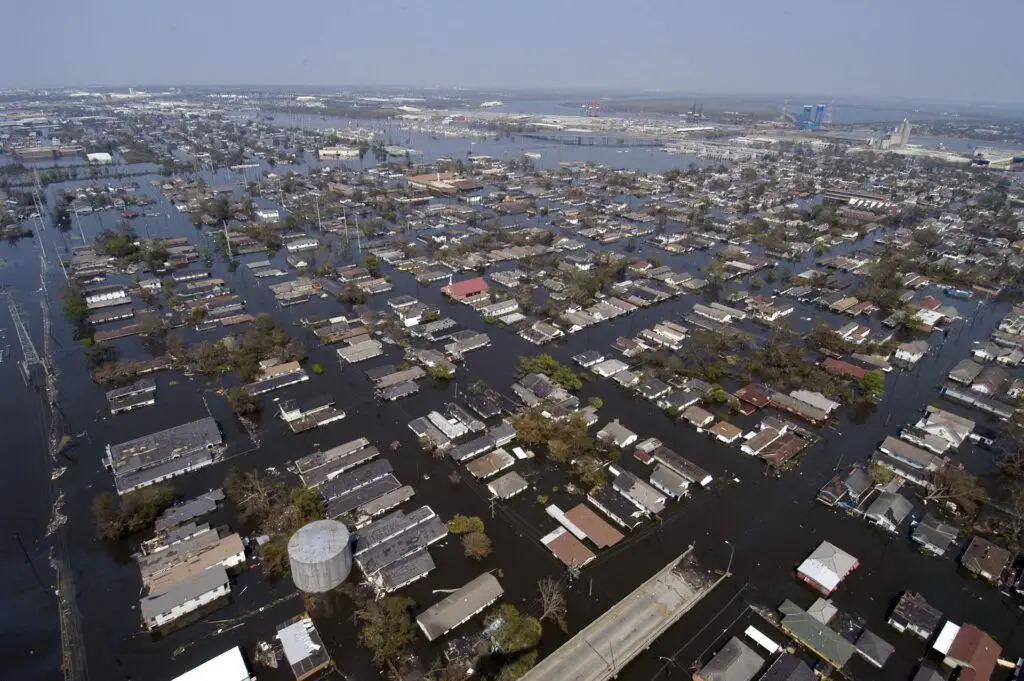
Christopher and Heather Monroe live on the water in Bradenton, Florida — the kind of address that photographs well and insures expensively. When Hurricane Milton came ashore in October 2024, it did what hurricanes do to waterfront property: it found every seam.
The Monroes hired their own claims professional, who walked the property, priced the damage, and arrived at a figure just north of $527,000. They filed with their carrier, Slide Insurance, and waited.
The answer came back as zero. Not a reduced payout, not a partial settlement pending further review — a full denial, with the company’s court filings arguing that most of the damage fell under exclusions like wear and tear, and that whatever remained still landed below the couple’s $33,440 deductible. The case is now set for trial in December 2026.
“They have made us feel almost like criminals,” Christopher Monroe said. “All we’re asking them to do is pay the claim.”
It took me longer than I’d like to admit to see what this case was actually describing. On its surface, it’s an insurance dispute — the kind of thing that lives in arbitration filings and adjuster reports, not in anything most people would call a moral story. But underneath the paperwork is a much older and much simpler question: what happens to a promise once the person who made it discovers what keeping it will cost.
In the previous installment, The Weight in the Bag, we examined a real estate deal that promised to spare a Minnesota buyer from interest, and quietly charged him interest anyway — a false balance dressed up as a fair one. This story is not that story. Nobody hid a number inside fine print here. The number was disclosed, argued over in open court, and defended on the record. What’s being tested this time isn’t whether the transaction was honest. It’s whether an institution will actually pay for the thing it promised to cover, once paying becomes expensive.
A HISTORICAL PARALLEL
What San Francisco Learned in 1906 About Who Pays and Who Disappears
To understand what’s actually being contested when an insurer walks away from a claim, it helps to look at the one disaster in American history that put every fire and property insurer in the country to the same test at once: the San Francisco earthquake and fire of April 18, 1906.
The earthquake itself did comparatively little structural damage. It was the four days of fire that followed that destroyed roughly 80 percent of the city and killed close to 3,000 people. Insurers ultimately paid out claims exceeding the combined profits the American fire insurance industry had earned over the previous forty-seven years.
What makes 1906 useful isn’t the scale of the disaster — it’s what the disaster revealed about the character of the institutions holding the policies. Most fire policies at the time explicitly excluded earthquake damage, giving insurers a legitimate argument to pay little or nothing, since the fires had technically been triggered by an excluded peril. Some companies simply stopped answering their policyholders’ mail.
Others made the opposite choice. Cuthbert Heath, running Lloyd’s of London’s San Francisco book, wired his agent a single instruction: “Pay all our policy-holders in full irrespective of the terms of their policies.” Lloyd’s had a strong legal argument for paying far less. It paid in full anyway, and built a century of American reputation on that decision.
Legal historian Robert James later cautioned against reading this as a clean morality tale. The insurers who paid in full often had no real legal defense to waive in the first place; the ones who contested sometimes had real grounds to do so. Even in 1906, the line between principled resistance and simple refusal was never as tidy as the folklore suggests — which is, if anything, the more useful lesson for 2026.
THE BIBLICAL PATTERN
The Vow That Costs You Something
Scripture is unusually direct about a specific kind of integrity: not honesty in what you claim to believe, but reliability in what you agreed to do, especially once agreeing to it turns out to be expensive.
Psalm 15 opens with a question — who may dwell in God’s presence — and answers it with a list of character traits rather than religious credentials. Buried in that list is a description that reads almost like a legal standard:
“He that sweareth to his own hurt, and changeth not.” (Psalm 15:4, KJV)
The Hebrew behind that line carries more weight than the English translation suggests. The phrase is closer to nishba l’hara — “swears to the harm” — a legal idiom that appears to describe a vow whose cost has already become clear to the one who made it, not a hypothetical risk taken in ignorance. The commendation isn’t for making a promise. It’s for the narrower, harder discipline of not revising it once the price is already known.
Ecclesiastes approaches the same territory from the opposite direction, warning against the temptation to hedge:
“When thou vowest a vow unto God, defer not to pay it… Better is it that thou shouldest not vow, than that thou shouldest vow and not pay.” (Ecclesiastes 5:4–5, KJV)
The logic is blunt. A conditional promise — one that quietly reserves the right to be reconsidered once fulfilling it becomes inconvenient — is treated here as worse than never having made the promise at all, because it trades on the appearance of commitment without the substance of it.
And James’s epistle, writing to a community with more economic power than conscience, names the specific sin of withheld payment in language sharper than either of the previous texts:
“Behold, the hire of the labourers… which is of you kept back by fraud, crieth.” (James 5:4, KJV)
None of these passages describe an insurance contract. But together they preserve a category of wrongdoing a modern reader can still recognize on sight: the gap between the word given at the moment of the agreement and the word honored at the moment of the claim. Nothing in these texts says a contested claim is automatically a moral failure — disputes over cause, extent, and coverage are a normal part of how insurance functions. What Psalm 15 and Ecclesiastes describe is narrower: the character of an institution that made a promise anticipating the storm, and then treats the arrival of that exact storm as the reason to renegotiate.
THE DATA
From One in Three to Nearly One in Two
Return to the numbers, because the trend line here says something the individual case can’t say on its own.
A recent investigation found that America’s five largest home insurers — State Farm, Allstate, Liberty Mutual, USAA, and Farmers — closed more than 44 percent of resolved claims in 2025 without paying the policyholder anything. A decade earlier, that same figure stood at 36 percent. USAA’s own non-payment rate reached 51 percent in the same period.
Slide Insurance, the company at the center of the Monroes’ dispute, paid zero on half of its claims in 2025, up from roughly a quarter of claims in 2022. In Florida specifically, more than 95,000 homeowners had claims denied following Hurricanes Helene and Milton, a substantial share attributed to flood-damage exclusions many policyholders did not realize applied to their coverage.
The Monroes are not an outlier in this data — they are what a 44-percent denial rate looks like once it reaches an actual living room. Their case isn’t evidence alongside the statistic. It’s the statistic, translated into a name, an address, and a trial date.
Analysts point to rising deductibles — increasingly calculated as a percentage of a home’s insured value — and to narrower internal standards for approving high-cost repairs like full roof replacements, standards plaintiffs’ attorneys in at least one case have described in court filings as an undisclosed “playbook” for minimizing payouts, existing nowhere in the policy the customer actually signed.
That undisclosed playbook isn’t simply a business strategy. It’s a quieter version of the vow Ecclesiastes warns against — language that sounds like a commitment at the moment it’s spoken, while privately reserving the right to mean less than it said the day it’s tested.
The shift isn’t in what insurers are legally allowed to do. It’s in how often they are choosing to do it. A promise that pays out in six cases of ten is a fundamentally different institution than the same promise paying out in five, even if not a single word of the policy language changed in between.
This is where 1906 becomes more than historical color. Every insurer doing business in San Francisco that April held, in principle, the same legal right to contest claims that Slide Insurance and its peers hold today. Some used it sparingly, understanding that the entire value of an insurance contract lives in the moment it’s tested. Others used it as the default position. What separated the two groups was never the legal language in front of them. It was what they understood their own word to be worth once it became expensive to keep.
THE QUESTION UNDERNEATH
The Water Line Nobody Can Erase
A house that takes on water leaves a mark. Contractors call it a water line — the visible ring left on drywall and siding showing exactly how high the flood reached, long after the water itself has receded. It doesn’t move. It doesn’t reinterpret itself later, once the lawyers have had time to look for an angle.
Christopher and Heather Monroe are still waiting for a courtroom to decide whether their insurer’s word will hold the same way. The trial scheduled for December 2026 will settle a dollar figure. It will not, by itself, settle the older question sitting underneath the filing — whether a promise written while the sun was out still means what it meant once the water arrived.
That question was never really about insurance. A marriage vow, a business contract, a campaign promise, a nation’s founding charter — every one of them is easy to keep on the day it costs nothing. What separates a durable promise from a decorative one is never the day it was signed. It’s the day, years later, someone tries to collect on it.
1. “The Home Insurance Coin Flip: Nearly Half of Claims Result in Zero Payout,” Wall Street Journal, 2025–2026, as reported by Globe Midwest Adjusters International, 2026.
2. Ibid.
3. Ibid.
4. U.S. Geological Survey, Earthquake Hazards Program; Insurance Information Institute, “The San Francisco Earthquake of 1906: An Insurance Perspective.”
5. Insurance Museum, “Insurance History Snippet: The 1906 San Francisco Earthquake,” 2021.
6. Philip Greenspun, “Book about the San Francisco Earthquake,” 2009.
7. Insurance Museum, “Insurance History Snippet: The 1906 San Francisco Earthquake,” 2021.
8. Robert A. James, “Six Bits or Bust: Insurance Litigation over the 1906 San Francisco Earthquake and Fire,” Western Legal History 24, no. 2 (2011).
9. “The Home Insurance Coin Flip,” Wall Street Journal, 2025–2026, as reported by Globe Midwest Adjusters International, 2026.
10. Ibid.
11. Ibid.
12. Florida Office of Insurance Regulation data, as cited in Tarrash & Tarrash Law Firm (2025) and Herman & Wells (2025).