The Walk That Used to End at Water
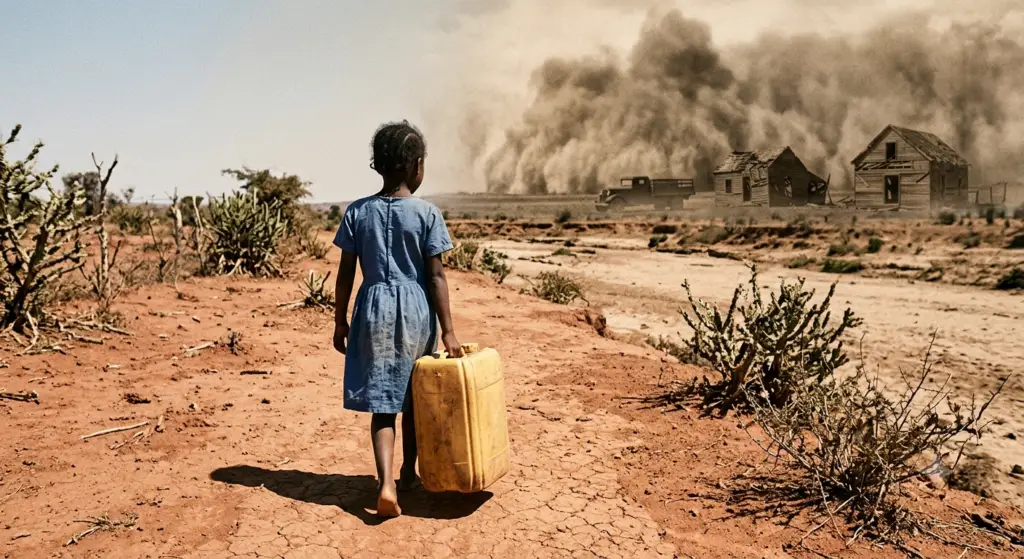
A child in the Grand Sud sets out most mornings before the heat is unbearable, carrying a yellow jerry can that is almost as tall as she is. The well she is walking toward has not run completely dry, not yet, but it no longer fills the can in one visit the way it used to. She will likely walk this same stretch of red dust two or three more times before the day is over.
That walk is the part of this story that rarely makes it into a headline. What does make the headline is this: two cyclones crossed southern Madagascar within the span of a single week this past February, and the government declared a state of emergency, opening a flash appeal for $67.9 million to cover the months that followed (OCHA, 2026).
The storms were not the beginning of anything. The drought underneath them had already been running for years — a stretch of prolonged dry spells, erratic rains, and locust outbreaks that the UN now describes as a convergence of shocks rather than a single disaster with a single date (UNRIC, 2026). The cyclones simply arrived on top of ground that had almost nothing left in reserve.
By the time the storms hit, the World Food Programme was already counting 1.57 million people as food insecure in the country, with 84,000 in emergency conditions and that number expected to climb toward 1.8 million in the months ahead (UN News, 2026). Numbers like these tend to blur together on a page. What they mean, in practice, is a specific village deciding this week which households still qualify for a ration and which will be asked to wait.
Families in the hardest-hit districts routinely walk four or five kilometers to reach a well or a river that hasn’t yet dried to mud (WFP, 2026). When the rice runs out before the next distribution, the fallback is whatever the land still offers on its own terms — wild tubers dug from the forest floor, cactus fruit stripped of its spines and boiled down, whatever the goats haven’t already stripped bare. None of that is new to this region. What has changed is how many consecutive seasons the fallback has had to double as the main course.
A drought does not ask a family’s permission before becoming their only remaining source of food. It simply arrives, dries the riverbed a little further than the year before, and waits to see who still has the strength to walk to whatever water is left.
WFP is currently short $18.3 million for its emergency operations here, a gap that has already forced the agency to cut its lean-season assistance down to just ten percent of the people it originally planned to reach — leaving more than half a million people without the aid that had been budgeted for them (UN News, 2026). Ten percent is not a rounding error. It is a decision, made somewhere in a spreadsheet far from the Grand Sud, about which villages get the sack of rice this month and which ones get told to wait — and it is the reason that child’s walk to the well is not likely to get any shorter soon.
That sequence — a natural failure of rain compounding an older, human weakening of the land until an entire region has almost nothing to fall back on — is not something this century invented. A little less than a hundred years ago, it happened across an ocean, on ground that had once been called the breadbasket of a different continent entirely.
Before that comparison, though, it is worth staying a moment longer with what a “decision made in a spreadsheet” actually looks like on the ground. In crises like this one, targeting decisions are typically pushed down to the community level — local committees ranking their own neighbors by need, weighing whose children show the clearest signs of malnutrition against whose family still has a relative nearby able to help before the next distribution arrives. It is not a job anyone asks for, and it is one that has to be redone every few weeks, for as long as the shortfall lasts.
The Plains That Learned to Fly
For most of the nineteenth century, the southern Great Plains of the United States were held together, quite literally, by grass. Deep-rooted native prairie grass gripped the topsoil through drought, wind, and grazing alike, the way it had for thousands of years before a single plow ever touched it. Then came the Homestead Act, the tractor, and a world war that made wheat suddenly, extraordinarily profitable.
Settlers who broke that grassland were not acting recklessly by the standards of their own moment. They were doing exactly what a booming wheat market told them to do, on land the federal government had explicitly invited them to claim and farm. That is worth holding onto, because it is easy, from a century’s distance, to read the Dust Bowl as a story of obvious folly. It read, at the time, as the sensible use of newly available land in a market that rewarded exactly that kind of use.
Rising wheat prices during and after the First World War drew settlers onto the Plains by the hundreds of thousands, and they plowed the native grassland under at a pace the land had never experienced (History.com, 2025). Between 1925 and 1930 alone, tens of millions of acres of that grass cover were stripped away and replaced with wheat, much of it planted with the new gasoline-powered equipment that made deep, wide plowing possible for the first time (AAAS, 2026). When wheat prices collapsed in the early years of the Great Depression, farmers already stretched thin responded by plowing up still more ground, chasing volume to make up for the falling price — a decision that made economic sense to any one farmer and collective sense to almost no one.
Then, in 1931, the rain stopped.
It did not return in any meaningful way for most of the decade. With the grass gone and nothing left to hold the exposed soil in place, the wind did what wind does to bare earth: it picked it up and carried it away, first in a few local storms, then in the enormous rolling clouds that came to be called black blizzards. The worst of them, on April 14, 1935 — remembered as Black Sunday — began in the Plains and rolled east at sixty miles an hour, dumping dust as far out as ships in the Atlantic two hundred miles from shore (AAAS, 2026). Regional dust storms climbed from fourteen in 1932 to a peak of seventy-two in 1937 before finally tapering off at the end of the decade (AAAS, 2026).1
Historian Donald Worster, whose 1979 study of the disaster remains the standard scholarly account, described the Dust Bowl as something closer to a choice than an accident — the outcome of a farming culture that had come to treat the grassland as capital to be liquidated rather than ground to be kept (Worster, 2004). The drought that triggered the collapse was, in the narrowest sense, an act of weather. The bare, wind-stripped soil that turned that drought into a decade-long catastrophe was an act of cultivation. Roughly 2.5 million people eventually left the Plains states, many of them heading west in search of any work a still-Depression-era economy had left to offer (History.com, 2025).
Many who fled arrived in California not as neighbors but as strangers competing for a shrinking number of harvest jobs, often in roadside camps with none of the infrastructure a sudden influx of that size required — refugees from an ecological disaster more than economic opportunists, people who had owned and worked their own land a decade earlier and now owned nothing but what a truck could carry.
Madagascar’s forests were not cleared by tractors, and its farmers did not plow under prairie grass for wartime wheat contracts. But the underlying pattern rhymes closely enough to be worth naming: decades of land pressure, deforestation, and shrinking fallow cycles had already thinned the south’s natural buffer against drought long before this decade’s rains started failing (UNRIC, 2026). Neither disaster required a villain. Both required only a natural stress arriving on top of a human one, at a moment when the ground had no reserve left to absorb either.
The federal response treated the disaster as an engineering failure as much as a weather event: starting in 1935, the Prairie States Forestry Project put unemployed farmers to work planting windbreaks to interrupt the wind before it could lift bare topsoil off the fields, and by 1942 roughly 220 million trees had gone into the ground across the Plains states (Living New Deal, 2026). None of it undid the storms that had already happened. All of it assumed, correctly, that the land’s vulnerability to the next drought was shaped less by nature than by what had been done to the ground in the years before it.
The difference is that the Plains eventually recovered their grass, their rain, and — over a generation — their population. Whether the same recovery is available to a country contributing almost nothing to the climate forces now pressing on it is a considerably less certain question, and one the next several decades will answer whether anyone intends to or not.
It is worth noting what the Dust Bowl comparison does not claim. Nobody in Antananarivo plowed under a prairie, and no single policy decision in Madagascar’s history lines up neatly with the wartime wheat contracts that drove settlers onto the American Plains. The parallel is narrower and, in a way, more durable than that: both disasters show a natural stress landing on ground a human choice had already weakened, with nobody in either case fully able to see, at the time, how much that earlier choice would end up costing.
Long before either a combine harvester or a cyclone forecast existed, a drying field was already being read as something more than weather in the text this series keeps returning to.
What the Prophets Already Knew About Dry Ground
Scripture treats a failed harvest as more than an agricultural event. It treats the drying of the ground itself as a kind of testimony — evidence entered into a much older case about what a people can and cannot control.
“The field is wasted, the land mourneth; for the corn is wasted… The vine is dried up, and the fig tree languisheth.” (Joel 1:10, 12, KJV)
Joel does not separate the locust and the drought from each other, and it does not separate either from the emotional weight of watching a season’s food disappear in real time. The prophet catalogs the failure crop by crop — corn, wine, oil, fig, vine — the way a farmer might walk a field counting losses, refusing to let the disaster stay abstract.
“Now it came to pass in the days when the judges ruled, that there was a famine in the land. And a certain man of Bethlehemjudah went to sojourn in the country of Moab, he, and his wife, and his two sons.” (Ruth 1:1, KJV)
The famine in Ruth is stated in a single clause and then left behind almost immediately — Scripture is far more interested in what the family does next than in diagnosing why the rain failed over Bethlehem that year. Naomi’s household does not wait it out. They migrate, the way Madagascar’s rural households increasingly migrate toward towns and coastal fishing communities when the inland harvest fails two years running.
It is worth noticing what Ruth’s narrator leaves out. There is no census of Bethlehem’s dead, no accounting of whose fields failed worst, no verdict on whether the town deserved what it got. The text simply moves the family down the road and lets the reader watch what happens to people who are no longer standing on their own ground — which is, in its own quiet way, a fairly exact description of what displacement by drought still looks like.
“I have withholden the rain from you, when there were yet three months to the harvest… So two or three cities wandered unto one city, to drink water; but they were not satisfied.” (Amos 4:7-8, KJV)
This is the closest thing Scripture offers to a description of walking four kilometers for a bucket that comes back half full. The wandering here is not exile and it is not judgment poured out all at once — it is thirst that persists even after the walk, water that does not fully satisfy the need that sent people looking for it in the first place.
There is a reason these three books, written across different centuries and circumstances, keep returning to the same physical details — a dried vine, a family on a road, a city that walks and still comes home thirsty. None of them describe famine as an abstraction. Each one insists on staying at the level of a single household’s decision: whether to stay and wait it out, whether to migrate, whether to keep walking toward the next well even after the last one disappointed.
Read side by side, these three passages resist a single, tidy cause. Joel names locust and drought together, refusing to isolate the natural failure from anything else. Ruth barely explains the famine at all, choosing instead to follow the family it displaced. Amos describes an uneven and partial mercy — rain withheld from one place, granted next door, water available but never quite enough. None of the three texts offers the comfort of a single culprit. All three assume that whatever caused the ground to fail, the people standing on it still have to decide how to respond to each other.
The Weather That Isn’t Neutral
Climate researchers have a term for what Madagascar represents on a global map of who bears the weight of a warming planet: it is often cited as one of the countries most exposed to climate extremes while contributing among the smallest shares of the emissions driving those extremes in the first place (UNRIC, 2026). That is not primarily a claim about policy or blame — it is closer to geography and atmospheric physics, certain regions simply sitting in the path of intensifying droughts regardless of how little carbon their own economies have produced. And the picture is not a clean morality tale either way: Madagascar’s own history of deforestation, driven largely by generations of subsistence agriculture and charcoal production, means the south’s vulnerability was not purely inherited. It looks far more like the Dust Bowl than like a story with a single villain — a land weakened by choices made under real pressure, then struck by a shift those choices had almost nothing to do with causing.
The pressure behind each choice, though, was not the same kind of pressure. The Plains were plowed under by a market chasing profit — a wheat price worth expanding into. The Grand Sud’s forests have been thinned mostly by households chasing survival — firewood, charcoal, one more season of cropland with no safety net behind it. Both leave the same bare ground once a drought arrives, but only one of them had the option of choosing otherwise.
A drought is not a neutral event just because no one signed the order for it. The land in the Grand Sud was thinned by generations of shortened fallow cycles long before this decade’s rains failed, the way the Plains were thinned by a wheat boom before 1931’s drought arrived — in both cases, the thinning determined not whether a dry year would come, but how much devastation it would cause once it did.
None of this means the response has been passive. WFP has spent recent years piloting climate-insurance schemes in Madagascar’s south, paying out to farming households automatically when rainfall data crosses a drought threshold, rather than waiting for a formal famine declaration to trigger aid (WFP, 2026). Villagers who take part describe leaning more heavily on group solidarity than on any government program to get through the worst stretches — sharing what one household still has with another that has less, on the understanding that the roles could reverse within a season (WFP, 2026). It is a small, human-scaled echo of the very pattern Scripture keeps circling back to: provision as something a community works out between its own members, not a mechanism that arrives fully formed from outside.
This is roughly the pattern Amos assumes without needing to argue for it: rain withheld unevenly, thirst unsatisfied even after the walk, a landscape where responsibility and consequence rarely land on the same address. The prophet does not ask which cloud owed which city an apology. He asks only what the wandering revealed about the people doing it.
Joel’s pairing of locust and drought carries the same double signature Madagascar has lived through more than once this decade — outbreaks compounding harvests already thinned by a lack of rain, the two failures reinforcing each other the way they do in the prophet’s opening chapter (UNRIC, 2026). Scripture never asks which of the two was the “real” cause. It simply records both, back to back, as a single season a household had to survive — the way Madagascar’s families are, in that same narrow sense, still walking: some toward a well that may or may not hold water, others toward the coast, toward a cousin’s town, toward whatever fishing village still has fish. The drought did not choose any of them individually. It arrived on ground that had already been asked to give more than it had left.
The Rain Owes No One an Explanation
The distance between a war and a harvest, this series noted in the previous installment on a shipping lane six thousand kilometers from a Myanmar rice paddy, can now be measured in a fertilizer invoice rather than a front line. Madagascar’s distance is measured differently still — not in a market that moved somewhere else, but in a sky that simply declined to do what it has done for this land across thousands of previous seasons.
Ruth’s famine in Bethlehem is recorded in a single verse, with no explanation offered for why the rain failed that particular year over that particular land. Scripture does not seem interested in resolving the question. It is interested only in what Naomi’s family did once the ground beneath them stopped providing — where they walked, who they became along the way, and whether anyone still living there was willing to make room for them when they eventually walked back.
The child in the Grand Sud will make her walk again tomorrow, and the well will give her a little less than it did the year before. She has no way of knowing about a wheat contract signed in Washington decades before she was born, or a Soviet harvest that failed an ocean away, because this time there is no contract to trace and no signature to find. There is only the sky, and the well, and the walk between them.
The ground does not owe an explanation for the year it fails. It only asks, the way it has always asked, who is left standing nearby with something to share once it does — and whether the answer to that question still depends, after everything, on where a person happened to be born.
1. Figures on the escalation of regional dust storms across the 1930s — from fourteen recorded storms in 1932 to a peak of seventy-two in 1937 — along with the scale and trajectory of the April 14, 1935 “Black Sunday” storm, are drawn from the American Association for the Advancement of Science’s historical review of Dust Bowl-era meteorological records, corroborated by Donald Worster’s standard scholarly account, Dust Bowl: The Southern Plains in the 1930s (Oxford University Press, 2004 ed.). Scripture quotations are from the King James Version (KJV), a public-domain translation.
OCHA. (2026). Madagascar. unocha.org
UNRIC. (2026). Madagascar: one of the countries most exposed to climate extremes. unric.org
UN News. (2026). World News in Brief: Madagascar hunger crisis. news.un.org
WFP. (2026). Madagascar. wfp.org
History.com. (2025). Dust Bowl: Causes, Timeline and Impact of the 1930s Disaster. history.com
AAAS. (2026). The Dust Bowl: A wake-up call in environmental practices. aaas.org
Worster, D. (2004). Dust Bowl: The Southern Plains in the 1930s (25th anniversary ed.). Oxford University Press.
Living New Deal. (2026). Shelterbelt Project (1934). livingnewdeal.org
Wikipedia. (2026). Great Plains Shelterbelt. en.wikipedia.org