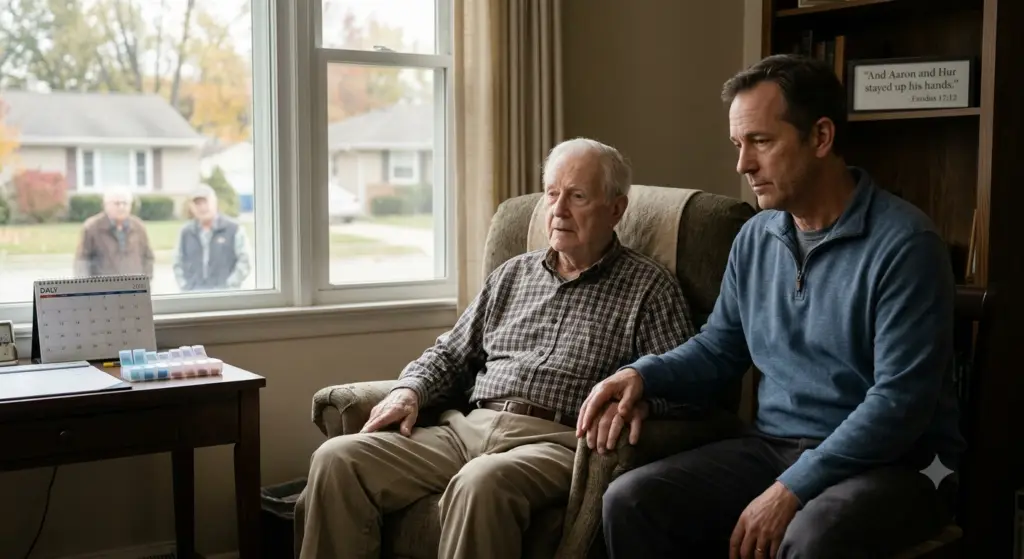
THE QUIET EPIDEMIC
A Speech Nobody Expected to Be About This
In early December 2025, a freshman United States senator walked onto the Senate floor to give the traditional first speech of a new term — the formal moment when an incoming member tells colleagues what they intend to stand for. He used it to talk about his father. Weeks earlier, a doctor had told him his father had Alzheimer’s disease, and warned him that the year ahead was going to be difficult. He has described sitting in his car afterward, still absorbing what he’d just been told, before he could bring himself to drive home.
Nothing about that scene is unusual, which is precisely the point. What made it briefly newsworthy was only that the man telling it happened to hold federal office. The same doctor’s appointment, the same parking lot, the same silence before driving home — that has already happened, or will happen, to a very large share of the people reading this sentence.
According to the most recent national count, roughly 63 million Americans — nearly one in four adults — are now providing ongoing care to a family member with a chronic illness, disability, or age-related condition, a figure that has climbed 45 percent since 2015 (National Alliance for Caregiving and AARP, 2025). Of that group, nearly 13 million are caring specifically for someone with Alzheimer’s disease or another dementia, and in the most recent year measured, those unpaid caregivers logged more than nineteen billion hours of care between them (Alzheimer’s Association, 2026). The average caregiver is fifty-one years old — not retired, not free of other obligations, typically still working, often still raising children of their own while caring for a parent at the other end of life.
What almost none of these figures capture is what the job actually feels like from the inside on an ordinary Tuesday: not the diagnosis, which arrives once, but the shift that never officially ends, the relief that rarely comes, and the particular kind of solitude that sets in when the person beside you needs you constantly and can no longer be much company in return.
Caregiving of this kind does not announce itself the way a funeral does. There is no single day when the neighborhood understands what has happened and responds accordingly, no casserole schedule, no card in the mail. The condition often worsens too gradually for anyone outside the house to register a clear before-and-after, and the caregiver, absorbed in the daily logistics of medication schedules and safety checks, rarely has the time or the language to explain what the last six months have actually cost. Friends drift not out of indifference but out of simple uncertainty about what to say, or when a visit would help rather than intrude, and the caregiver — already stretched thin — is seldom the one with energy left over to manage anyone else’s discomfort about the situation. The isolation, in other words, tends to be mutual and unintentional on both sides, which makes it considerably harder to notice from either one.
Care Used to Be Distributed. Now It Is Assigned.
For most of American history, caring for a sick or failing family member was not a task one person carried alone. It was distributed labor, shared across a household and a neighborhood by default, long before anyone had reason to think of it as a policy problem. Historical accounts of rural American life describe home care as work provided jointly by family and neighbors, in communities where professional medical help was scarce and mostly out of reach.1 A sick bed rarely had exactly one person attending it.
Church rolls and township records from the nineteenth century describe a now-vanished custom that some historians call “sitting up” — neighbors taking turns through the night at the bedside of someone gravely ill or dying, so that no family carried the entire burden of round-the-clock watching alone. A woman nursing her dying husband could expect a rotation of other women from the church or the next farm over to relieve her for a few hours at a time, not because anyone had organized a formal program, but because the custom made the alternative — one person watching alone, night after night, for as long as it took — almost unthinkable.
That rotation had a name, even if nobody wrote it down as policy: it meant a caregiver was, by default, never the only one watching. The labor of care was heavy, but it moved from shoulder to shoulder rather than settling permanently onto one.
The twentieth century professionalized nursing and, with real and significant benefits, moved a great deal of that care into hospitals, nursing homes, and the hands of trained specialists. Florence Nightingale herself, writing about the nursing reforms she championed, insisted that care belonged not only in institutions but “at home” — a caution that the century which followed her did not entirely heed.2 As formal medicine expanded, the informal rotation of neighbors quietly contracted. Care became something a trained professional did in a building, rather than something an entire community did, in shifts, in the next room.
Put plainly, Americans have gotten remarkably good, over the same century, at extending how long a life lasts, and remarkably worse at sharing the work of sustaining it. Longer lives mean longer illnesses, longer decline, longer stretches of exactly the kind of care that used to be split among many hands. The math went one direction. The rotation went the other.
What has happened more recently is a kind of partial reversal without a return of the old rotation. Rising costs, policy shifts, and a shrinking long-term care workforce have pushed responsibility back onto families — the 63 million figure did not exist because Americans decided to revive the sitting-up tradition, but because paid alternatives priced themselves, or were priced by policy, out of reach for a great many households. One recent federal budget action alone is projected to strip close to a trillion dollars from Medicaid funding over the coming decade, a change analysts expect will fall hardest on the millions of caregivers who currently rely on Medicaid-funded support to make their arrangement survivable at all.3 Care returned to the family. The neighbors who used to share the watch did not come back with it.
What families are left holding, in other words, is the weight of the old arrangement without its structure — the whole shift, with none of the relief.
The rotation has thinned from another direction as well. A meaningful share of today’s caregivers are managing a parent’s decline from a different city or a different state than the one they grew up in, a consequence of a labor market that has spent decades rewarding people for moving toward better jobs and better schools rather than staying near the house they were raised in. The neighbors who might once have taken a turn “sitting up” are, for many families, no longer geographically available even in principle — not because anyone rejected the old custom, but because almost nobody involved still lives close enough to practice it. Distance did not abolish the tradition of the rotating watch so much as make it logistically impossible before anyone got the chance to miss it.
WHAT SCRIPTURE ALREADY KNEW ABOUT THE WEIGHT
The Arms That Grow Heavy
Scripture does not treat the exhaustion of caring for someone else as a private failure to be managed quietly, and it does not wait until the modern era to notice that a single person’s strength has limits. One of its clearest pictures of shared burden-bearing is not a teaching at all, but a scene — a battle Israel could only win as long as Moses held his hands raised, and a moment when Moses’ own strength, entirely predictably, ran out.
“But Moses’ hands were heavy; and they took a stone, and put it under him, and he sat thereon; and Aaron and Hur stayed up his hands, the one on the one side, and the other on the other side; and his hands were steady until the going down of the sun.” — Exodus 17:12 (KJV)
Notice what the text does not do. It does not rebuke Moses for growing tired, as though fatigue itself were a spiritual failing to repent of. It simply records what heavy arms do after enough hours: they need something under them, and someone on either side. Aaron and Hur do not take over the task; Moses’ hands still hold themselves up. They simply keep the position from collapsing under its own weight, which is very often the entire difference between a caregiver who survives the year and one who does not.
The most detailed picture of presence offered to a suffering person, though, comes earlier in the story of a man losing everything at once.
“So they sat down with him upon the ground seven days and seven nights, and none spake a word unto him: for they saw that his grief was very great.” — Job 2:13 (KJV)
Job’s three friends get a great deal of criticism later in the book, and most of it is deserved — once they start talking, diagnosing his suffering and assigning it a cause, the text treats their theology as badly mistaken. But that judgment falls on the talking, not on the sitting. For seven full days before a single word was spoken, three men simply sat on the ground beside a devastated friend and said nothing at all, because they correctly judged that nothing they could say would match what they were seeing. Scripture preserves that silent week as the one part of their visit worth recording without correction.
Paul’s letter to the Galatians turns both scenes into an instruction rather than an example to admire from a distance.
“Bear ye one another’s burdens, and so fulfil the law of Christ.” — Galatians 6:2 (KJV)
The verb is plural and mutual by design — burdens are to be borne by more than the person already carrying them, distributed the way Aaron and Hur distributed the weight of Moses’ arms, the way a whole church distributed the work of a sickbed before hospitals existed to do it instead. Scripture never treats “bear ye one another’s burdens” as a suggestion for the unusually generous. It states it as the ordinary operating law of a functioning community — closer to a load-bearing wall than a nice sentiment stitched onto a pillow.
Scripture does not require that every catastrophe be interpreted as divine judgment; it does, however, insist that societies eventually reveal the moral conditions under which they have chosen to live.
THE ARITHMETIC OF ONE PAIR OF ARMS
A Room the Church Rarely Sees
There is a particular irony worth naming plainly, since it touches the very institution Galatians 6:2 was addressed to in the first place. Church attendance is, for a great many caregivers, one of the first ordinary rhythms to disappear — not from any loss of faith, but from simple logistics. A person cannot easily leave a parent with dementia alone in the house for a Sunday morning, and finding someone qualified and willing to sit with a loved one for two or three hours is often harder than finding childcare, precisely because so few congregations have built any equivalent of a nursery for the other end of life. The caregiver who most needs a congregation’s practice of burden-bearing is frequently the one least able to physically show up and receive it.
The result is a kind of structural blind spot inside the very community built, at least in principle, on the instruction to bear one another’s burdens. A congregation can organize a meal train for a new baby with remarkable speed and almost no prompting. The same congregation often has no comparable reflex for a member quietly managing a five-year illness in a back bedroom two miles away — not from unwillingness, in most cases, but because the need never became visible enough to trigger the reflex. Put bluntly: American churches have built an elaborate, practiced architecture for celebrating a life’s beginning, and left almost no comparable architecture for tending a life’s end. Job’s friends, notably, did not wait for an invitation or an announcement before making the trip to sit with him. They came because they heard, and heard specifically enough to know where to go.
There is a sociological name for part of what has gone missing here, distinct from the isolation research itself. Sociologists distinguish between “strong ties” — the small circle of family and close friends who carry most of the emotional weight in a life — and “weak ties,” the much larger surrounding network of neighbors, acquaintances, and fellow congregants who rarely carry much weight individually but who, in aggregate, used to notice things early.4 The old sitting-up rotation ran almost entirely on weak ties: it did not require deep intimacy with the sick woman down the road, only enough casual, repeated contact for someone to notice she needed a night off. What has collapsed most sharply in American life over the past several decades is not strong ties — most people still have a spouse, a sibling, a best friend — but precisely this wider layer of weak ties that used to do the noticing before a crisis became invisible. A caregiver today is rarely short on people who love them. They are short on the looser network that once made isolation logistically difficult to sustain.
What Happens When Aaron and Hur Don’t Show Up
Set the biblical picture of shared weight-bearing next to what current research is finding inside American caregiving households, and the shape of the problem sharpens considerably. A national study of caregivers supporting a family member with dementia, drawing on a federally funded sample, found that a meaningful share reported significant social isolation — and that isolation ran deeper among male caregivers than female ones, driven in large part by unusually small networks of people they could actually talk to about what they were carrying (National Study of Caregiving, 2025 analysis). Isolation among caregivers, in other words, is not a side effect that occasionally shows up. It is close to a structural feature of the role as currently arranged.
The median length of time a family spends caring for someone with dementia runs to roughly five years — not a crisis with a defined endpoint, but a sustained, years-long condition of daily responsibility (A Place for Mom, caregiver research summary). Five years is long enough for a friendship to quietly lapse from lack of attention, long enough for a small group or a men’s ministry to stop calling because the caregiver stopped being able to show up, long enough for the very support networks that might have shared the weight to have moved on by the time the weight finally lifts.
Here again the arithmetic of Exodus 17 is worth sitting with directly. Moses did not need Aaron and Hur for one dramatic afternoon. The text specifies that his hands stayed steady until the going down of the sun — an entire day’s battle, held up by two men taking positions on either side and simply staying there. A caregiver managing a five-year illness is fighting a version of that same day, on a scale the text never had to imagine, and in a great many American households today, nobody has taken the position on either side.
The financial and physical toll compounds the isolation rather than sitting apart from it. Chronic pain, sleep disruption, and elevated mortality risk all appear at higher rates among long-term family caregivers than among the general population, and the same body of research consistently identifies isolation itself — not merely the physical workload — as one of the strongest predictors of caregiver burnout (integrative review of caregiver burden literature, 2025). The isolation is not an unfortunate side effect layered on top of the hard part. For a great many caregivers, the isolation functions as the hard part, the thing that turns a difficult season into an unsustainable one.
The gender pattern in the research deserves a moment of its own, since it complicates any simple story about who suffers most. Male caregivers in the national study reported measurably higher isolation than female caregivers, driven mainly by smaller networks of people they discussed personal matters with and lower rates of religious attendance, even though they were less likely than women to be living entirely alone. Women, meanwhile, remain more likely to become caregivers in the first place and to carry the role for longer stretches, often while also managing paid work and their own children’s needs. Isolation reaches both sexes by a different route — and by whichever route it arrives, the current structure of American caregiving proves unsustainable for both.
None of this is offered here to diagnose any individual reader’s household, and it should not be read that way. What the research and the historical pattern together point toward is structural, not personal: a role that used to be shared by design has been reassigned, largely without anyone deciding to reassign it, onto individuals who were never meant to hold it alone — the same reassignment this series has traced elsewhere, in a very different room, with a very different set of men holding a very different kind of weight.
What made the old “sitting up” custom effective was never sentiment. It was scheduling — a rotation that did not depend on any single neighbor’s depth of feeling for the sick woman down the road, only on a shared, almost unspoken expectation that no one watches entirely alone. That is a structural claim, not an emotional one, and it is the same structural claim Exodus 17 makes about two men holding up a third man’s arms until sundown. Burnout, in both the ancient text and the modern research, is rarely a failure of love. It is what happens on schedule when love is asked to do a job that was designed for at least three people.
It is worth naming, too, what has not filled the gap the old rotation left behind. Online caregiver forums and support groups have multiplied substantially in the past decade, and they provide real value — practical advice on managing a difficult medication schedule, a place to describe a hard day to people who understand it without explanation. What they cannot provide is relief in the literal sense: nobody in a forum thread can sit with your mother for three hours on a Saturday afternoon so you can leave the house. Information travels easily across a screen. That specific, physical, load-bearing kind of presence does not.
Who Takes the Position on the Other Side
Nobody who has sat in that particular parking lot — the doctor’s words still settling, key in the ignition, not quite ready to drive — gets any special exemption from what comes next: the years of appointments, the slow accounting of what a parent can no longer do alone, the particular loneliness of being the sole keeper of information that changes for the worse a little at a time. A floor speech, on the rare occasion one is given, offers something close to what Job’s friends gave Job in the first seven silent days: witnesses. People who hear what is being carried and do not immediately try to fix it, explain it, or look away from it. Most caregivers never get a chamber full of colleagues to listen. Most get, if they are fortunate, one or two people willing to do what Job’s friends did before they opened their mouths.
That is a small thing measured against sixty-three million households and a five-year median, and it would be dishonest to present one speech as any kind of solution. But it is not a small thing measured against Exodus 17, where the solution was never grand either — a stone to sit on, and two men willing to stand on either side until the sun went down. Nothing in that scene required an institution, a policy fix, or a fully rebuilt neighborhood rotation. It required two people who noticed the arms were heavy and did not wait to be asked before taking a position.
It is worth noticing, too, what Aaron and Hur did not do. They did not attempt to lift Moses’ arms for him, as though the caregiver’s own labor could simply be taken over by someone else. They did not tell him how he ought to feel about the battle, the way Job’s friends eventually did before the text corrects them. They stood on either side and held up what he could no longer hold up alone, in the exact position he needed it held, for exactly as long as the day required. That is a fairly precise description of what most exhausted caregivers actually need from the people around them — not a rescue, not advice, but a second and third pair of hands positioned at the specific point where the weight has become too much for one person to bear until sundown.
For the reader who recognizes the shift that never ends more than the speech that briefly named it, the invitation embedded in these three passages is not abstract. Somewhere nearby is a person whose hands have been raised too long — a caregiver whose watch has had no second shift in longer than anyone around them realizes, because the culture that used to notice such things automatically has mostly stopped noticing. Scripture’s oldest instruction on this point was never addressed to the person already exhausted. It was addressed to whoever happens to be standing nearby, well enough rested to take a side.
A civilization is measured less by how long it manages to keep people alive than by who is left standing beside the most exhausted person in it.
In the previous installment, we examined what Scripture says about the ache of loneliness itself — the verses that name the condition without flinching from it. This piece has tried to name one of its heaviest, least visible forms: the isolation of the person still standing beside someone else’s suffering, long after everyone else has gone home.
Watchman Insight traces one pattern in two directions — the choices nations make in war and famine, and the choices ordinary people make in the quiet of an ordinary week. Both, eventually, reveal what a people have decided they can live with.
1. Historical Timeline, Home Visiting (rural American home care provided by family and neighbors prior to widespread access to trained medical workers).
2. Florence Nightingale, cited in Nightingale, F. and McDonald, L., Florence Nightingale on Public Health Care, p. 607.
3. NPR / WYPR, “Policy relief for family caregivers seems stalled out. But there are signs of change” (December 30, 2025).
4. Mark Granovetter, “The Strength of Weak Ties,” American Journal of Sociology 78, no. 6 (1973); concept of social capital as developed in Robert D. Putnam’s subsequent research on American civic life.
Additional data: National Alliance for Caregiving & AARP, Caregiving in the U.S. 2025; Alzheimer’s Association, 2026 Alzheimer’s Disease Facts and Figures; National Study of Caregiving (Johns Hopkins analysis, 2025); caregiver burden integrative review (2025).
New essays every week. Delivered quietly.