Waiting for Someone Strong Enough
There is a kind of order that people living through state collapse learn to recognize long before any political scientist names it for them: the hand clearing the road and the hand that put the roadblock there in the first place can belong to the same man. A protection racket and a public service can share an address.
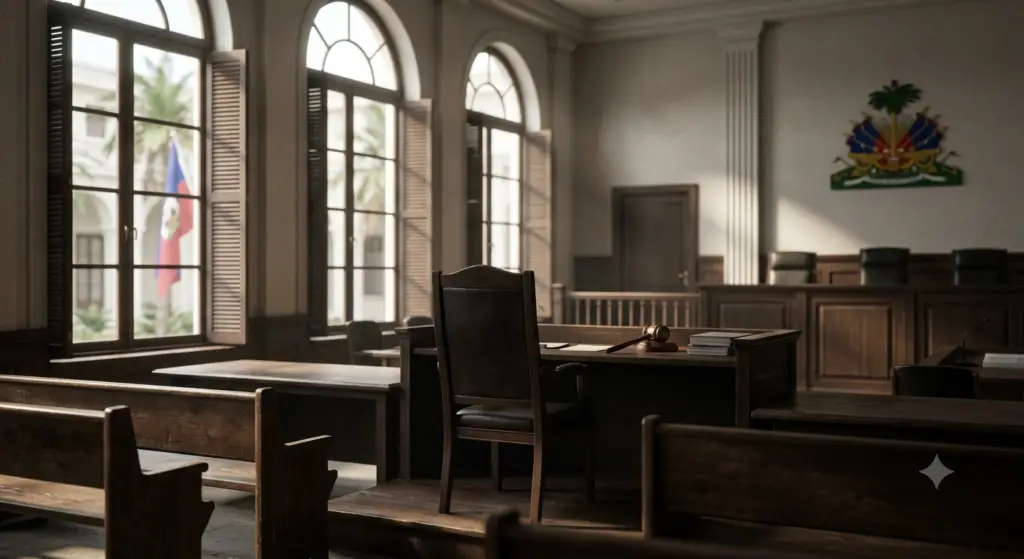
Haiti was supposed to hold its first presidential election in a decade on August 30. In late July, the country’s electoral council pushed the vote back again, to December 13, citing insecurity it could not guarantee (Reuters, 2026; Haitian Times, 2026). The acting prime minister had said months earlier that elections would wait until the armed coalition controlling most of the capital had been “eliminated” — a precondition no calendar has yet managed to meet. In the meantime, that coalition keeps functioning, in its own violent way, as the only government many residents currently experience directly.
Residents describe something specific about what that looks like from inside it: markets reopen because armed men allow them to, roads clear because armed men clear them, and a population that has waited years for someone properly constituted to say so simply stops being able to fully separate the men keeping order from the men who dismantled it in the first place. That confusion is not a failure of the people living through it. It is the predictable result of a state stepping back long enough for someone else to step forward.
A United Nations-authorized Gang Suppression Force has been deploying into the country since the fall, and more than a thousand foreign troops have arrived since the spring to try to reverse what years of absence produced (Global Centre for the Responsibility to Protect, 2026). It is not the first outside force Haiti has hosted this century, and no one closely watching expects it to resolve, on a soldier’s timeline, what took years of institutional silence to create. An election calendar can be rewritten in an afternoon. Whatever produced the conditions that keep forcing it to be rewritten cannot.
We have been tracing this same shape for several weeks now in the Book of Judges — what happens when a community keeps failing to build anything durable enough to carry its own weight. In the previous installment, Abimelech took his father’s authority by killing seventy brothers, because Israel had never built a structure to prevent one ambitious son from seizing what had never been settled. Samson, four chapters later in the same book, is what happens when that failure repeats itself so many times that Israel stops even trying to build something shared, and instead lets one man’s body absorb what a whole people should have been carrying together.
Rome Before It Had an Emperor
Centuries after Samson and two thousand years before Port-au-Prince, Rome went through its own version of this. By the second century BC, the Republic’s institutions were, on paper, fully intact — the Senate still met, the courts still convened, the elections still happened. But land reform had stalled for a generation, and the army had quietly begun to trust whichever general could actually deliver on a promise of land more than it trusted a Senate that kept deferring the question. By the time Marius reorganized the legions to accept landless volunteers, a soldier’s loyalty after twenty years of service belonged to the man standing in front of him, not to the institution that had never quite gotten around to rewarding him.
Historians disagree about which failure mattered most — land, army, or a Senate that would not compromise. What’s harder to dispute is the shape of the outcome: crises that a republic’s structures can no longer absorb do not disappear. They get redirected toward whoever looks strong enough to absorb them personally.
That redirection had a face before it had a name. When Sulla marched his own legions into Rome itself — a line no Roman army had crossed before him — the Senate did not organize a defense. It simply had nothing left to defend itself with. Two generations of deferred crises had already trained the city to expect that whoever arrived with the most loyal soldiers would be the one who decided what happened next. Sulla was not an aberration the Republic’s institutions failed to stop. He was the institutions’ own accumulated failure, finally given a name and an army.
The crossing of the Rubicon, a generation later, was less the beginning of Rome’s collapse than the moment a long institutional deterioration finally became impossible to disguise. Rome had already spent decades training itself to expect that emergencies would be solved by individuals rather than by process; Caesar simply arrived to collect what the Senate had already stopped being able to hold.
None of that makes Samson a Roman general — he never sought power the way Marius, Sulla, and Caesar each did, in turn. But the mechanism repeats regardless of motive: a structure stops doing its ordinary work, and a strong individual absorbs the pressure instead — which, for a while, genuinely does look like deliverance, because in the short term, it often is. That is precisely why the arrangement works long enough to become a habit, in Rome, in Port-au-Prince, and in the chapters we’re about to read. No one ever votes to dismantle an institution outright. They simply stop calling on it, one emergency at a time, until it has quietly become irrelevant to how anything actually gets decided.
A Judge Set Apart, and Alone
Judges 13 opens with the same refrain that opens most of the book’s cycles — Israel doing evil, an oppressor given power over them, this time the Philistines for forty years. But then the text does something it has not done with any judge before this one. An angel visits a barren woman directly, before the child is even conceived, and tells her exactly what he will be for:
“For, lo, thou shalt conceive, and bear a son; and no razor shall come on his head: for the child shall be a Nazarite unto God from the womb: and he shall begin to deliver Israel out of the hand of the Philistines.” (Judges 13:5, KJV)
Read against the larger arc of Judges, Samson can look like Israel’s workaround for a structure it never built — one body assigned to do what an unformed judiciary, army, and priesthood could not. But scripture does not actually present him that simply. It presents him as genuinely raised up by God, set apart before he could consent to it, empowered by a real and repeatedly demonstrated gift — the lion torn open with his bare hands, a city gate carried off on his shoulders, a thousand men fought with the jawbone of a donkey. None of that is written as accident or excess. It is written as calling. That is the harder fact sitting underneath this chapter, and it resists a tidy sociological reading. The institution had already failed before the man was born — and yet the man himself was still, genuinely, of God. Both things are true in the text at once, and neither cancels the other. A person can be genuinely gifted for a task without inhabiting the kind of life, or the kind of community, that can safely carry what that gift eventually costs.
The Nazirite vow itself was never meant to be a permanent, involuntary condition. Numbers 6 describes it as a voluntary act — a man or woman choosing, for a season, to set themselves apart through unshorn hair, abstention from wine, and avoidance of the dead, as a visible sign of devotion they could also choose to end. Samson never gets that choice; his vow is imposed before birth, permanent rather than seasonal, worn rather than chosen. What does it mean to be consecrated to a purpose before you have any capacity to consent to it? Judges never answers that directly, but Samson’s entire life is lived inside the question.
The contrast with the judges before him is worth sitting with. Deborah judged Israel from beneath a palm tree, and when war came, she summoned Barak and ten thousand men from two tribes. Gideon, for all his early hesitation, gathered an army, tested it, trimmed it to three hundred, and led it. Even Jephthah was formally negotiated with by the elders of Gilead before he agreed to fight. Whatever their flaws, each of those judges operated inside some remaining thread of communal process — a summons, a council, a negotiation.
Samson never gathers an army. He never asks Israel to follow him anywhere. Every one of his recorded victories is a solitary act, performed and then walked away from, with no one beside him to remember it accurately or hold him accountable for how he got there. Each episode after his birth follows an unmistakable escalation, and it is worth watching his world contract exactly as his power grows. The gift arrives first — inhuman strength, tearing a lion apart with his bare hands on the road to Timnah, alone, telling no one, not even his own parents. Then appetite: he marries against his parents’ counsel because “she pleaseth me well” (14:3), then turns a private discovery from that same lion’s carcass — honey, taken from a corpse he alone knew about — into a wedding riddle wagered against thirty men’s clothing. Then retaliation: when his bride weeps the answer out of him and the riddle is betrayed, he pays the debt in violence, striking down thirty strangers in a different town for their garments, and later burns Philistine grain fields for reasons that are entirely his own (15:4–5). Then isolation: the elders of his own tribe, rather than defending him, bind him themselves and hand him to the Philistines, telling him plainly, “Knowest thou not that the Philistines are rulers over us?” (15:11) — his own people apologizing to their oppressors for the inconvenience of his existence. By the final chapter, no one around Samson is positioned to counsel, restrain, or even fully see him — which is exactly the condition under which he meets Delilah, alone, and gives away in pieces the one thing that was never actually his to auction:
“And she made him sleep upon her knees; and she called for a man, and she caused him to shave off the seven locks of his head… And he wist not that the LORD was departed from him.” (Judges 16:19-20, KJV)
That is the line the whole chapter turns on. Not that his hair was cut — that he could not tell, in the moment, that the source of his strength was already gone. He wakes the way he always wakes, expects his body to do what it has always done. It doesn’t. This is what happens to a gift once every structure capable of checking it has been removed: it stops feeling like a gift at all and starts feeling like a fact about the person carrying it, indistinguishable from his own strength until the exact moment it isn’t. The gap between his own confidence and the truth of what has already left him is the most quietly devastating sentence in the book.
Neither could Israel, watching from a distance, ever fully separate the gift from the man carrying it. It is a slow transfer, made one relieved concession at a time — he is faster, he doesn’t need permission, only he can do this — until an entire people has quietly handed its own survival to a single person’s judgment, without ever voting on the transfer at all. No formal moment marks when Israel stopped expecting deliverance to be a shared project; it simply stopped happening, the way a muscle stops being used once someone else always lifts the weight. When a community outsources its deliverance this completely, it loses more than a fallback plan if he fails. It loses the ability to notice the failure while there is still time to do anything about it.
His last recorded words are a private plea, blind and chained between two pillars in a Philistine temple:
“O Lord GOD, remember me, I pray thee, and strengthen me, I pray thee, only this once, O God, that I may be at once avenged of the Philistines for my two eyes.” (Judges 16:28, KJV)
He gets his strength back for one final act, and it costs him his life along with the lives of everyone in that building.
It also leaves an uncomfortable question sitting in the rubble of that temple: if Samson had died quietly in his sleep some ordinary night before Delilah, would anything in Israel’s arrangement for its own survival have continued without him?
What the Pattern Doesn’t Explain
The pull toward a strong individual is not confined to failed states, and political science offers at least a partial account of why. Writing in the Journal of Democracy, Roberto Stefan Foa traces how authoritarian populists across weakly institutionalized democracies build support less on ideology than on a promise to restore order that decayed state capacity can no longer deliver on its own (Foa, 2021). Institutional weakness, in other words, is a large part of why a strongman becomes possible.
It explains less well why people begin to prefer him — why uncertainty starts to feel more exhausting than danger, why one man’s decisiveness starts to feel more trustworthy than a slow process nobody controls. Part of the answer is that institutional failure rarely means only one thing. Sometimes a court still exists but can no longer deliver a verdict anyone trusts; sometimes a government still exists but no one believes it represents them anymore. Haiti has both problems layered on top of each other — a state with almost no remaining capacity to act, governed, until recently, by a transitional council few Haitians felt had any standing to govern them at all. A strongman does not need to solve both failures. He only needs to look, for a while, like he is solving one of them.
That gap, between what makes a strongman possible and what makes him wanted, sits closer to the center of Samson’s story than any statistic about institutional decay. Uncertainty is exhausting in a way that danger, oddly, is not always. A slow process nobody controls asks something of a people that a single decisive man does not: patience with an outcome no one can yet guarantee. It is not hard to understand why, offered the choice, exhausted people keep choosing the man.
Haiti’s numbers, at least, are not in dispute. Since President Jovenel Moïse’s assassination in 2021, the country has not held a single election. More than sixteen thousand people have been killed and roughly 1.5 million displaced by escalating gang violence since January 2022 (Global Centre for the Responsibility to Protect, 2026). None of that happened because Haiti’s institutions were strong and a coalition of armed men tore them down. The institutions had already stopped functioning. The armed men arrived afterward, to do — visibly, on their own terms — what a state that could not even hold an election was no longer able to do at all.
Judges tells a version of this same story six times before it reaches Samson: a failure to build anything durable, followed by oppression, followed by the emergency raising of one gifted individual to absorb what a divided people would not organize itself to carry. We’ve already watched two earlier turns of it in this series — Deborah summoning an army from beneath a palm tree, and Gideon refusing a crown he was offered outright, then quietly building an idol that outlived his own resistance to power. Neither of them escaped the pattern completely. But both still had something Samson never gets: a people willing, at least once, to organize around a shared cause instead of a single body.
By Samson’s chapters, even that has worn away. Six generations of judges have produced no standing court, no shared army, no method for raising a leader that doesn’t depend on crisis and charisma showing up in the same person at the same moment. Samson is the cycle taken to its furthest point — no council, no army, not even a marriage built on shared conviction, carrying the weight of a people’s deliverance in a body that was always, eventually, going to be one betrayal away from failing alone.
The Weight Nothing Else Was Built to Hold
None of this argues against strength itself, or against the real relief a capable person can bring into a genuine emergency. Judges never suggests Samson should not have existed. The question underneath every cycle in this book is narrower and harder to dismiss: what does a community build, or fail to build, in the years between emergencies, so that its survival stops depending on whether one exhausted person can keep carrying it?
That question shows up wherever one gifted person becomes the entire structure holding something together — a congregation built so completely around one pastor’s gifts that no one else was ever developed to teach, counsel, or lead in his absence, so that his departure, failure, or simple aging leaves the church discovering, all at once, that nothing was actually built underneath him. It is rarely a failure of affection. The people who built that arrangement usually loved him, trusted him, and could point to real fruit from his years of leading. That is exactly what makes the arrangement so easy to build and so hard to notice building. The same test applies just as well to a marriage, a family, or a workplace that has quietly let one person become indispensable: would the work continue if that person disappeared tomorrow?
Every one of those arrangements works, often for far longer than it should. That is what makes them dangerous. A system built around one strong person rarely announces its fragility in advance. It announces it once, at the exact moment the person carrying it turns out to be tired, wrong, or simply human in a moment that needed something sturdier than a person.
There is a specific grief inside Samson’s ending that is easy to miss under the collapsing temple. It is the grief of a man who was never given anywhere else to put his strength — no council, no elders, no community that had built him a place beyond the emergency he was born to solve. Comfort, in scripture, rarely comes from one person absorbing an entire burden alone; it comes from a body of people sharing weight that was never meant to rest on one set of shoulders. Samson’s tragedy is not only that he fell. It is that almost no one was close enough to catch him.
We are not condemned to his ending. What his story leaves behind is less an instruction than a question worth sitting with quietly — where deliverance, in whatever shape it takes, is currently resting on one unaccountable set of shoulders, and what it would cost to start distributing that weight before it has to be carried alone. That question does not require a crisis to be worth asking. It is usually easier to ask before one arrives than during it.
Related reading on this theme: The Weakening — on what carrying a burden without support does to the body over time — and The Man Who Fell Alone, on the gap between being housed and being held.
1. Reuters, “Haiti Announces Election Delay Amid Security Challenges,” July 27, 2026; Juhakenson Blaise, “Inside Haiti’s Road to 2026 Elections: CEP Revises Calendar, Keeps Aug. 30 Vote Date,” The Haitian Times, January 6, 2026.
2. Roberto Stefan Foa, “Why Strongmen Win in Weak States,” Journal of Democracy 32, no. 1 (January 2021): 52–65.
3. Global Centre for the Responsibility to Protect, “Haiti,” country report, 2026.
New essays every week. Delivered quietly.