Hook
The camera lingered on the eyes
In October 1998, a lawyer in Cincinnati picked up his direct line and heard a cattle farmer from Parkersburg, West Virginia, say that his cows were dying left and right. The lawyer, Rob Bilott, had spent his career defending chemical companies, and a few months later he would make partner at his firm. The caller, Wilbur Tennant, had no firm behind him and no expert, and by his own telling very few people left to phone.
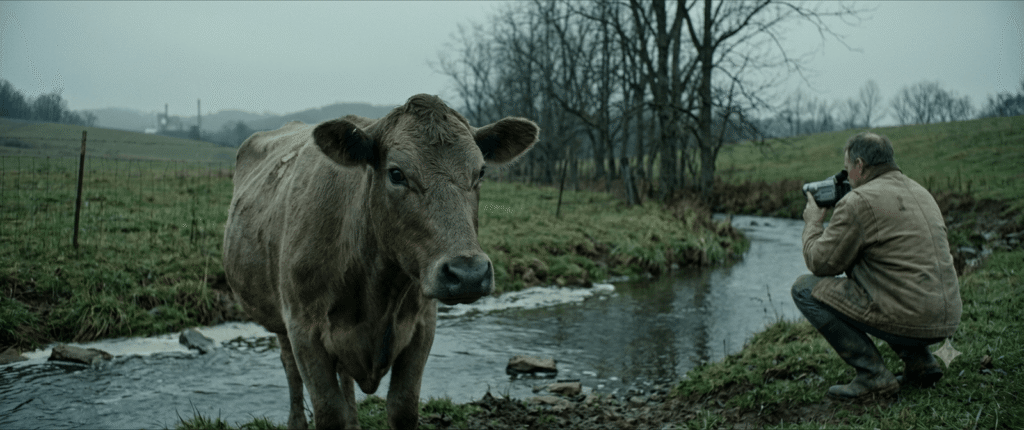
About a week later Tennant drove up with his wife and a set of videotapes he had made himself (Rich, 2016).1 On the tapes were a creek and a pasture, a cow with patches of hair gone and its back humped, and a man in work clothes opening a dead animal so the lens could see inside. He narrated as he cut, pointing at discolored organs. By his count on the footage, he had lost 153 animals, and the veterinarians in town either would not return his calls or did not want to get involved.
Bilott watched the video and studied the photographs for hours. One detail stayed with him, according to Rich’s reporting: Tennant kept bringing the camera in close on the animals’ eyes.
Historical Case
How a company town learns what not to hear
Parkersburg was a company town, and the company was DuPont, which had run a plant nearby since 1948 (Right Livelihood Foundation).2 The trouble on the Tennant farm began, as Tennant understood it, after his brother sold part of the family land to DuPont, and the land became a landfill above the creek where the cattle drank. The animals, as the foundation summarizes his account, developed bluish eyes, bleeding noses, and foam at the mouth.
Tennant went to the state and to the Environmental Protection Agency, and no one would test the water (E&E News, 2020).3 Offices existed, in other words, and none of them took up his question.
When Bilott sued in the summer of 1999, DuPont proposed a joint study of the farm. Six veterinarians carried it out, three chosen by the company and three by the EPA (Rich, 2016). Their report is in the record, and it is specific. The team found a herd suffering from four conditions, among them malnutrition and copper deficiency, and it faulted how the animals were fed, doctored, and protected from flies (herd-health report, via Toxic Docs).4 The Tennants did not accept that reading. A fair telling carries the finding anyway, because it shows how an inquiry can be conducted in good order and still answer a narrower question than the one a farmer is asking.
Tennant went on calling Bilott’s office nearly every day, though Bilott often had nothing to report. While reading company correspondence with regulators, Bilott noticed a compound abbreviated PFOA and requested every document DuPont held on it. The company resisted until a judge ordered it to comply, and roughly 110,000 pages arrived, some of them half a century old. Bilott concluded from them that DuPont had known for decades what the chemical could do, a conclusion he later pressed in court, and DuPont settled the Tennants’ claim.
The story did not stop there. In 2001 Bilott filed a class action for about 70,000 people in West Virginia and Ohio whose drinking water was contaminated by the same compound, and the litigation that followed ran for years, including a settlement of roughly $671 million in 2017 (The Black Sea).5 Tennant, according to the Right Livelihood Foundation, died only a few years after his own case closed.
Biblical Lens
Three old accounts of a hearing that never happens
The first is the vineyard of Naboth, which we looked at in an earlier essay on Ahab and the vineyard (1 Kings 21). A king wants a field that a man refuses to sell, and the taking is done with paperwork: a public accusation, two paid witnesses, and a verdict that looks like procedure. What matters here is only the method, a theft dressed as a hearing.
The second is the prophet Amos at a city gate, the place where disputes were once heard (Amos 5:10–12). He describes people who despise the one who speaks plainly there, who press the righteous, and who push the poor aside. The gate is still standing in his account, but nothing is decided at it. Parkersburg had its own offices, and by Tennant’s account none of them would test the creek.
The third is a single line from the Proverbs (11:1). A false balance is an offense to the Lord, and an accurate weight delights him. The line is addressed to merchants, and it applies just as well to records, to whether what goes on the scale is what it claims to be.
Scripture never asks us to read every poisoned field as a message from heaven. What it does keep returning to is a quieter claim, that a people reveals the conditions it has accepted by whom it answers and whom it lets ring unanswered.
Pattern Insight
What one set of tapes made possible
The numbers in this case are large. Tennant reported 153 dead animals on his tapes. The documents Bilott obtained ran to about 110,000 pages. The class he represented numbered some 70,000 people, and the legal fight, begun in 1998, was not settled until 2017.
It is tempting to read those figures as a victory of scale. But each of them traces back to a single early act: a man who could not get anyone to look made a record that did not need anyone’s permission. Before there were 110,000 pages, there were a few hours of video from a farmer who knew what he was seeing and did not know who would believe him.
Procedure was not the villain in this story. The veterinary study, the federal court, the judge’s order to produce documents, and the eventual settlements all belong to the machinery that a lawful society builds to find things out, and in the end that machinery worked. Institutions are good at processing what is put in front of them, and getting something put there is the harder part. What failed first was the listening that has to happen before any procedure can begin.
That is where the pattern from Naboth and Amos comes back. The harm in their accounts is possible because the place where claims are tested has gone quiet, and what reopens it is rarely a grand institution. It is more often a plain account, offered again and again by someone unwilling to stop.
There is a cost in this pattern as well. Whoever first carries an honest weight into a crooked market seldom lives to see the market change. The Bible’s long argument about debt and release keeps its attention on the same figure, the party with the least power in an unequal bargain, who is often the last to be repaid for what the bargain cost him. Tennant’s case was closed, and his vindication arrived mostly for other people, in other towns, after he was gone.
Closing
A hearing begins long before the trial
In the previous installment, we examined faithful work that almost nobody sees. Tennant’s work was seen by almost no one as well, until a lawyer pressed play, and the difference is instructive. The labor in the earlier case went unnoticed by accident, while in Parkersburg the silence around it was kept.
A hearing begins before the courtroom. It begins when the veterinarian returns the call, when an agency sends someone to sample the creek, and when a lawyer who has spent his career on the other side picks up a phone from a stranger. Those small decisions are how a town settles what it can afford to know.
Seen from there, the camera that kept returning to a cow’s eyes looks like more than evidence. It was a farmer’s attempt to make the animals look back at the people who had declined to look at them. Whether a town can learn to answer before the tapes arrive is a question this story leaves open.
1. Nathaniel Rich, “The Lawyer Who Became DuPont’s Worst Nightmare,” The New York Times Magazine, 2016.
2. Right Livelihood Foundation, profile of Robert Bilott.
3. “Lawyer: ‘We needed to sound the alarm’ on PFAS health risks,” E&E News by POLITICO (interview with Rob Bilott).
4. Tennant Farm Herd Health Investigation, Cattle Team Report, as archived by Toxic Docs.
5. “The poison of the century,” The Black Sea (Forever Lobbying Project).
New essays every week. Delivered quietly.