The Line That Held
There Is a Silence After a Signature
There is a particular kind of quiet that settles after someone signs their name to something they may not survive — a weight a signature carries that a spoken promise never quite does, because it stays behind as evidence after the person who made it is gone. It has become almost ordinary, in recent years, to hear about this shape of message — a journalist filing one last dispatch before a connection goes dark, sent with no certainty it will be read while its sender is still alive to know it.
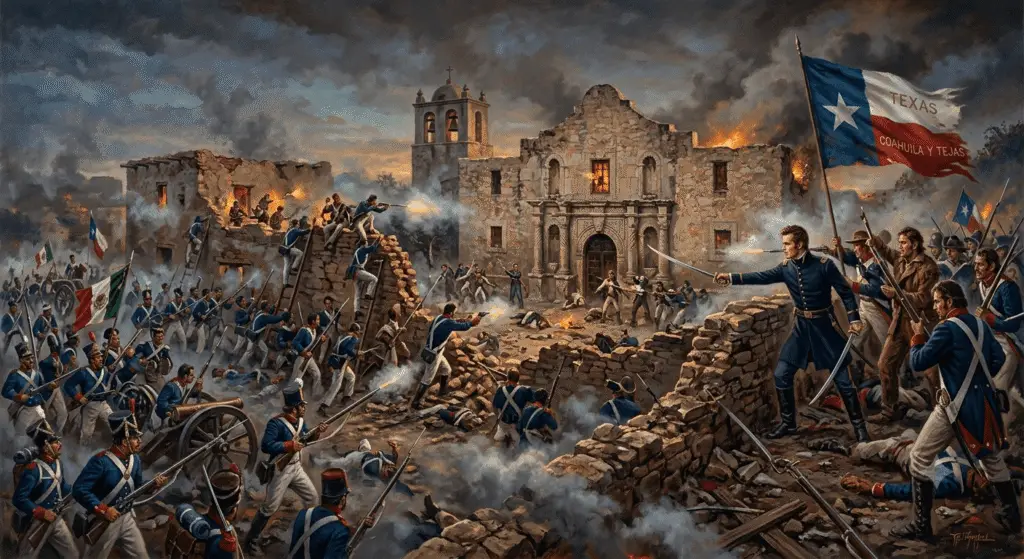
On February 24, 1836, a twenty-six-year-old lieutenant colonel sat at a makeshift desk inside a besieged mission in south Texas and wrote one of these messages more than a century before we had a name for the genre. His name was William Barret Travis. The mission was the Alamo. And the letter he wrote that morning — addressed “To the People of Texas and All Americans in the World” — would outlive almost everything else about him.
A Colonel, a Mission, and a Letter Answered Too Late
By the time Travis picked up his pen, the situation inside the Alamo’s crumbling walls was already close to hopeless. Roughly 189 defenders — Texian volunteers, recent American arrivals, and Tejano fighters loyal to the Texas cause — were surrounded by a Mexican army under General Antonio López de Santa Anna that historians estimate at well over a thousand men, with more arriving daily.1 The Alamo was never as simple as the legend that followed it. This was not yet a clean story of a united people defending freedom against tyranny; it was a fractured colonial territory, Anglo settlers and Tejano allies bound together by a revolution whose politics were still being argued out even as the siege began. Travis himself was part of that unresolved complexity — among the men and boys inside those walls was a young man named Joe, whom Travis had purchased the year before and who would later survive the battle to give one of history’s only firsthand accounts of it. Whatever else his letter claims about liberty, it was written by a man who held another human being as property, and that fact does not cancel out the letter — but it should sit alongside it. The mission itself had not been built to withstand a siege of this size — its walls were long, low, and difficult to hold with the artillery and manpower available.
Travis’s letter did not pretend the odds were good. He described the bombardment the garrison had already endured, the demand for surrender he had answered with a cannon shot, and his intention to hold the position regardless of what came next. The line that has survived him is short enough to fit on a plaque: “I shall never surrender or retreat.” What tends to get lost is the sentence just before it, where Travis called on “the citizens of Texas and all Americans in the world” for reinforcements and supplies “as soon as possible.”
Help did come — just not enough of it, and not in time. A company of thirty-two men rode in from Gonzales in the early hours of March 1, the only outside force to reach the Alamo before its fall.2 It is worth being precise here, because the more dramatic version of this story — that no one answered at all — is not quite true, and the truer version is harder: thirty-two people heard the letter and came, and it still was not enough. Travis kept sending couriers out after that. By March 3, in a second letter to a fellow officer, he wrote that he had “given up all hope of receiving assistance” but would “still hold out to the last.” A few days later, Santa Anna’s forces overran the walls before dawn. By Joe’s account — the same young man Travis had purchased, and one of the few survivors — Travis was among the first defenders killed, shot while manning the north wall.3
What makes his case worth pausing on isn’t that he died defending a position; soldiers have done that in every recorded war, for causes that ranged from noble to indefensible. What makes it worth pausing on is the documented gap between the moment he stopped expecting rescue and the moment he stopped fighting. Those were not the same moment. By his own written account, Travis spent his final days with little realistic hope that help was coming, and stayed anyway.
Three Men, a Furnace, and a Sentence That Does Not Promise an Outcome
Scripture preserves an older version of that same gap, and it is worth reading slowly rather than skimming past as background.
In the book of Daniel, three officials — Shadrach, Meshach, and Abednego — refuse to bow to a golden image erected by King Nebuchadnezzar. The penalty is death by fire. Given one more chance to comply, their answer is recorded like this:
“If it be so, our God whom we serve is able to deliver us from the burning fiery furnace, and he will deliver us out of thine hand, O king. But if not, be it known unto thee, O king, that we will not serve thy gods, nor worship the golden image which thou hast set up.” — Daniel 3:17–18 (KJV)
The structure of that answer is what deserves attention, more than the drama around it. It is not a claim that rescue is guaranteed, and it is not defiance built on the assumption of a happy ending. It is a decision made in the conditional — “but if not” — that holds regardless of which way the outcome breaks. The three men do not know, as they say this, whether they are about to be saved or about to die. Joshua makes a smaller version of the same move when he tells the tribes of Israel to “choose you this day whom ye will serve” (Joshua 24:15) — the choosing comes first, with no preview of the result attached.
There is a harder question sitting underneath this text than the one it usually gets asked to answer. It is not simply would God deliver them. It is what kind of devotion is even possible once a person has stopped assuming the answer is yes. Confidence that God will do what we want is one thing. Fidelity to God when we do not know what God will do is a different, harder thing — and it is the second one Daniel’s account is actually interested in.
None of this is meant to flatten Travis into a biblical figure, or to suggest that defending a Texas mission carries the moral weight of three men refusing an idol. The comparison becomes interesting at a narrower point than that, and it is worth naming the difference plainly: the three men’s refusal was submission to a God they believed sovereign over the outcome either way; Travis’s was a matter of military and political honor, owed to a cause and to the men who had put their trust in him. These are not obviously the same kind of commitment, even where they take the same shape. Scripture does not promise that everyone who holds a line will be vindicated, and it does not ask readers to treat every doomed stand as automatically righteous — history holds plenty of last stands fought for causes that deserved no defense at all. Courage is not proof of righteousness. A person can be entirely sincere and still be wrong about what was worth dying for. What the text does preserve is narrower and, I think, more durable: that the decision to hold a position is sometimes made before anyone knows how it ends, and that the choosing itself — not the outcome, and not the cause’s ultimate justice — is where a person’s actual convictions get tested.
What Shifted, and What Didn’t
Psychology can describe part of why a person keeps a commitment once the odds turn against it — it just can’t answer the question scripture is actually asking, which is not why do people persist but whom, or what, are they persisting for. There is a useful distinction here between a commitment that survives only as long as it looks likely to pay off, and one that has become part of how a person understands who they are — internalized identity rather than calculated outcome. The second kind tends to hold under exactly the conditions that dissolve the first.4
Travis’s letters read like a real-time record of that shape forming. His first letter, on February 24, is written by a man still doing the arithmetic of rescue — reinforcements, more powder, a relief column large enough to matter. By March 3, the letter changes register entirely. He is no longer arguing for why help should come. He is stating, plainly, what he intends to do regardless.
What shifted wasn’t the odds — the odds did not improve. What shifted was where the odds sat in his decision. He did not necessarily stop hoping; his letters don’t read as a man who had given up on wanting to live. What he stopped doing was making hope the condition of his obedience. That distinction — hope that persists without being allowed to dictate the terms of what someone will or won’t do — is close to what we explored in an earlier piece about the particular endurance of people who keep waiting for word about someone missing, refusing to let the absence of an answer decide anything for them in advance. It is a narrower and stranger posture than courage.
The Alamo story that gets told in legend tends to flatten this into a single moment — a line drawn in the sand, a clean decision made once and never revisited. The letters themselves are quieter and more demanding than that. They show a man who kept writing down the same intention, in slightly different words, across several days of growing certainty about what it would cost him. That is not the shape of a myth. It is the shape of someone renewing a choice they had already made, because the first time making it wasn’t enough to make it stick.
It is fair to ask, at this point, what if Travis was simply wrong — wrong about the cause, wrong about the odds, wrong to stay when leaving might have preserved something worth more than a wall. That possibility does not undo the pattern this essay is tracing. The claim here was never that Travis was right because he persisted. Persistence is not the same thing as faithfulness; sometimes the faithful act is to stay, and sometimes it is to leave, and courage on its own does not tell you which. The claim is narrower: that a decision can be morally serious, and worth examining closely, even when its outcome is unknowable and even when the man making it, and the cause behind it, were flawed in ways that later history has made plain.
The Signature Comes Before the Answer
Return, for a moment, to that opening image — someone filing a final message with no idea whether it will be read while they are still alive to know it. What makes those messages difficult to read isn’t the content. It’s the timing. The sender wrote them before the outcome, not after.
Travis’s letter belongs to that category, a century and a half early. So does the answer three men gave a king who held their lives in his hand. None of them had the luxury of committing only after they knew how the story would end. The signature came first. What it would cost, and whether it would be worth it, came after — and by then, the choosing was already finished.
1. Davis, W.C. (1998). Three Roads to the Alamo. HarperCollins.
2. Hardin, S.L. (1994). Texian Iliad: A Military History of the Texas Revolution. University of Texas Press.
3. Jackson, R.L. & White, L.S. (2015). Joe, the Slave Who Became an Alamo Legend. University of Oklahoma Press.
4. Vallerand, R.J. (2015). The Psychology of Passion: A Dualistic Model. Oxford University Press.
New essays every week. Delivered quietly.