Hook
Thirty-Four Years
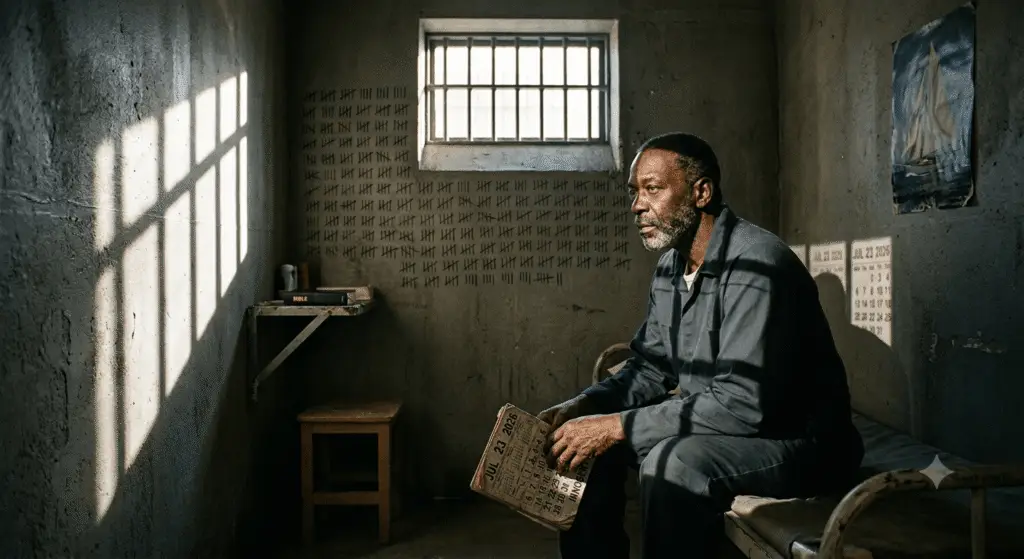
Jermaine “Marlow” Wright is not a name most readers will recognize. On July 23, 2026, a Delaware court gave him something few human beings ever receive: a Certificate of Innocence.[1]
He had spent thirty-four years on death row for a robbery and murder he did not commit. Convicted in 1992. Cleared this summer. The 203rd person exonerated from an American death row since 1973.[2]
Thirty-four years is longer than most marriages last. Longer than most careers run start to finish. It is enough time for the technology in a visiting room to change twice, for parents to grow old and die, for a country to elect five different presidents. The state can eventually correct a verdict. It cannot correct a calendar.
That distinction is the one I keep returning to. Not whether Wright will recover — courts don’t measure recovery — but what thirty-four years, specifically, does to the shape of a person’s remaining life. It’s a question this essay can’t answer for him. But it’s one Scripture, and one very famous film, have both tried to sit inside.
Historical Case
The Wall
The Shawshank Redemption is, on its surface, a story about a wrongly convicted banker named Andy Dufresne, sentenced to two life terms at a Maine penitentiary for a murder he didn’t commit. But the film isn’t really interested in his innocence as a plot mechanism. It’s interested in something closer to physics: what happens to a person subjected to a force — time, confinement — he has no ability to shorten.
The prison’s real weapon isn’t the walls. It’s what the walls do to a man’s sense of what’s still possible. The film gives this a name through Red, Andy’s friend and the story’s narrator, who describes what happens to men who’ve been inside long enough: they stop being able to function without the walls, even as the walls are what’s destroying them.
A system can imprison a person twice. First it locks the body. Then, more quietly, it locks the imagination — narrowing what a person believes he’s still allowed to want.
Andy never fully surrenders to the second kind. He spends years requesting library funding from a legislature that ignores him, until, eventually, it doesn’t. He risks solitary confinement to play two minutes of opera over the prison speakers — not because it changes his sentence, but because some part of him refuses to accept that everything inside those walls has to sound like a cell.
None of this is hope in the sense of “I will get out.” It’s closer to a much smaller, stubborner claim: this place does not get to decide who I am. The tunnel he’s quietly digging behind a poster for nineteen years is almost a footnote to that claim, not the point of it.
But is that kind of hope just a piece of Hollywood invention — a comforting fiction built for two hours of screen time? Long before anyone wrote Andy Dufresne, a much older text had already told a stranger version of the same story, about a man whose prison sentence did not mark the end of anything that mattered.
Biblical Lens
The Prisoner Scripture Remembers
Joseph is sold by his own brothers, falsely accused by Potiphar’s wife, and thrown into an Egyptian prison for a crime he didn’t commit. Genesis doesn’t skip past what that cost him. But it also refuses the ending we might expect:
“And Joseph’s master took him, and put him into the prison… But the LORD was with Joseph, and shewed him mercy, and gave him favour in the sight of the keeper of the prison.” (Genesis 39:20–21, KJV)
Read that again slowly. Nothing in that sentence shortens his sentence. Joseph doesn’t walk out early because God is with him. He stays exactly where he is — for years — while something in him keeps functioning that the prison can’t reach. It’s worth being precise about what that claim is and isn’t. It isn’t “be patient, God has a plan for your suffering.” It’s narrower: the presence of God does not always change the location of a person’s suffering. Sometimes it changes what the suffering is allowed to take from him.
The Psalms carry the same waiting into first person, and they don’t disguise how long it took:
“I waited patiently for the LORD; and he inclined unto me, and heard my cry. He brought me up also out of an horrible pit, out of the miry clay, and set my feet upon a rock.” (Psalm 40:1–2, KJV)
But this can’t be allowed to slide into a tidier lesson than the text actually offers. Waiting is not the same thing as approving of the conditions that make waiting necessary. The psalmist isn’t praising the pit. He’s describing what it took to survive it, which is a different thing entirely.
Paul goes further, turning suffering into something closer to a sequence:
“We glory in tribulations also: knowing that tribulation worketh patience; and patience, experience; and experience, hope.” (Romans 5:3–4, KJV)
A fair reader should be allowed to push back here, because the modern evidence doesn’t fully cooperate. Suffering doesn’t reliably build character. It can also flatten a person, or leave a wound that never closes into anything useful. Scripture’s actual claim is smaller and more defensible than the inspirational version: not that suffering is inherently productive, but that it doesn’t get the final say in who a person becomes.
A brief note on how to read this: none of these texts claim a person’s suffering was assigned for a reason, or that patience earns eventual release. What they insist on is narrower — that a wrongly taken year is never fully returned, and Scripture does not pretend otherwise; it only insists that what a person becomes while enduring it is not erased along with the time.
Pattern Insight
When Justice Has a Clock
Wright’s case is not an outlier so rare it can be treated as a fluke. The Death Penalty Information Center’s own tally puts the number at 203 exonerations from American death rows since 1973 — a figure large enough that the organization now maintains it as a permanent, ongoing database rather than a closed historical count.[2] A peer-reviewed review of the broader exoneration literature makes the same point in more academic terms: wrongful convictions are, at this point, a well-documented and recurring feature of the American criminal justice system, not a series of isolated errors.[3]
Two weeks before Wright’s certificate was issued, an Ohio parole board recommended commuting the death sentence of Tyrone Noling, who has spent thirty years on death row awaiting exactly this kind of hearing.[4] The point of naming his case alongside Wright’s isn’t that two men suffered similarly. It’s narrower: justice has a clock, and the people waiting on a verdict do not control its pace.
That raises a question this essay can’t resolve, but shouldn’t skip past either: who had the standing to ask either man to wait that long? Endurance is what the wrongly convicted person has to do. Correction is what the institution that convicted him owes. Those two things live on opposite sides of a line, and it’s worth naming a temptation that Christian writing sometimes falls into here — quietly collapsing them into a single, individual virtue called patience, as though the correction were optional and the endurance were the point.
Release, when it finally comes, is also not the same thing as restoration. A court can establish innocence. It cannot establish that the lost years never happened — that the thirty-fourth birthday spent in a cell gets recorded anywhere except in the file where it actually was.
Closing
The Years No Court Can Return
Andy Dufresne’s wall came down after nineteen years, one scraped inch at a time. Wright’s case took thirty-four to be reopened. Neither man got to negotiate the length down. The difference between them was never the size of the wall. It was only what happened, inside each man, during the years the wall refused to move.
In the previous installment, we looked at what a shrinking food ration reveals about who gets counted inside a boundary someone else drew. This is the same question turned toward time instead of grain: who gets believed, how long a person can be made to wait for it, and what it costs him in the meantime.
A verdict can be overturned. A wall can come down. But no court, however careful, can return a year.
The question worth sitting with isn’t only whether a wrongly convicted man can endure the wall. It’s whether the people who never had to live behind it will remember, once he’s out, how long it actually stood.
[1] Jermaine “Marlow” Wright case — Delaware Superior Court, Certificate of Innocence issued July 23, 2026; reported by the Death Penalty Information Center, August 5, 2026.
[2] Death Penalty Information Center, “Innocence” (topic overview), 2026.
[3] Richard A. Leo and Lara Bazelon, “Exonerations: Causes, Consequences, and Reforms,” Annual Review of Criminology 9 (2026): 317–342.
[4] Death Penalty Information Center, “Ohio Parole Board Recommends Commutation of Death Sentence for Tyrone Noling,” August 26, 2026.
New essays every week. Delivered quietly.