Hook
A Hand Raised in a Federal Courtroom
The room is smaller than people expect. Folding chairs, a flag on a pole that has stood in that same corner for years, linoleum that squeaks under a hundred pairs of good shoes worn for the occasion.
Every year, several hundred thousand people in the United States stand in rooms like this one and raise a hand. They repeat a sentence they did not write, in front of witnesses who did not choose them, and when the sentence ends, something about their legal existence has changed. The blessing — citizenship, a passport, a vote — is real, and it is meant to be permanent.
It is worth being precise about the exception, because the exception is instructive. Denaturalization in American law is not a penalty for a change of heart, and it is not triggered by ordinary failure to live up to the oath’s spirit. It applies, narrowly and rarely, to cases where the oath itself was false at the moment it was spoken — fraud or material misrepresentation in the naturalization process, not disappointment discovered later. The blessing is not conditional on perfect performance afterward. It is conditional on the truth of the thing said at the threshold.
Nobody in that room uses the word curse. But a structure this precise — a status granted by public declaration, revocable only if the declaration itself was hollow — is older than the courtroom, and older than the country that built it.
In the previous installment, we followed a law written before Israel had a border to enforce it — a constitution recited to a people with no territory yet to test it on. What happens in Deuteronomy 27 through 30 is the next move in that same sequence, and it is louder than a courtroom oath by a considerable margin. The law stops being read. It gets staged.
Historical Case
The Treaty That Named Its Own Curses
Seven centuries before Christ, the Assyrian king Esarhaddon needed his regional vassals to accept his son as heir before the succession happened, not after. The document that survives from that arrangement — what scholars refer to as the Vassal Treaties of Esarhaddon — is long, specific, and almost entirely made of consequences.
It lists the loyalty required in a handful of lines, then spends dozens more listing what happens to the body, the household, the crops, and the descendants of anyone who breaks the terms. Boils. Barrenness. Wild animals in the streets. A wife taken by an enemy while the husband watches. The list does not read like law. It reads like a threat with a legal cover page, written by scribes whose job was to make disloyalty to the empire feel cosmically dangerous.
The biblical scholar Moshe Weinfeld noticed something in 1965 that has been debated and refined ever since: the curse sequence in Deuteronomy 28 follows the same order, in places the same imagery, as the Assyrian treaty curses composed in the same general region and century (Weinfeld, 1965). Boils again. Madness. Blindness. A wife taken by another man in plain sight of her husband. Delbert Hillers later widened the comparison, cataloguing how deeply the treaty-curse genre of the ancient Near East had shaped the prophetic and legal vocabulary of Israel’s own scribes (Hillers, 1964).
What that resemblance means has become the more interesting question in recent decades. Bernard Levinson and Jeffrey Stackert have argued for something sharper than shared genre — that Deuteronomy’s scribes knew the Assyrian loyalty oath specifically, and rewrote it on purpose (Levinson & Stackert, 2012). On this reading, the borrowed language is not homage. It is a quiet act of literary defiance: the same vocabulary an empire used to terrify subject peoples into loyalty toward a foreign king gets redirected, almost word for word in places, toward loyalty owed instead to the God who had already freed that people from an empire like the one that wrote the original. A vassal treaty measures loyalty to a king who demands it. Deuteronomy borrows the king’s own grammar and hands it to a God who does not need to demand what he has already earned. The empire’s threat language becomes, in Israelite hands, a covenant a people could actually choose to keep.
That distinction matters more than the surface similarity. Esarhaddon’s document protects one man’s throne. Deuteronomy’s document, whatever else it is doing, keeps returning to widows, foreigners, and the poor — categories a king protecting his own succession has no particular reason to mention at all.
What the comparison also explains, more usefully than any accusation of borrowing could, is why Deuteronomy 28 is as long and as repetitive as it is. A modern reader expects a law code to state its penalty once and move on. A treaty audience in the ancient Near East expected something closer to liturgy — language built to be recited aloud, remembered by ear, and impossible to later claim one had not heard. The repetition in Deuteronomy 28 is not emotional excess. It is covenant rhetoric doing exactly what the genre required: making the terms unforgettable to a people who would have no written copy of their own to check against, borrowed from the very empire whose grip that people had just escaped.
Biblical Lens
Two Mountains, One Voice
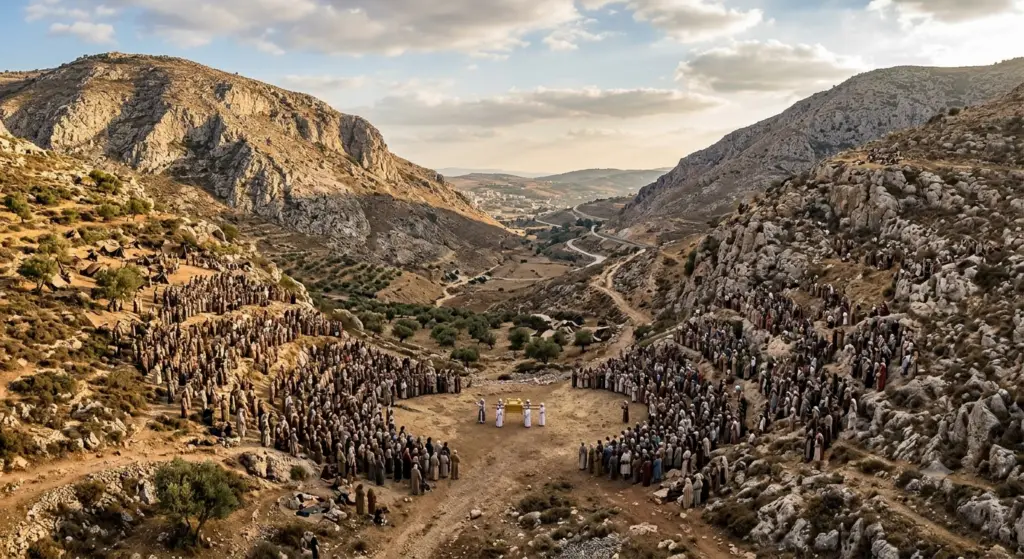
The scene itself is almost theatrical in its staging. Six tribes are told to climb Mount Gerizim, six to climb Mount Ebal, and to stand facing each other across the narrow valley between, while the Levites recite the terms of the covenant so that both slopes can hear it at once (Deuteronomy 27:11–13). Picture the acoustics of it as much as the theology: a voice sent down into a valley and thrown back off two rock faces, so that six tribes hear the blessing arrive from Gerizim’s side and six tribes hear the curse answer from Ebal’s, and every person standing there is made to listen to the version they did not choose as well as the one they did. The valley does the work a modern amphitheater does — it turns one voice into something the whole assembly can hold in common.
Nothing about the geography is incidental. A nation about to enter a land it has never seen is first arranged, physically, into the shape of its own choice.
It is worth pausing on a common misreading here. In the American imagination, the word curse tends to summon something closer to folklore — a hex, a spell, an unlucky object. That is not what the text is doing. A curse, in Deuteronomy, is not a spell cast on the unlucky. It is the public, structural consequence of a covenant broken in the open. A society that stops keeping faith with its own terms does not need a supernatural agent to unravel; the unraveling is what broken terms do on their own, given enough time. The text simply names that unraveling in advance, rather than pretending it will not come.
What follows in chapter 28 makes the terms almost unbearably plain — but it is worth resisting the pull toward the curses alone, since the blessing that opens the chapter is not a footnote to them. It is stated first, in detail, and it is specific in a way “prosperity” as an abstraction never is: full granaries and full kneading-troughs, livestock that multiply rather than fail, harvests generous enough that surrounding nations come to borrow rather than the reverse, a people so provided for that scarcity becomes the anomaly instead of the norm (Deuteronomy 28:1–13). None of it is framed as a prize handed down for good behavior. It is framed as what covenant fidelity naturally produces — the ordinary shape of a community whose members have kept faith with each other as much as with God. Blessing, on this reading, is closer to a description of a functioning society than a reward for an obedient one.
And then, several chapters later, after blessing and curse have both been laid out in full, the text turns to the listener directly and asks them to choose.
“I have set before you life and death, blessing and curse; therefore choose life” (Deuteronomy 30:19, paraphrased).
It is easy to read that line quickly, as a tidy closing exhortation, and miss the scene it is actually spoken inside. This is Moses at the edge of the very land he will not be allowed to enter, delivering what amounts to his final extended address to the people he has led for forty years through terrain that broke and remade nearly all of them. He will not be there to see which mountain they answer. He will not cross the river with them. The appeal to choose life is not abstract moral instruction offered from a safe distance — it is the last extended thing a dying leader has left to say to the only people he has, and it is framed, deliberately, as an act of love rather than a warning issued from above him.
Scripture does not require that every catastrophe be interpreted as divine judgment; it does, however, insist that societies eventually reveal the moral conditions under which they have chosen to live.
Pattern Insight
The Ceremonies We Still Perform
The anthropologist Victor Turner spent much of his career studying what happens to a person in the middle of a ritual — the moment after the old status has been shed and before the new one has been granted, when a person is neither what they were nor yet what they are becoming. Turner called this condition liminality, and he argued that societies build formal ceremonies specifically to manage it, because an unresolved in-between state is intolerable to hold for long (Turner, 1969).
But Turner’s model does not end at the threshold. The ritual’s purpose, in his account, is to move a group all the way through liminality into what he called communitas — a temporary but real bond formed among people who have just passed through the same disorienting passage together, stripped for a moment of the ranks and roles that separated them before. A platoon that has finished basic training has this. A congregation that has just witnessed the same baptism has it, briefly. What the ceremony produces is not only a change in individual status. It is a shared identity that did not exist in the room before the ritual began.
This is closer to what happens on those two mountains than liminality alone can explain. Twelve tribes climb two different slopes as twelve separate groups, each with its own territory, its own grievances, its own memory of the wilderness years. They come down from that valley as something the text has not called them before in quite the same way: one covenant people, bound not by blood alone but by having stood together and heard, out loud, the same two futures named over their heads. The geography does the sorting. The shared hearing does the binding.
A citizenship oath does a smaller version of the same thing. So does a military enlistment, a wedding, an ordination, a diploma handed across a stage, a corporate onboarding that ends with a signature nobody reads closely, a new member’s vow recited in front of a congregation. In each case, a person walks in ambiguous and walks out categorized, and a room full of strangers walks out, briefly, as something closer to a single body. The paperwork alone was never going to be enough. The room, the standing, the repeating — that is what performs the change.
The blessing was never a reward waiting to be earned. It was a description of the road already chosen, spoken out loud so the road could not later be denied. That is the part a modern reader tends to miss, standing outside the genre. The mountain ceremony is not primarily about threat. It is about the psychological and communal weight of making an abstract commitment impossible to misremember later — the same reason a courtroom asks a person to say the words aloud rather than simply sign a form, and the same reason a wedding still asks two people to speak in front of witnesses what a signed license alone could accomplish in private.
Closing
What the Mountains Were For
Return to that room with the folding chairs and the flag in the corner. The oath recited there is thin compared to what a Levite would have shouted across a valley in the wilderness — a single paragraph instead of a mountain full of consequence, a signature instead of a nation split into two facing slopes. But the underlying instinct is the same one, reaching forward three thousand years. A society that cares whether its members remember what they agreed to does not let the agreement stay quiet. It stages it, and it makes strangers into something closer to kin in the staging.
Deuteronomy 27 through 30 is not, in the end, a threat aimed at a fragile people. It is a document doing everything it can to make sure a choice, once made, could never be misremembered as an accident — borrowing, if Levinson and Stackert are right, the very grammar of the empire that people had just walked out of, and handing that grammar to something the empire never offered them. The mountains did not create the blessing or the curse. They made both of them impossible to forget.
Notes: Moshe Weinfeld, “Traces of Assyrian Treaty Formulae in Deuteronomy,” Biblica 46 (1965); Delbert R. Hillers, Treaty-Curses and the Old Testament Prophets (Pontifical Biblical Institute, 1964); Bernard M. Levinson & Jeffrey Stackert, “Between the Covenant Code and Esarhaddon’s Succession Treaty,” Journal of Ancient Judaism 3 (2012); Victor Turner, The Ritual Process: Structure and Anti-Structure (Aldine, 1969).
New essays every week. Delivered quietly.