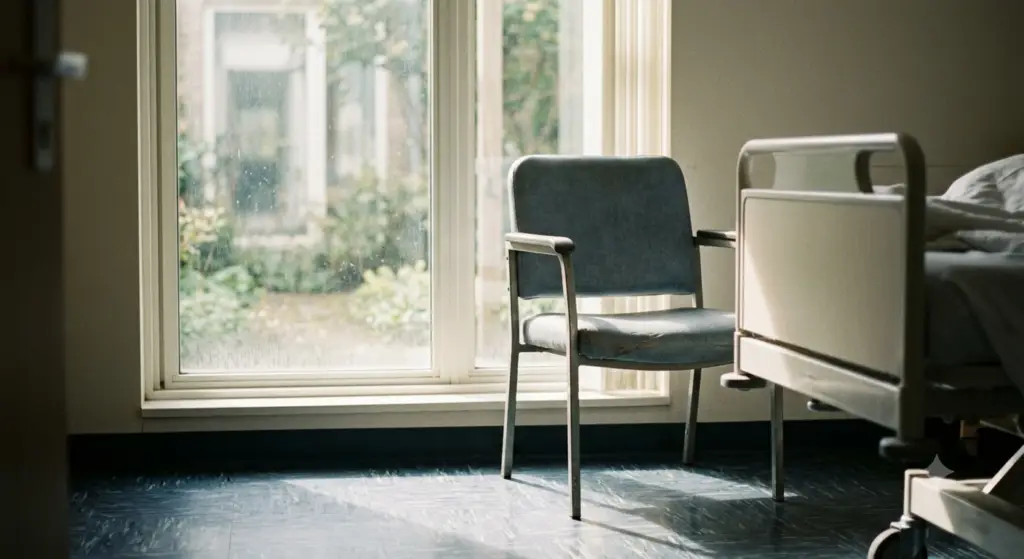
The Box Nobody Wanted to Add
Hospital discharge folders now carry a page most families don’t expect. Alongside the medication schedule and the follow-up appointment card sits a short checklist that has nothing to do with the patient at all — questions about sleep, appetite, and how many days it has been since the caregiver spoke to another adult who wasn’t a nurse or a doctor.
Several hospital systems added it after readmission data kept pointing to the same pattern: the person managing the pill organizer, the feeding schedule, and the 2 a.m. alarms was quietly deteriorating alongside the person they were caring for, and nobody was tracking it until it became an emergency of its own.
A report released last year gave that deterioration a number. Roughly 63 million Americans are now providing unpaid care for a family member, and close to one in four of them report feeling socially isolated — a figure researchers describe as rising, not stabilizing.1 The isolation is worse for women, for LGBTQ+ caregivers, and for anyone who took on the role without feeling they had another option.
The pattern shows up again and again in caregiver interviews and support-group transcripts, no single account but a recurring shape: a feeding pump reset at 2 a.m., a dinner cooling untouched three rooms away, a phone that hasn’t rung with a friend’s name in weeks. It isn’t a diagnosis of any one person. It’s a shape the data keeps drawing on its own.
A few weeks ago, this space looked at a different kind of solitary chair — the counter seat built for one, in Party of One, where an entire hospitality industry has quietly redesigned itself around the diner who prefers to eat alone. That chair is chosen. It can be left at will, and increasingly it’s built for comfort. The chair by the hospital bed is a different piece of furniture entirely — nobody selects it from a menu, and for the person in it, getting up is rarely an option.
The Sickroom That Swallowed a Household
The idea that caring for the sick is a private, domestic, and largely invisible task has a long history in the American and British household, and it has a name historians still use: the “Angel in the House,” borrowed from Coventry Patmore’s mid-nineteenth-century poem of the same title. The phrase described an ideal of Victorian womanhood built around selfless service inside the home — and nursing a sick husband, child, or parent sat near the center of that ideal.2
Scholars who have studied nineteenth-century domestic medicine manuals and family periodicals have identified two competing images of the woman-as-nurse that circulated at the time: one romantic, the moral center of the household holding the family together through quiet strength; the other unromantic, the manager who actually performed the physical labor of illness — the boiled linens, the fever watches, the medicine measured out by candlelight.3 Both images described the same woman. Neither included the possibility that she might need care herself.
What made this arrangement so durable wasn’t cruelty. It was architecture. A household with a sickroom in it reorganized its entire rhythm around that room — visitors were discouraged, outings canceled, the caregiver’s social calendar quietly emptied without anyone deciding to empty it. The Victorian home didn’t isolate its caregivers on purpose. It simply built a structure in which isolation was the default output, and no one built a corresponding structure to interrupt it.
The professionalization of nursing later in the century, largely through Florence Nightingale’s model, gave paid nurses training, uniforms, and eventually public respect. It did nothing for the daughter, wife, or mother doing the same work at home for free. If anything, it sharpened the division: skilled care now had a visible, credentialed home in the hospital, while unskilled love — the kind performed by family, for family, without pay — stayed exactly where it had always been, behind a closed bedroom door.
That split did not close in the century and a half since. It relocated. The sickroom became a spare bedroom with a hospital bed rented by the month, and the woman who once sat beside it with a basin and a Bible now sits beside it with a phone full of pharmacy reminders and a laptop open to a portal she doesn’t fully understand. Visiting hours have given way to visitor fatigue — friends who meant to check in, then didn’t, then felt too guilty to start. The furniture changed. The isolation did not.
What Scripture Assumes About the Ones Who Serve
Scripture is unusually attentive to the person doing the caring, not just the person being cared for — and it rarely lets the caregiver’s own exhaustion pass without comment.
“But Martha was cumbered about much serving, and came to him, and said, Lord, dost thou not care that my sister hath left me to serve alone? bid her therefore that she help me. And Jesus answered and said unto her, Martha, Martha, thou art careful and troubled about many things” (Luke 10:40–41, KJV).
Jesus doesn’t respond to Martha’s complaint by redistributing the labor. He doesn’t send Mary to the kitchen, and he doesn’t rebuke Martha for the act of serving itself. Instead, he speaks her name twice — a gentle, deeply personal address — and names her internal condition before he says anything about the meal. The text restores Martha’s identity before it rearranges her schedule. The problem was never that she served. It was that her serving had curdled into an isolation she hadn’t chosen, and Jesus meets that condition first, not the to-do list underneath it.
“And Ruth said, Intreat me not to leave thee, or to return from following after thee: for whither thou goest, I will go; and where thou lodgest, I will lodge: thy people shall be my people, and thy God my God” (Ruth 1:16, KJV).
What Ruth offers Naomi is not sentiment. The Hebrew tradition names this kind of loyalty hesed — a covenant faithfulness that binds one person’s fate to another’s when there is no possibility of repayment. Ruth’s vow costs her precisely what modern caregivers report losing: her homeland, her people, her own place to belong. But hesed, unlike a one-directional sacrifice, was never meant to run in only one direction. Naomi, empty and bitter at the start of the book, becomes the one who eventually secures Ruth’s future in Bethlehem. The caregiver and the cared-for turn out to need each other’s presence in ways neither could have predicted at the city gate.
“Bear ye one another’s burdens, and so fulfil the law of Christ” (Galatians 6:2, KJV).
Paul doesn’t write this command in the singular. “One another” is plural on both ends — it describes an arrangement, not an exhortation aimed at whichever individual happens to be strongest. Read this way, a caregiver’s quiet deterioration isn’t a personal shortfall in faith or resilience. It’s an assignment the people around her haven’t yet picked up.
Scripture does not require that every catastrophe be interpreted as divine judgment; it does, however, insist that societies eventually reveal the moral conditions under which they have chosen to live.
None of these passages suggest that caregiving itself is the problem, or that Martha, Ruth, or any modern caregiver erred by staying. What they hold up, together, is a pattern: caregiving was never meant to be carried by one set of hands while everyone else’s stayed empty.
The Numbers Behind the Diagnosis
A separate analysis, drawn from the National Study of Caregiving and published through the Journals of Gerontology, put a finer point on the same picture: among roughly 24 million family caregivers of older adults, about 12 percent met criteria for social isolation and 27 percent reported loneliness — figures researchers flagged as a public health concern in their own right, independent of the health of the person being cared for.4
The demographic pattern inside that data is worth sitting with. Caregivers who felt they had no real choice in taking on the role — no siblings to share it, no financial way to hire help, no spouse to split the load — reported isolation at meaningfully higher rates than caregivers who chose the role freely. So did LGBTQ+ caregivers, who are statistically less likely to have the kind of extended family network that traditionally absorbs some of the load.
There is also a financial layer to the isolation that rarely makes it into the theological conversation. A caregiver who reduces work hours or leaves a job to manage a parent’s care doesn’t just lose income — she loses the coworkers, the office friendships, and the daily structure that a job quietly provides. Isolation compounds: fewer hours outside the home produce fewer relationships outside the home, which produces less support for the caregiving itself, which produces still fewer hours free. Middle-aged women remain the single largest group carrying this weight, often while simultaneously raising their own children — a position now commonly called the “sandwich generation,” squeezed on both sides with no additional hours added to the day.
The Labor That Has No Off Switch
The isolation described here is structurally different from the kind explored a few weeks ago in the solo-dining data. A diner eating alone can, at any point, invite someone to join, cancel the reservation, or simply leave. The caregiver’s isolation isn’t a preference the market accommodated. It’s a side effect of a role that was never built with an exit built into it. There is no counter seat facing the kitchen for the person managing a parent’s medication schedule at 11 p.m. — there is only the next task, and the one after it.
This is also why caregiver isolation resists the usual remedies offered for loneliness generally. Advice to “reach out to a friend” or “join a group” assumes a category of person with discretionary hours to spend. A caregiver managing feeding tubes, medication timing, and a job on top of it often has none of those hours left over, for anyone, including herself. The isolation isn’t a failure of effort. It’s the predictable result of a role that consumes exactly the hours a person would otherwise use to stay connected to other people.
What the historical record and the modern data agree on is this: a society has never lacked people willing to care for the sick, the aging, and the dying. A caregiver’s quiet deterioration is not a personal failure of faith or emotional resilience; it is a congregation’s unmet assignment — the very obligation named plainly in Galatians 6:2, and just as plainly absent from most family caregivers’ actual week.
The Vigil No One Relieves
None of this argues that caregiving is a burden to escape, or that loving a parent, spouse, or child through illness is a mistake requiring correction. Scripture never frames the willingness to sit by the bed as the problem. Ruth’s vow is treated as the beginning of restoration, not a cautionary tale.
The harder question isn’t why so many Americans are caring for the people they love. That answer is simple enough — love asks it of them, and most don’t hesitate. The harder question is why the hospital had to invent a checklist to notice what the church, the neighborhood, and the extended family used to notice on their own: that the person keeping the vigil needs someone to occasionally sit with them in it.
The circle around that chair can still be rebuilt. It rarely requires a grand structural reform to start — often, it begins with one person willing to take the first shift. A hot meal brought without being asked for. An afternoon quietly covered so the person carrying it can step outside for an hour. The first person who chooses to sit down beside that chair alters the trajectory of a family’s solitude. In doing so, they remind a congregation of what it was always meant to be.
1. AARP, “New Report Reveals Crisis Point for America’s 63 Million Family Caregivers,” 2025.
2. Coventry Patmore, The Angel in the House (1854–1862), as discussed in Sage Reference Encyclopedia of Motherhood, “Angel in the House.”
3. Claire Furlong, cited in Old Operating Theatre Museum, “Women, Medicine Chests, and Family Health in the 19th-Century Home,” 2022.
4. National Study of Caregiving IV, Journals of Gerontology, as reported in caregiver isolation research summaries, 2026.
New essays every week. Delivered quietly.