HOOK
A Warning That Arrived in the Same Breath as a Funeral Count
Kahambu Deborah is forty years old and has six children. Her farmland sits outside Mongbwalu, a mining town in Ituri Province, and for months rebel violence had already made that farmland hard to reach. Then Ebola containment measures closed the roads a second time, for a second reason. She is not a statistic yet — only a woman still walking toward a field that keeps moving further away.1
On July 29, the World Food Programme’s acting executive director stood in the same province and described what he was watching in three words: a crisis on top of a crisis. UN officials have called the outbreak behind him the fastest-growing Ebola epidemic ever recorded — more than 3,300 confirmed cases, over 1,400 deaths, and a single twenty-four-hour period in late July in which fifty people died of the virus alone.
The number that took longer to make headlines was the second one. Across the forty-eight health zones now affected, more than 2.6 million people face acute food insecurity, and roughly 628,000 have already crossed into emergency-level hunger. Ituri itself was already one of the country’s worst hunger hotspots before a single Ebola case was confirmed there.
The mechanism connecting Kahambu Deborah’s two obstacles is not mysterious. Border closures. Movement restrictions. Bans on gatherings, which in rural Congo often means bans on the markets themselves. Every measure epidemiologists consider necessary to stop a hemorrhagic virus with a fatality rate near 40 percent is, simultaneously, a measure that stops a mother from reaching a field she was already struggling to reach.
HISTORICAL CASE
The Wall Built to Save a Region That It Also Starved
Last time, this space examined a drought in southern Madagascar with no author at all (see The Field Between Two Skies). Ituri is the opposite case: a crisis with an author acting in good faith, which turns out to create its own kind of damage.
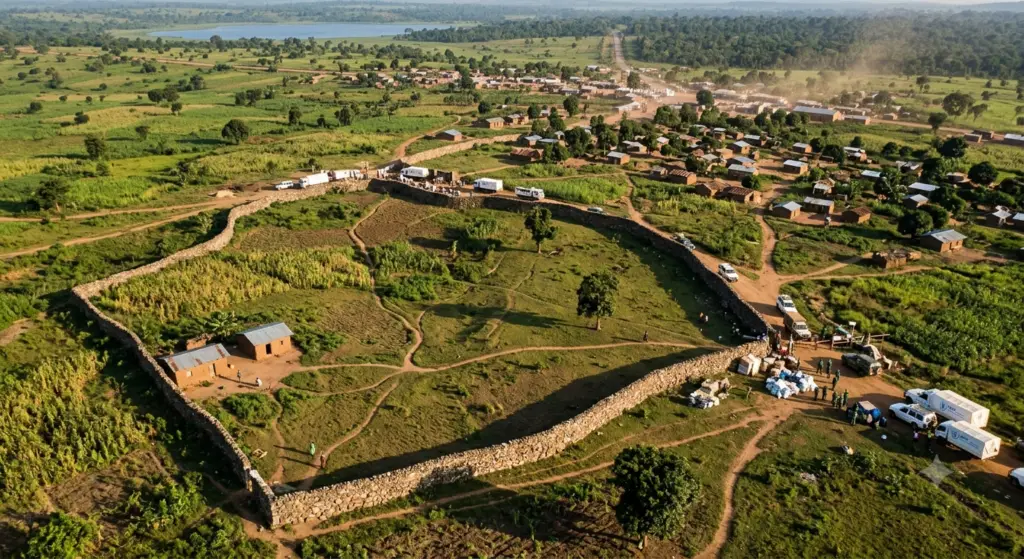
In the spring of 1720, plague reached Marseille aboard a merchant ship carrying silk and cotton from the Levant. Within months the disease had killed perhaps half the city’s population. The response — enforced with royal backing from Paris, in close coordination with the provincial estates and parish authorities of Provence — was to build what became known as the mur de la peste: a wall of dry stone stretching roughly twenty-seven miles across the hills of the Vaucluse.
Local records describe conscripted laborers stacking fieldstone by hand through the summer of 1721, working fast enough that whole sections rose in weeks. Carts loaded with grain from villages on the far side arrived at the line and simply stopped there, unloaded onto nothing, because there was no longer a road through. Historian Cindy Ermus, in her research on the Marseille plague, has documented how the cordon sanitaire produced its own secondary emergency — one measured not in infections but in the price of bread in villages that had never seen a single plague case.2
The wall worked, in the narrow sense that historians generally credit it with slowing the disease’s spread. It also cut off the ordinary grain trade feeding dozens of towns nowhere near an infected household. Congo’s forty-eight health zones are not behind a stone wall — they are behind checkpoints and a shrinking list of roads officials consider safe — but it is the same wall, three hundred years younger, built by the same good intentions, producing the same shadow crisis.
BIBLICAL LENS
The Ones Already Standing Outside the Camp
“All the days wherein the plague shall be in him he shall be defiled; he is unclean: he shall dwell alone; without the camp shall his habitation be.” — Leviticus 13:46 (KJV)
Scripture does not require that every catastrophe be interpreted as divine judgment; it does, however, insist that societies eventually reveal the moral conditions under which they have chosen to live.
The instruction in Leviticus is not cruelty. Ancient Israel had no germ theory, but it had centuries of observed contagion, and the isolation law functioned as the era’s best available public health measure. The law commands quarantine. It does not, anywhere in the text, command forgetting the quarantined — and that distinction is the hinge the rest of this story turns on.
The clearest narrative working-out of that law sits three books later, during a siege of Samaria so severe the text records mothers negotiating to eat their own children. Outside the city gate — already outside, by law, before the siege ever began — sat four men with leprosy.
“And there were four leprous men at the entering in of the gate: and they said one to another, Why sit we here until we die?… Now therefore come, and let us fall unto the host of the Syrians: if they save us alive, we shall live; and if they kill us, we shall but die.” — 2 Kings 7:3-4 (KJV)
Read quickly, that line sounds like men gambling on a chance at survival. Read slowly, it says something closer to the opposite. Why sit we here until we die is not the question of men looking for an exit. It is the question of men who had already finished grieving their own deaths and were simply choosing which direction to face while it happened.
“Then they said one to another, We do not well: this day is a day of good tidings, and we hold our peace… now therefore come, that we may go and tell the king’s household.” — 2 Kings 7:9 (KJV)
The four men were never inside the famine, technically — Leviticus had put them outside the camp long before Samaria’s granaries ran dry. And yet the famine reached them anyway, exactly as fully as it reached everyone behind the wall. What the text records next is not a rescue. It is a report. The four men do not storm the palace or distribute the grain themselves; they simply refuse to keep what they have seen to themselves. They are the loneliest witnesses in the story — outside every system, owed nothing by the city that excluded them — and the only ones positioned to see the collapse before the city itself did.
PATTERN INSIGHT
The Second Bill, Arriving After the First Is Already Paid
The World Food Programme’s current ask for Congo is $293.6 million over six months — funding for logistics, food assistance, and the work of keeping delivery trucks moving through checkpoints designed to stop exactly the kind of movement those trucks require.3 That figure is not the cost of fighting Ebola; the medical response has its own separate budget. It is the cost of the crisis the containment measures created on top of the first one.
A quarantine line is never just a line around a disease. It is also a line around every ordinary transaction that used to cross that space. Every quarantine draws two maps at once. One marks infection. The other marks interruption — and the second map is almost always larger than the first, because interruption spreads through networks infection never touches: the buyer who never shows up, the truck that turns back, the wage that stops arriving three villages from anyone actually sick.
The same double map appears anywhere a state restricts movement for good reason and pays for it later. A military blockade produces the casualties everyone counts, and a second, quieter toll made of the farms nobody could reach while it held. A mandatory evacuation zone after a climate disaster produces the headline flood, and a second bill written months later in the businesses that never reopened because the roads back in stayed closed longer than the water did. The policy is rarely the villain. The invoice that arrives after the policy, once the emergency has already been declared solved, is where the structural blind spot tends to live — and it is almost never sent to whoever signed off on the policy in the first place.
What separates Congo’s version from every other food crisis this series has traced is that there is no obvious villain to blame for the second bill, and no obvious way to avoid paying it. Loosen the checkpoints and the virus spreads faster. Keep them tight and hunger spreads faster. WFP’s own language — food assistance as frontline containment — is really an admission that there is no clean answer, only a race to fund both problems before either outruns the other.
This is the same dilemma handed to the four men at Samaria’s gate, just inverted. Leviticus had isolated them for reasons that made sense on their own terms. The siege then handed them a second crisis the isolation law had never anticipated and could not solve. They did not choose between the two problems any more than Kahambu Deborah chooses between a rebel-blocked road and an Ebola-closed one. What they chose, once they had stumbled onto an answer neither crisis had prepared them for, was what to do with it.
CLOSING
What the Wall Was Never Built to Stop
Ituri’s checkpoints will come down eventually, the way the stone wall across Provence eventually came down once plague burned itself out three centuries ago. What tends to outlast the wall is the second crisis it built without meaning to, the one still running for months after the emergency that justified the wall has already passed.
Skau called what he saw in Ituri a crisis on top of a crisis, and the phrase holds because it refuses to pretend the two layers are one problem wearing different names. One is a virus. The other is a market that a virus’s containment happened to close on a woman named Kahambu Deborah, who is still, as of this writing, trying to reach her own field. Scripture’s account of Samaria’s gate never resolves which crisis the four men should be understood as suffering from first. It simply records that both were true at once, and that the men with every reason to say nothing chose to say something instead.
Every wall keeps something out. But every wall also keeps someone waiting on the other side of it, for as long as the wall stands. The harder question a checkpoint never answers on its own is not whether it was right to build. It is whether anyone on the inside is still keeping track of who got left standing at the gate — and whether, when the news finally reaches them, it will still be worth carrying.
Sources: WFP · Associated Press (2026.07.29) · UN News · IPC, DRC Acute Food Insecurity Analysis (2026) · Cindy Ermus, research on the 1720–1722 Marseille plague · WFP, “2026 Ebola outbreak: Key facts” (2026)
1. Associated Press reporting, filed July 29, 2026, from Mongbwalu, Ituri Province, DRC.
2. Provence’s plague wall (mur de la peste) was built in 1721 under royal authority in coordination with local Provençal governance; documented in regional archives and academic accounts of its economic effects on non-infected villages.
3. WFP’s six-month funding requirement for logistics, food assistance, and Ebola-response support across affected eastern provinces, per the July 29, 2026 UN briefing.
New essays every week. Delivered quietly.