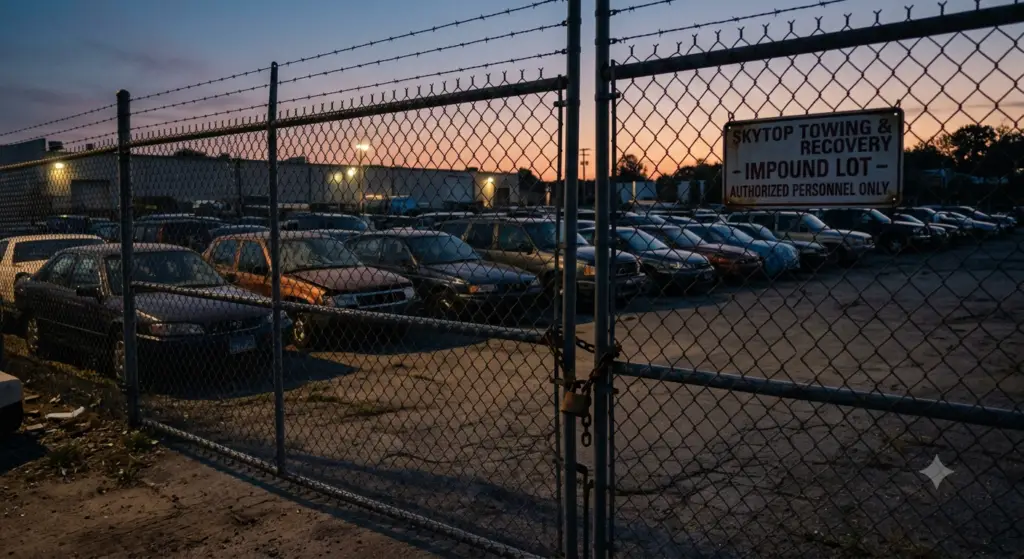
A Parking Lot in Meriden, Cars That Never Came Back
This spring, a Pulitzer board sat in a room in New York and gave its prize for local reporting to a story about parking lots.
Not battlefields. Not courtrooms with famous names on the docket. Parking lots — the kind with cracked asphalt and a chain-link fence, in towns like Meriden and Hartford, Connecticut, where a car sits under a tarp until someone with the right paperwork decides what happens to it next.
The investigation, published by The Connecticut Mirror and ProPublica and later honored with journalism’s highest prize, documented something almost too mundane to sound alarming — as the two newsrooms reported when their reporting won the Pulitzer Prize for local reporting in 2026. A home care worker helping a patient down the stairs came back outside to find her car gone. A young man mistakenly left his parking sticker in the wrong spot and, within weeks, lost the vehicle that got him to work. Two other drivers, Magana and Bennett, never got a phone call at all — their Hummer and their PT Cruiser simply sat behind a padlocked gate at a company called Skytop, waiting to be sold.
Connecticut law let towing companies petition to sell a seized car after just fifteen days. It was one of the shortest windows of its kind in the country. Storage fees piled up daily, cash-only in many cases, until the amount owed exceeded what the car itself was worth — and the debt became, in practice, a kind of quiet confiscation.
What makes the story land somewhere deeper than outrage is a detail the reporters surfaced along the way: a state employee, tasked with overseeing the very system meant to protect drivers, was found selling some of those same cars for profit on the side, according to their 2026 findings. The people entrusted with the gate were the ones who benefited most from what passed through it.
None of this required a villain twirling a mustache. It required a system efficient enough, and quiet enough, that no single person had to feel responsible for what it took from the people who could least afford to lose it.
Rome Had a Word for This, and It Was Not Kind
Long before Connecticut wrote its towing statutes, Roman law had already worked out, in exacting detail, how a creditor could lay claim to what a debtor owned.
Under the practice known to legal historians as pignus — the pledge — a creditor could seize a debtor’s property as security for unpaid debt. But early Roman law went further than a modern lien ever could. Under the harsher arrangement known as nexum, the collateral did not stop at tools or land. Roman legal historians have traced how the claim on a defaulting debtor moved in stages: first the harvest, then the field itself, and finally — when neither sufficed — the debtor’s own body and labor, bound over to the creditor as living security.1 A man could, in effect, become collateral for his own debt.
The parallel to a modern tow yard is not that the mechanisms are identical. They are not. No one in Meriden is being sold into bondage. But the underlying logic survives with unsettling clarity: when a claim is permitted to expand without a fixed edge, it does not usually stop at convenience. It moves toward whatever the debtor cannot afford to lose — because that is precisely what guarantees payment.
Rome did not abolish debt. It did something narrower and, in its way, more durable: it drew a boundary between what a person owes and what a person is. The Lex Poetelia Papiria, passed around 326 BCE, formally ended nexum and forbade the outright bondage of debtors for unpaid loans. Historians of Roman law regard it as one of the earliest recorded instances of a legal system distinguishing a debtor’s obligations from a debtor’s personhood1 — not a claim that Rome had solved exploitation for all time, since debt bondage and its cousins would resurface in other forms for centuries after. Only that, on this one point, the law had located a line worth drawing at all.
That older question — where a legitimate claim is required to stop — is where this story is actually headed.
A Cloak Returned Before Nightfall
“If ever you take your neighbor’s cloak in pledge, you shall return it to him before the sun goes down, for that is his only covering, and it is his cloak for his body; in what else shall he sleep? And if he cries to me, I will hear, for I am compassionate.” (Exodus 22:26-27, ESV)
“No one shall take a mill or an upper millstone in pledge, for that would be taking a life in pledge.” (Deuteronomy 24:6, ESV)
“Do not rob the poor, because he is poor, or crush the afflicted at the gate, for the LORD will plead their cause and rob of life those who rob them.” (Proverbs 22:22-23, ESV)
What is striking about these three texts, read together, is how specific they are about which possessions cannot be taken. Not any garment — the one someone sleeps in. Not any tool — the millstone, without which a household cannot grind its own grain and simply stops eating. The law does not ask creditors to forgive debt. It draws a single, narrow line: whatever a person needs merely to keep living cannot be the price of what they owe.
A car in 2026 America occupies almost exactly that category for a home care worker whose shift starts before sunrise. It is not a luxury pledged carelessly. It is the millstone — the thing that, once removed, does not just cost money but removes the means of earning any money at all.
The Bible’s concern here is not sentimental. It is structural. It regulates the exact point where an ordinary legal mechanism — a pledge, a debt, a lien — quietly crosses into something that starves a household. And it places the burden of noticing that line not on the poor, but on whoever holds the power to enforce it.
Where a Claim Is Allowed to Stop
The Connecticut towing statute was not designed maliciously. Almost no exploitative arrangement is designed maliciously — it is designed efficiently, and efficiency, left unexamined, tends to slide toward whoever benefits fastest.
Fifteen days is fast. It is fast enough that a driver working two jobs, without reliable mail delivery to a current address, could lose the legal window to reclaim their car before they even learned it had been sold. The investigation found that towing companies frequently relied on outdated registration addresses, so notice letters went to apartments people had long since left. The arrangement was not failing to notify people. It was succeeding, exactly as built, at a speed that made notification nearly beside the point.
Within a year and a half of publication, Connecticut lawmakers passed reforms with near-unanimous bipartisan support — extending the sale window, requiring credit card payment options, mandating advance warning before a tow from an apartment lot. But the more durable lesson sits underneath the specific fix. Every claim — a debt, a lien, a legal pledge — has to stop somewhere short of the debtor’s survival, or it stops being a claim and becomes something closer to a taking.
This is the deeper reason Exodus and Deuteronomy bother to specify which objects are off-limits, rather than simply commanding generosity. A vague appeal to mercy leaves the boundary to whoever holds the leverage — and leverage, left to define its own limits, rarely volunteers to shrink. The millstone law does something more exacting: it locates the one asset a household cannot lose without losing its ability to survive at all, and places that asset permanently outside the reach of any legitimate claim, no matter how legitimate the debt behind it.
Notice, too, what kind of law this is. Scripture does not simply urge the creditor to feel compassion and hope he acts on it. It draws a fixed perimeter around whatever a household needs to keep living — a boundary the claim itself is never permitted to enter, whether the creditor that day happens to be generous or not. It functions less like moral advice and more like architecture: a sanctuary built into the statute, so the protection holds regardless of who is standing on the other side of the ledger.
That is the harder inheritance this story leaves behind, once the specific reform is old news. A statute can be rewritten. A fifteen-day window can become thirty. Those fixes reach exactly as far as the law’s fixed perimeter — the sanctuary — is drawn. What they cannot reach is everything the letter of the law does not cover, which is where Deuteronomy’s older instinct still has work to do: that whoever holds a legitimate claim over someone poorer than themselves will ask, unprompted, what that person cannot survive without. Reform can close the worst structural gaps. It has never yet managed to install that instinct where the law’s perimeter runs out.
What the Ledger Does Not Draw
Somewhere in Meriden tonight, a fenced lot still holds cars behind a padlock, waiting on paperwork instead of people. Most will simply be reclaimed, quietly, by owners who scraped together the fee in time. A few will not be. The gate does not distinguish between the two kinds of stories; it only registers whether the payment arrived before the deadline.
What the ancient law understood, and what a fifteen-day statute nearly forgot, is that not all leverage is equal simply because it is legal. A debt is real. A pledge is a reasonable thing to ask for. But somewhere between the ledger and the person stands a line that Exodus insisted on drawing by nightfall, every single time: this is what he sleeps in; this is what she needs merely to keep her household fed. Cross that line, and the claim is no longer collecting a debt. It is taking a life in pledge, however careful the paperwork looks.
The reformers in Hartford did not quote Deuteronomy on the floor of the legislature. They did not need to. They had simply looked closely enough at a parking lot to see what an ancient shepherd-society had already worked out three thousand years earlier — that fairness is measured not by what power is permitted to take, but by what it has the discipline to leave alone.
Almost everyone, eventually, is handed a claim over someone with less leverage than themselves — a debt owed, a favor due, an advantage merely inherited. The cars behind that fence are still just cars. But the question resting quietly on that fence line will still be waiting the next time the leverage runs the other way, and it will not care what we were legally owed. It will only ask what we chose, in that moment, to leave behind.
1 On nexum, pignus, and the Lex Poetelia Papiria’s abolition of debt bondage in the early Roman Republic, see Alan Watson, Rome of the XII Tables: Persons and Property (Princeton University Press, 1975). On the Connecticut towing investigation, see The Connecticut Mirror and ProPublica, “On the Hook” series, 2026.
New essays every week. Delivered quietly.