HOOK
A Price Moved Before a Single Ship Did
On July 20, 2023, India’s government banned the export of non-basmati white rice, a policy built to keep an 11 percent rise in domestic prices from climbing further. Benchmark Thai rice — grown in a different country, shipped through different ports — rose 22 percent in the months that followed (IFPRI, 2024).
No cargo had yet been rerouted. No warehouse had yet gone empty. The price moved on the announcement alone, on the market’s understanding that a nation holding close to 40 percent of the world’s rice trade had just decided, quietly and without apology, that its own citizens came first.
By August 2023, weeks after the ban took effect, India’s own state rice stocks stood at 37.6 million tonnes — nearly three times the government’s own buffer norm (IFPRI/CGSpace, 2023). The shelves were not bare. The instinct to close the door anyway was.
This was not the first time a single exporter’s caution had rippled outward into someone else’s grocery bill. During the 2007–2008 food price spike, India, Vietnam, Egypt, and Cambodia each restricted rice exports within months of one another, and international rice prices rose faster than any harvest shortfall on record could explain.
Every government carries obligations that begin at home, and export restrictions are not, in themselves, irrational. Protecting a domestic population from inflation is a legitimate use of state power, and India’s own rural poor have as strong a claim on affordable rice as anyone abroad does. The deeper question is not whether that instinct is defensible. It is whether protecting one population’s entitlement to food can be accomplished without quietly dismantling someone else’s.
In the previous installment, we examined a blockade that starved a capital city by cutting the fuel that moved its food — trucks burning on the roads into Bamako, a nation’s bread supply broken three links downstream of the wheat itself. What follows here is an older, colder version of the same arithmetic: a famine where the grain in question never left the country at all, and people died in front of it anyway.
HISTORICAL CASE
Three Million Deaths Without a Crop Failure
In 1943, in the Indian province of Bengal, somewhere between two and three million people starved to death in a year when the region’s rice harvest was not, by most agricultural accounts, catastrophically short (Sen, 1981)1. The famine that killed them was not a famine of failed crops. It was a famine assembled, piece by administrative piece, out of wartime decisions that had almost nothing to do with how much rice actually existed in the province.
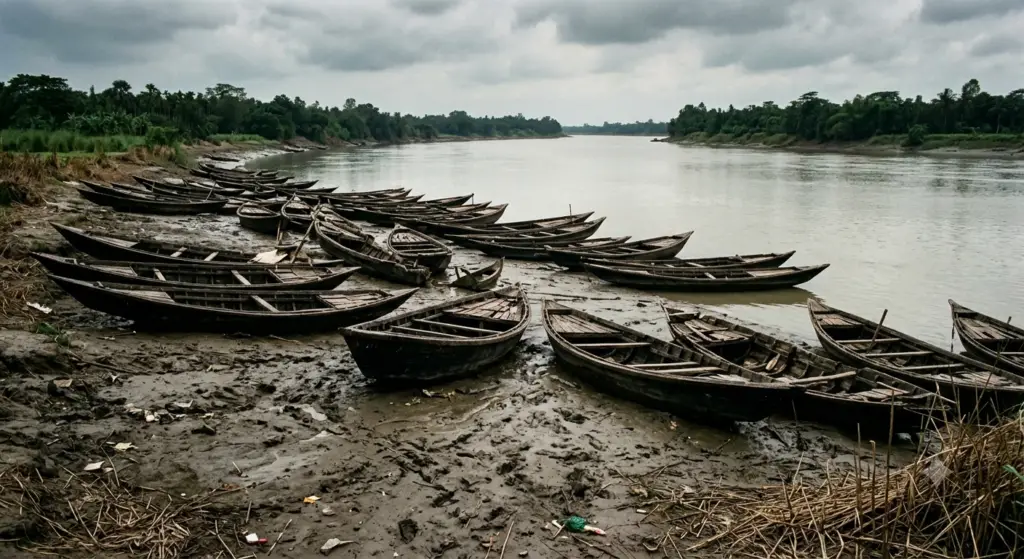
The trouble began the year before, in 1942, when Japanese forces took Burma and stood, for the first time, within plausible striking distance of eastern India. British colonial administrators, anticipating an invasion along Bengal’s coast, launched what internal documents called a denial policy — the deliberate removal or destruction of boats along the delta, so that an invading army would find no transport waiting for it if it landed.
The boats being denied to a hypothetical enemy were the same boats a very real fishing and farming population used to move rice, fish, and themselves through a landscape where rivers did far more work than roads ever could. Tens of thousands of vessels were seized, disabled, or destroyed within a matter of weeks. Alongside the boats, local rice stocks judged surplus to military need were removed from coastal districts under a parallel denial order, on the theory that an invader should find no supply either.
At almost the same time, provincial governments elsewhere in British India — worried about their own wartime shortages — began restricting rice exports to protect local supply, sealing Bengal off from the surplus regions that might otherwise have fed it. Calcutta, meanwhile, was absorbing a wartime population of soldiers, war-industry laborers, and administrators, and colonial priorities kept the city’s own markets stocked even as the countryside emptied around it.
None of this required a missing harvest. It required only that grain keep moving toward whoever the war had decided mattered most, and away from whoever it hadn’t. Rural laborers and fishermen — people whose entire claim on food ran through wages that collapsed as prices climbed — found themselves unable to buy rice that, in a strict market sense, was still there.
The shortage was never only in the fields.
Traders held stock rather than sell into a currency of collapsing government price controls, betting correctly that prices would keep rising. Contemporary relief accounts describe roads into Calcutta filling through the autumn of 1943 with landless laborers and fishermen’s families, walking for days on word that the city still had rice — arriving to find it priced for people who still had wages, which they, by then, no longer did.
Historians continue to debate how much weight to assign to wartime logistics, imperial priorities, administrative failure, and the decisions made by Britain’s wartime cabinet under Winston Churchill. What the documentary record makes hard to dispute is simpler: the famine was compounded by policy. It was not caused by a missing harvest.
The Bengal famine did not end because more rice arrived from somewhere. It ended, gradually, into 1944, when the war’s administrative pressures eased and grain began moving again along channels that had simply been shut for the better part of two years.
BIBLICAL LENS
A House of Bread With Nothing to Eat
Scripture never insists that a catastrophe must carry a verdict from heaven — but it does insist, again and again, that a people’s true priorities eventually surface, whether or not anyone intended them to be seen.
Centuries before economists had language for markets or entitlements, the book of Ruth opens on a famine with an irony built directly into its geography.
“In the days when the judges ruled, there was a famine in the land, and a man of Bethlehem in Judah went to sojourn in the country of Moab, he and his wife and his two sons.” — Ruth 1:1 (ESV)
Bethlehem means, roughly, house of bread. The text does not linger on this joke; it simply lets a family leave the house of bread to find food elsewhere, which is itself the entire argument of the chapter compressed into one sentence. Famine in this text is never an abstraction — it is a family walking out of a town whose name promises exactly what the town, at that moment, cannot provide.
Later in the same chapter, word arrives that reverses the direction of the migration.
“Then she arose with her daughters-in-law to return from the country of Moab, for she had heard in the fields of Moab that the Lord had visited his people and given them food.” — Ruth 1:6 (ESV)
The famine ends the way famines in this text tend to end — not through a dramatic miracle described in detail, but through a quiet restoration of ordinary supply, mentioned almost in passing, as if the narrator assumes the reader already understands that food returning to a hungry place is itself the event worth recording.
Ruth records what a family experiences on the receiving end of famine. Scripture does not stay there. A different text names the mechanism behind famine more directly — not scarcity as absence, but scarcity as something much closer to what happened in Bengal.
“Hear this, you who trample on the needy and bring the poor of the land to an end… that we may make the ephah small and the shekel great and deal deceitfully with false balances.” — Amos 8:4–5 (ESV)
Amos is not describing a shortage. He is describing merchants who cannot wait for a holy day to end so they can return to shrinking the measure and inflating the price — a market working exactly as designed, extracting the most from the people with the least power to refuse it. Ruth records what famine does to a family forced to move. Amos records what certain people do with a famine once it arrives. The distance between those two texts is roughly the same distance that separates a bad harvest from a policy decision.
Read together, Ruth and Amos sketch something the Hebrew Bible calls mishpat — a justice that is rarely satisfied by charity offered after the fact. Mishpat restores a functioning claim. It asks not whether the hungry were pitied, but whether they were let back into a system that was supposed to include them all along.
PATTERN INSIGHT
The Ledger That Was Never About Supply
History keeps returning to the same arithmetic.
The economist Amartya Sen spent much of his career elaborating a version of the same observation Amos made three thousand years earlier, though Sen arrived at it through Bengal’s own famine records. His central claim, later formalized as entitlement theory, was that famines are rarely caused by there being too little food in aggregate (Sen, 1981). They are caused by a collapse in specific people’s ability to command the food that exists — through wages, through prices, through rationing systems that quietly decide whose claim on the harvest still counts.
Bengal in 1943 fits the theory almost too cleanly. Rural laborers watched their wages fail to keep pace with rice prices inflated by wartime spending and hoarding, which meant their entitlement to food collapsed even in months when regional stocks, on paper, remained adequate.
Hunger is often not the absence of food. It is the disappearance of permission.
A decade earlier and a continent away, the same mechanism produced a far larger catastrophe under a very different flag. The 1932 Ukrainian harvest, while below target, was not by itself a catastrophic failure. The Soviet state requisitioned grain quotas from Ukrainian villages regardless, and requisition brigades searched homes for hidden reserves even as those quotas were met. Grain continued moving out of the republic — some of it exported abroad — while the villages that grew it starved. Historians estimate the resulting famine, now known as the Holodomor, killed several million people who died not at the edge of an empty field, but within sight of grain that had already been claimed by someone else.
Aggregate supply and human survival turn out to be two different ledgers, and history’s worst famines are almost never a story about the first one running dry. They are stories about the second ledger — the one tracking who still has a working claim on the food that exists — being closed to entire populations while the first ledger, technically, still balances.
This is the same ledger India’s 2023 export ban was quietly writing, at a far smaller scale and with far less loss of life. A country holding stocks nearly three times its own buffer norm chose to protect a domestic entitlement structure — its own citizens’ claim on rice — at the direct cost of entitlement structures in countries with no independent production to fall back on (IFPRI, 2023). Thailand’s 22 percent price spike was not a supply story either. It was the visible edge of a decision made in a warehouse thousands of miles from anyone who would end up paying for it.
Mali’s fuel blockade, examined in the previous installment, belongs to the same family of failure, even though its mechanism runs through diesel rather than export policy. In each case — Bengal’s boats, Ukraine’s requisition quotas, India’s export ban, Mali’s burned tanker trucks — the deficit that actually kills people sits one or two steps downstream of the resource itself. The bread breaks in almost the same place every time: not at the field, but somewhere in the space between the field and the mouth that needed what it grew.
CLOSING
What a Full Warehouse Can Still Mean
The rice that moved Thai prices in 2023 never had to leave an Indian port to do its damage. Neither did the boats denied to Bengal’s fishermen in 1942 ever face the Japanese army they were meant to stop — they simply sat disabled on riverbanks while the people who depended on them walked toward Calcutta instead. A market can register a scarcity that a warehouse audit would never confirm, because the thing actually running short is rarely the grain itself.
Bethlehem’s name did not stop being true during its famine; it simply stopped, for one season, being able to prove it. The family that left in Ruth’s opening verse was not fleeing an empty world — Moab, after all, had bread — but a house of bread that had, for reasons the text never fully explains, lost its claim on its own name for a while.
Readers with full pantries are not besieged, and nothing here argues otherwise.
Every famine, sooner or later, settles the same account. Not whether the food existed. But who was still permitted to reach it.
Sources: Amartya Sen, Poverty and Famines: An Essay on Entitlement and Deprivation (Oxford, 1981) · International Food Policy Research Institute (IFPRI), “India’s Export Restrictions on Rice Continue to Disrupt Global Markets, Supplies, and Prices” (2024) · IFPRI / CGIAR, “India’s Rice Export Restrictions and BIMSTEC Countries” (2023)
- Sen’s 1981 study, drawing on Bengal’s own famine inquiry records, remains the foundational academic account of the 1943 famine as a failure of food entitlement rather than aggregate food availability.
IFPRI’s 2024 market update tracks the benchmark Thai white rice price rising 22 percent following India’s July 2023 non-basmati export ban. An IFPRI-affiliated CGIAR report documents India’s state rice stocks at 37.6 million tonnes as of August 2023 — roughly three times the government’s own mandated buffer requirement at the time of the ban.
New essays every week. Delivered quietly.