A Docket With Ninety Names on It
On the last Tuesday of every month, a wood-paneled courtroom in Coffeyville, Kansas fills with people who owe money to the town’s only hospital. A ProPublica reporter who sat in that courtroom in 2019 counted ninety names on a single morning’s docket — men and women summoned by the hospital, by local doctors, or by the city’s own ambulance service over unpaid medical bills.
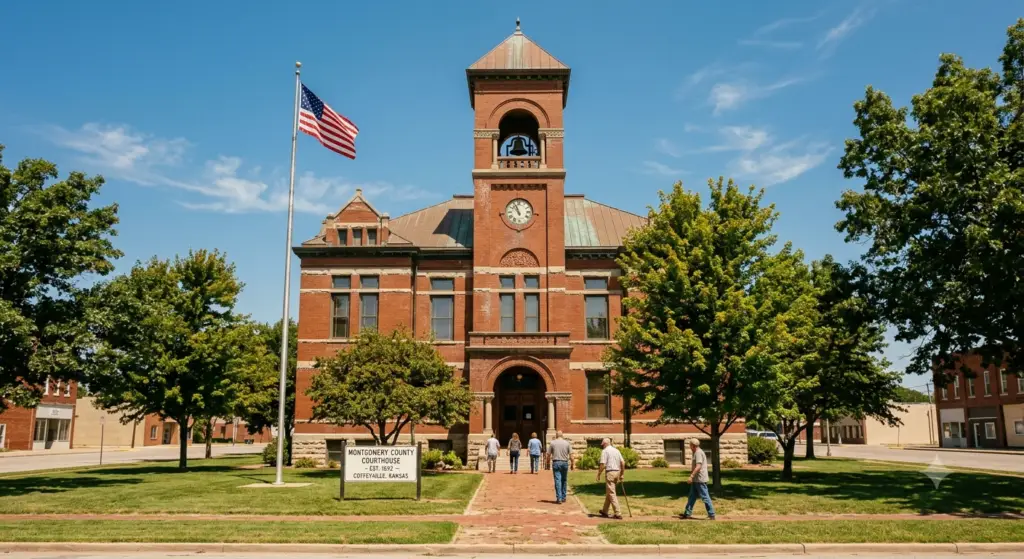
Coffeyville sits just over the Oklahoma line, population under ten thousand, the kind of town where the county courthouse and the grain elevator are still the two tallest things on the skyline. It’s better known, if it’s known at all, for a shootout more than a century old — the Dalton Gang tried to rob two banks here in 1892 and died in the street for it. These days the more ordinary drama plays out inside, on a folding chair, waiting for your name to be called.
July mornings in Montgomery County start cool and don’t stay that way. By the time the docket opens, the courthouse parking lot is already shimmering with heat off the asphalt, and the wait for a name to be called can stretch past an hour under a ceiling fan that mostly just moves the same warm air around the room.
Some people showed up in eye patches. Some limped to their seats on canes. All of them understood the same unwritten rule: skip the hearing, and a judge might sign a warrant with your name on it.
Tres Biggs, 41, was one of them. He worked two jobs while caring for a son with leukemia and a wife living with Lyme disease — the kind of schedule where a missed shift means a missed paycheck, and a missed paycheck means the hospital bill waits another month. Twice he missed the court-ordered “debtor’s exam,” a hearing Montgomery County uses to question people under oath about their finances. Twice was enough.
The debtor’s exam itself is a strange kind of hearing. It isn’t a trial. Nobody argues about whether the bill is owed — that question was settled, usually by default, months earlier. The exam exists only to ask a person, under oath, to list what they own: bank accounts, vehicles, wages, anything a judgment might eventually be collected against. A defense attorney is rarely present, because there’s rarely anything to defend. The whole proceeding lasts a few minutes, and the only real jeopardy in the room is whether you managed to show up for it.
He was arrested, strip-searched, hosed down, and issued a jumpsuit — over a hospital bill.
“You wouldn’t think you’d go to jail over medical bills,” he told the reporter. “I’m a country kid. I had to strip down, get hosed, and put a jumpsuit on.”
I read that investigation twice before I understood the incentive actually running underneath it. Bail in Montgomery County is set at $500 — ordinary enough, until you learn it isn’t refunded once someone shows up in court, the way it is almost everywhere else in the country. In Coffeyville, that money goes straight to the collection attorneys and the hospital that sued the person in the first place.
The people profiting from the arrest are the same people the arrested person already owed.
Debt, on its own, isn’t the danger here. Most of us carry some, and most of it never touches our freedom. Debt becomes dangerous the moment it turns into leverage over survival — the moment the thing being collected is no longer money owed but a person’s time, their liberty, their next paycheck before they’ve earned it. Everything in this story is downstream of that single hinge.
This isn’t the first courtroom this space has lingered in. In the previous installment, this space traced how a courtroom in Minneapolis took sixteen years to admit it had let a television crew write the ending to a murder trial before the jury did. This is the same building, wearing a different uniform. That was a courtroom moving too fast toward certainty. This is a courtroom that has quietly stopped distinguishing between a person who broke the law and a person who simply got sick and couldn’t pay for it.
The Prison America Thought It Had Closed
The United States is not supposed to jail people for owing money. Debtors’ prisons were common across Britain and its colonies well into the nineteenth century. Charles Dickens’s own father, John, was locked in London’s Marshalsea prison in 1824 over an unpaid debt to a baker, and the twelve-year-old Charles spent his afternoons visiting him there instead of in a classroom — an experience that would later surface, barely disguised, in Little Dorrit and David Copperfield.
American states didn’t wait for a novelist to make the case. Beginning in the early 1800s, one legislature after another wrote a version of the same sentence into its state constitution: no person shall be imprisoned for debt. By the 1830s, most of the country had abolished the practice outright.1 The reasoning wasn’t sentimental. Lawmakers had noticed that jailing a debtor accomplishes the opposite of what a creditor actually wants — a man in a cell cannot work, and a man who cannot work cannot repay anyone.
The irony is that the old ban never actually left the books. Kansas’s own constitution, like most states’, still carries a clause declaring that no person shall be imprisoned for a debt arising from a contract. It has sat there, technically in force, through the entire period Coffeyville’s warrants were being issued — because the arrests aren’t formally for the debt. They’re for contempt of the hearing about the debt, a distinction with no meaningful difference to the person in the cell, but enough of one, on paper, to keep the constitutional ban from ever being triggered. Strip away the paperwork and what remains is a civil debt wearing a criminal-court disguise — poverty relabeled, one hearing at a time, as defiance of the court.
The legal scholar Robert Cover spent much of his career arguing that judicial words are never just words — that a judge’s sentence, however calmly written, is backed by the same machinery that puts a hand on a person’s shoulder and a door between them and their family.2 A contempt order reads like paperwork. What it authorizes is a deputy, a squad car, and a cell. Coffeyville’s warrants are a case study in exactly the gap Cover spent his career pointing at: the distance between how coercive a legal instrument sounds and how coercive it actually is once someone shows up to enforce it.
The economics behind the gap are plain enough to fit on an index card. Kansas never expanded Medicaid, which leaves rural hospitals like Coffeyville Regional Medical Center absorbing costs that a program in most other states would have covered. The hospital reported roughly $1.5 million in uncollectible patient debt in a single recent year and filed the large majority of the county’s roughly two thousand medical debt lawsuits over five years. A private collections firm, paid in part from what it recovers, has handled the resulting warrants for hospitals across most of Kansas almost without exception — even though the hospitals themselves could instruct it to stop. Three forces, one outcome: an underfunded safety net, a contractor paid by results, and a courthouse willing to enforce the difference.
The courthouse side of that equation deserves its own look. Kansas, like many rural states, staffs its lowest-tier courts with magistrates who aren’t required to have passed a bar exam — a design built for the volume of small claims and traffic tickets a county this size actually generates, not for weighing a sick man’s liberty against a collections firm’s spreadsheet. When the same office handles both, the docket doesn’t distinguish between the two kinds of case as carefully as the stakes would suggest it should. A magistrate without formal legal training is, by definition, relying more heavily on the paperwork put in front of them — and the paperwork, in these cases, is drafted entirely by the party asking for the warrant.
Kansas is not the only place this particular loophole has quietly reopened. Reporting on medical debt collection has turned up similar contempt-based arrests in parts of Missouri and Utah, each one working through the same mechanism: a civil debt, a missed court date, and a criminal-adjacent tool — contempt, not debt — doing the actual jailing. The common thread isn’t one bad law passed by one bad legislature. It’s a gap between what the founding-era reforms explicitly banned and what a contempt statute, written for an entirely different purpose, happens to allow if nobody closes it.
The scale is easy to underestimate from the outside, because Coffeyville itself is small enough to sound like an outlier. It isn’t. The same collections firm that handles Coffeyville’s warrants works for hospitals in most of the state’s other counties, using the same contract terms, the same debtor’s-exam procedure, and, where local judges allow it, the same non-refundable bail. A mechanism this replicable isn’t really a Coffeyville story that happens to be true elsewhere. It’s a statewide arrangement that happens to be easiest to see from Coffeyville, because a reporter went looking there first.
A Warning Written for Lenders, Not Just Borrowers
“Then his master summoned him and said, ‘You wicked servant! I forgave you all that debt because you pleaded with me. And should not you have had mercy on your fellow servant, as I had mercy on you?'” (Matthew 18:32-33, ESV)
“No one shall take a mill or an upper millstone in pledge, for that would be taking a life in pledge.” (Deuteronomy 24:6, ESV)
“I brought charges against the nobles and the officials. I said to them, ‘You are exacting interest, each from his brother.’ … So they said, ‘We will restore these and require nothing from them. We will do as you say.'” (Nehemiah 5:7, 12, ESV)
Scripture does not require that every catastrophe be interpreted as divine judgment; it does, however, insist that societies eventually reveal the moral conditions under which they have chosen to live.
None of what follows requires treating scripture as a religious authority to find compelling. Read purely as legal history, the millstone law is a strong candidate for the oldest written safeguard of its kind on record — a society deciding, in writing, that a security interest has to stop before it touches a person’s means of survival.
The servant in Matthew 18 had just been forgiven an amount he could never have repaid in ten lifetimes, and within the same chapter he goes out and has a fellow servant thrown in prison over a debt worth a few months’ wages. The master’s fury in that story isn’t really about the size of either debt. It’s about a man who received mercy from an impossible distance and, within hours, refused to extend an ounce of it downward. The parable ends with the unforgiving servant delivered “to the jailers” — a phrase some translators render, more literally, as “torturers.” It’s a strange image for a story ostensibly about money, until you’ve read about a man with a son on chemotherapy standing in a Kansas courthouse hallway.
The law behind a millstone is oddly specific until you picture what a millstone actually is: the tool a household uses to grind that day’s grain into that day’s bread. Deuteronomy 24 doesn’t ban lending, or even collateral generally — a chapter later it explicitly allows a creditor to take a cloak as security, so long as it’s returned by sunset, since a poor man might have nothing else to sleep under (Exodus 22:26-27). What the law bans is taking, as collateral, the one object a family needs simply to survive the day. The line isn’t drawn around the debt. It’s drawn around the point where collection stops touching a person’s assets and starts touching their life.
Nehemiah 5 shows the same principle enforced against people with far more power than a Kansas hospital ever had. Jerusalem’s own nobles were charging their fellow Israelites interest during a famine, holding fields, vineyards, and even children as security, while the city wall was still half-rebuilt and everyone needed each other simply to survive the reconstruction. Nehemiah didn’t negotiate quietly or draft a policy memo. He called a public assembly, named the practice out loud, and made the lenders promise on the spot to give it all back — not eventually, not partially, but immediately, in front of witnesses. He adds, almost in passing, that he himself had been lending money and grain to the poor, and that he too would stop demanding repayment (Nehemiah 5:10). He didn’t ask the nobles to do something he wasn’t already doing.
Read together, a parable, a property law, and a public reckoning aren’t primarily instructions for the person who owes money. They are instructions for the person, or institution, holding the leverage — a consistent, ancient insistence that the law of God pays closer attention to what a lender is permitted to take than to what a borrower is obligated to give.
What the Numbers Are Actually Measuring
Over roughly a year, more than thirty arrest warrants were issued in Coffeyville over medical debt, and at least eleven people were jailed (ProPublica, 2019). In a city of under ten thousand people, that’s not a rounding error — it’s a meaningful fraction of the adult population passing through the same courtroom door for the same underlying reason. The judge who signs most of those warrants, under Kansas’s system for limited-jurisdiction courts, is not required to hold a law degree.
That’s not a flaw unique to Coffeyville, either — Kansas, like many states, allows non-lawyer magistrates to preside over exactly this tier of court, on the theory that debtor’s exams and small claims don’t require the training a felony trial does. The theory holds up fine for the cases it was designed for. It holds up less well once the same magistrate’s signature can end, functionally, in a jail cell for someone whose only offense was falling behind on a bill they never had a courtroom-grade lawyer to contest.
The warrant looked legal. The jail was legal. The debt was real. The injustice emerged only when every legal piece locked together.
The $500 bail is the detail that exposes the mechanism most clearly. In most American jurisdictions, bail exists to guarantee a court appearance and is returned once that appearance happens — it’s a deposit, not a fine. In Coffeyville it instead flows to the collection attorneys and the hospital, converting an appearance bond into a second, informal payment on the very debt that triggered the arrest. A bail that gets refunded exists to produce a court appearance. A bail that gets kept exists to produce revenue — and once revenue becomes part of what a warrant accomplishes, the incentive to issue fewer of them weakens considerably.
Nehemiah’s confrontation worked precisely because it made that kind of mechanism visible and then closed it immediately — not through a payment plan or a grace period, but full, public restoration, witnessed by the whole assembly, so the arrangement couldn’t quietly resume the following week. Modern debt-collection law carries a version of the same instinct, even if it rarely moves with Nehemiah’s speed. Federal fair-debt-collection statutes and most state exemption laws already recognize categories of “millstone” a creditor generally cannot seize — a primary vehicle needed for work, a modest amount of household goods, a portion of wages below a certain threshold.3 Coffeyville’s warrant system doesn’t formally violate those protections. It simply routes around them, using the leverage of the criminal justice system to accomplish informally what direct seizure of a millstone is no longer legally allowed to accomplish directly.
The gap between Nehemiah’s timeline and ours is worth naming plainly. Nehemiah fixed the problem in a single chapter, because the fix required nothing but a public assembly and a room full of people willing to give something back the same afternoon they were confronted. Reforming a contempt statute requires a legislature, a governor’s signature, and a news cycle loud enough that no lawmaker wants to defend the old version. That’s a slower kind of accountability, and it means the burden of noticing tends to fall, in the meantime, on whoever happens to be reading a small-town docket closely enough to ask the plain question out loud.
Congregations in towns like Coffeyville rarely think of hospital collections policy as a discipleship question, and there’s no reason they should have to reinvent Nehemiah’s public assembly to treat it as one. A church benevolence fund that quietly pays off a member’s medical judgment before it reaches a warrant does, in miniature, exactly what Nehemiah did — it closes the gap before the leverage gets used.
But a benevolence fund can only ever catch individuals, one warrant at a time, in the one town where someone happened to be paying attention. The gap itself is legislative, and it closes at that scale or not at all: a state law barring bail money from flowing to the plaintiff who requested the warrant, or requiring a licensed attorney’s review before any contempt warrant tied to a civil debt can be issued, would end the incentive in every county at once, not just the one a congregation happens to notice. It’s the same narrow fix this series traced in a Hartford towing statute — closing one specific door without ever answering the larger question of how much leverage any institution should be allowed to hold over someone already down to nothing. Nehemiah’s fix worked because it was public, immediate, and binding on everyone in the room. A statute is the modern equivalent of that room — the only version of “immediately, in front of witnesses” available to people who will never sit in the same courthouse as Tres Biggs.
The Millstone Nobody Named
Tres Biggs went back to work after his night in the Montgomery County jail. The docket kept its schedule the following month, and the month after that, ninety names deep again, the same wood-paneled walls holding the same quiet arithmetic they’d held the July before.
Every age finds a new shape for the same old temptation. The form changes — a mill, a cloak, a bail bond that never comes back — but the underlying pull doesn’t: a person with leverage over someone weaker, and a hundred locally reasonable reasons to use it. Deuteronomy 24 wasn’t written for Kansas. It was written for whichever century managed to invent its own version of a hospital that can also, quietly, become a jailer.
That’s the part no statute can fully close on its own. A law can ban a specific mechanism — bail flowing to a plaintiff, a contempt warrant issued without an attorney’s review — and each closed mechanism is worth closing. But the temptation the mechanism serves doesn’t retire with the law. It waits, patient as a millstone left standing in a field, for the next generation to forget why the line was drawn where it was.
Deuteronomy 24 never asked whether a creditor’s intentions were good. It asked what, specifically, was being taken, and whether the person doing the taking had noticed that a line had been crossed. That’s a narrower question than it sounds, and a more useful one, because it doesn’t require anyone in Coffeyville to be a villain. It only requires someone with the authority to ask, plainly, whether a $500 bail that never comes back is still a bail — or whether, sometime between the warrant and the jumpsuit, it quietly became something else.
1 On the history of imprisonment for debt and its abolition across American states in the early nineteenth century, see Peter J. Coleman, Debtors and Creditors in America: Insolvency, Imprisonment for Debt, and Bankruptcy, 1607–1900 (Madison: State Historical Society of Wisconsin, 1974). 2 On judicial language as an act backed by organized force, see Robert Cover, “Violence and the Word,” Yale Law Journal 95 (1986). 3 On statutory exemptions protecting a debtor’s essential property and wages from seizure, see the Consumer Financial Protection Bureau’s overview of the Fair Debt Collection Practices Act, consumerfinance.gov; and reporting on the Coffeyville warrants, ProPublica, “When Medical Debt Collectors Decide Who Gets Arrested,” 2019.
New essays every week. Delivered quietly.