Section I
The Timber That Built Everything and the Price No One Noticed
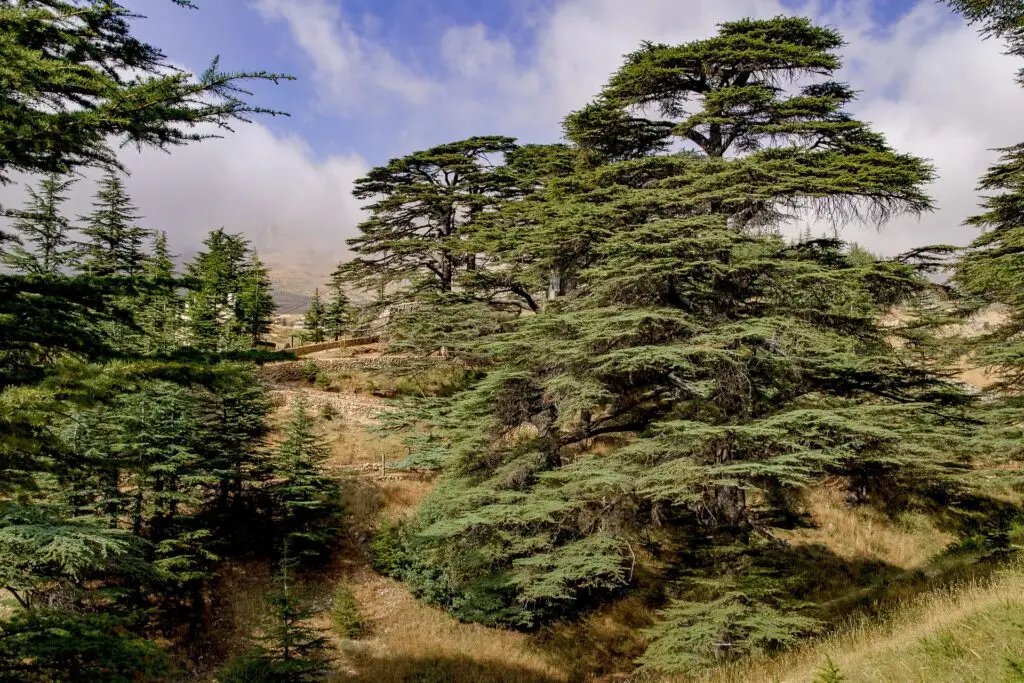
On October 8, 2023 — the morning after the Hamas attack on southern Israel — Hezbollah launched its first rockets from southern Lebanon across the Blue Line. The valley from which those rockets came is called the Beqaa. The mountains sheltering the launch sites are the same cedar-covered ridges that Hiram, king of Tyre, offered to Solomon roughly three thousand years ago.
The geography has not changed. The logic of that geography — who controls the high ground, who trades the timber, who builds the temple, and who eventually burns it — remains stubbornly unaltered.
This is not a coincidence to be explained away quickly. It is a pattern, and patterns deserve to be read slowly.
In the previous installment, we examined how Solomon’s trade networks and the archaeology of excess set the conditions for fracture. Read Part 2-1: The Weight of Gold →
Section II
A Supply Chain, a Civilization, and the Debt It Left Behind
To read 1 Kings 5 as a diplomatic pleasantry between two friendly kings is to miss the structural tension embedded in the transaction.
Hiram of Tyre controlled what the ancient Near East could not manufacture: the cedar of Lebanon. These were not decorative trees. In a region almost entirely deforested by Bronze Age demand, the forests of the Lebanon range were the strategic resource equivalent of Gulf oil in the twentieth century. Every major empire — Egyptian, Hittite, Assyrian, Babylonian — had sent envoys to Lebanon. The timber built warships, palaces, and the inner sanctuaries of gods. Control of the Lebanon range was, in the most literal sense, control of civilization’s infrastructure.
Solomon needed it. What he offered in return — wheat and pressed olive oil, primary agricultural goods — represented the perennially unequal bargain between a land-based agrarian state and a maritime commercial empire. The asymmetry deserves closer attention. Tyre supplied high-value processed materials (timber, skilled engineers, bronze craftsmen) and received in exchange bulk commodities. Israel appears to have entered a relationship of growing dependency upon a more technologically sophisticated partner — the precise terms remain debated, but the directional logic of the text is suggestive.
What followed bears some resemblance to what modern economists call resource dependency, though the ancient context does not map cleanly onto contemporary categories. The kingdom of Israel was being gradually reshaped by the economic logic of the partnership — not through conquest, but through the quiet gravity of trade.
What made this dangerous was not the cedar. It was the labor structure the cedar required.
To fulfill the quotas Hiram demanded — thirty thousand men in monthly rotations to the Lebanon highlands, eighty thousand stonecutters, seventy thousand carriers — Solomon implemented what the text calls mas, the forced levy (1 Kings 5:13–14, ESV). The same word appears in Exodus for Egyptian corvée labor. The same word the Israelites fled. Now Solomon, in the act of building God’s house, was doing to his own people what Pharaoh had done to their ancestors.
The temple was under construction. The fault line was already forming.
The Beqaa Valley sits between the Lebanon and the Anti-Lebanon mountain ranges in a geological rift formed by the same tectonic forces that shaped the Jordan River valley and the Dead Sea. It is one of the most strategically contested corridors in the ancient world. Egyptian armies moved through it. Hittite chariots wheeled in it. Alexander passed through it. The Crusaders built castles on its ridgelines.
The reason is simple: the Beqaa is the passage between the sea and the interior. Control the valley, and you control transit. You control what moves, what is taxed, what is blocked. The road runs between dust and stone, between the cedar shadow above and the dry plain below, and whoever holds that road holds the commerce of the region.
The Phoenicians of Tyre understood this instinctively. They were not a land empire. They were a network empire — ports, trade routes, colonies, and the maritime intelligence to connect them. Their power did not require occupying the Beqaa. It required that no one else could close the route. The Lebanon range was their natural wall. The cedar forests were their most powerful trade card.
This geographic logic never expired. When Hezbollah established its infrastructure in the Beqaa Valley beginning in the 1980s — with Iranian Revolutionary Guard assistance, in the fractured landscape left by Lebanon’s civil war — it was occupying the same strategic terrain that Phoenician merchants had guarded, that Crusader knights had contested, that Ottoman tax collectors had fought to hold. The mountain is the same mountain. The logic of high ground, concealment, and control of the transit corridor is the same logic.
The weapons are different. The pattern is not.
Section III
What the Text Hides in Plain Sight
The passage in 1 Kings 5 has the texture of a royal press release. Two kings, an exchange of letters, mutual expressions of goodwill, a deal concluded to the satisfaction of both parties. The narrator’s tone is almost cheerful.
But the biblical text is doing something more complicated than celebrating Solomon’s achievement. It is quietly constructing the evidence for the prosecution.
Three passages frame what is happening.
The first is Deuteronomy 17:16–17, where Moses instructs the future king of Israel explicitly:
“He must not acquire many horses for himself or cause the people to return to Egypt in order to acquire many horses… And he must not acquire many wives for himself, lest his heart turn away, nor shall he acquire for himself excessive silver and gold.” (Deuteronomy 17:16–17, ESV)
The prohibition is not incidental. It anticipates exactly what Solomon will do. The Torah’s political theology is that centralization — horses, foreign marriages, accumulated wealth — is the path to the destruction of the covenant community.
Solomon was reading the same Torah he was violating.
The second is 1 Kings 9:20–22, which clarifies that the forced labor did not fall on Israelites — then adds, almost immediately, the detail that Adoniram was in charge of the levy, the same Adoniram who will be stoned to death when Rehoboam tries to enforce the same labor policy in 1 Kings 12. The text places the information quietly, without commentary. The reader is expected to notice.
The third is 1 Kings 11:1–4, the account of Solomon’s foreign wives and their altars — including, specifically, an altar to Milcom on the hill east of Jerusalem, built for the Ammonite women in his household. The spiritual drift encoded in the economic dependency comes to its explicit conclusion here. The cedar-and-grain trade created the network of foreign marriages. The foreign marriages created the altars. The altars created the apostasy. The chain is traceable.
The economic system was not itself the sin. It became dangerous because it created conditions in which covenantal loyalty could gradually be displaced — not by a single decision, not by a moment of obvious rebellion, but by the slow accumulation of arrangements that each seemed reasonable in isolation.
The temple was completed. It was magnificent. And the conditions for its destruction were already embedded in the methods of its construction.
Section IV
The Dutch Republic, the Phoenician Network, and the Competence That Consumes
The parallel that illuminates Solomon’s dilemma most sharply is not from the ancient world. It is from seventeenth-century Amsterdam.
The Dutch Republic of the 1600s was, by almost every measure, the most remarkable civilization of that moment. Its merchant fleet carried more cargo than England, France, and Germany combined. Its artists produced more original paintings per capita than any society before or since. And it was explicitly, institutionally, self-consciously Calvinist — a nation bound by self-imposed covenantal obligations, whose Reformed church anchored its civic life.
It was also building an empire that required precisely the kind of moral compromises Calvinist theology condemned. The Dutch East India Company ran the spice trade through enforced monopolies and coerced labor, including the methodical destruction of competitive production in the islands of Banda and Maluku (Masselman, The Cradle of Colonialism, 1963). The Dutch governors of Batavia were, in their home churches, elders and deacons. They had developed a cognitive architecture that allowed the commercial world and the theological world to coexist without interrogating each other.
Solomon was building a remarkably similar architecture — with one crucial inversion. While the Dutch externalized their cruelty to distant shores, Solomon turned the machinery of state exploitation inward upon his own people. The tragedy ran in the opposite direction: not outward to the colonized, but downward through the levy, the rotation, the highland camp, the man cutting cedar for a house he would never enter.
The craftsmen Hiram sent were magnificent — Huram-abi, son of a Tyrian father and an Israelite mother, a master of bronze and cedar and fine linen (2 Chronicles 2:13–14). His competence was unquestionable. His presence required a reorientation of what “building the house of God” meant in practice: it meant working alongside a man whose father worshipped Baal, whose skills had been trained in a Phoenician religious context, whose aesthetic sensibilities were formed by a culture that had no Sinai and no Torah. The temple that housed the ark of the covenant was built, in part, by craftsmen whose communities had never heard the Shema.
This is not a reason to condemn the temple. It is a reason to take seriously the question the text will not let rest: what did the competence cost, and who paid it?
The question does not belong only to the ancient world.
Today, our institutions thrive on invisible costs. University endowments grow through investment portfolios whose underlying holdings are rarely examined for labor conditions or environmental impact. Church building campaigns are funded by industries whose ethics rarely face pulpit scrutiny. Even the artificial intelligence infrastructure supporting the screen you are reading from relies on data centers that consume the energy of entire nations, assembled under labor standards we would never tolerate at home.
The transaction looks different from the buying end. It always has.
Solomon saw the temple rising — its cedar paneling, its bronze pillars, the ark finally resting in a house of stone rather than a tent of goatskin. He did not see — or chose not to see — the thirty thousand men rotating through the Lebanon highlands, sleeping in temporary camps, away from their families for a third of every year, cutting timber for a house of God they would never be permitted to enter beyond the outer court.
The pattern insists: what we build reveals what we were willing to do to build it. And the biblical narrative, with characteristic patience, will eventually present the invoice.
Section V
The Timber Is Still There. So Is the Fault Line.
In 1982, when Israeli forces pushed into Lebanon during Operation Peace for Galilee, they advanced through the same terrain Solomon’s timber-carriers had traversed three millennia earlier. The cedar forests are mostly gone now — centuries of demand from empires that came and went reduced them to protected remnants on the upper ridges. But the mountain is unchanged. The Beqaa Valley is unchanged. The logic of who holds the high ground and why has not changed.
Hezbollah does not control southern Lebanon because it is strategically sophisticated, though it is. It controls southern Lebanon because the terrain rewards the defender, punishes the attacker, and has done so since the Bronze Age. The same features of the Lebanon range that made it valuable to Hiram — its verticality, its defensibility, its position between the coast and the interior — make it a natural fortress for whoever occupies it and refuses to leave.
What the pattern offers is not prophecy. It offers something more durable than prophecy: an account of why geography produces the same conflicts across centuries, and why the solutions that seem to resolve those conflicts — treaties, temple projects, economic partnerships — often contain within them the terms of the next disruption.
Solomon’s transaction with Hiram was successful by every measurable standard. The temple was built. The alliance held. The trade routes functioned. The diplomatic correspondence was cordial. And somewhere in the northern territories that Solomon had ceded to Hiram as partial payment for the cedar — twenty cities in the region of Galilee (1 Kings 9:11) — the seeds of the northern kingdom’s future alienation from Jerusalem were already germinating. Smoke in a still room. Not yet a fire, but already present.
Footnotes
1 Masselman, George. The Cradle of Colonialism. Yale University Press, 1963. The most comprehensive English-language account of VOC commercial and labor practices in the seventeenth-century East Indies.
2 All biblical citations follow the English Standard Version (ESV) unless otherwise noted. 1 Kings 5:13–14 (forced levy); 1 Kings 9:11, 20–22 (territorial cession and labor classification); 1 Kings 11:1–4 (foreign marriages and apostasy); Deuteronomy 17:16–17 (royal prohibition); 2 Chronicles 2:13–14 (Huram-abi’s lineage).
3 On the strategic geography of the Beqaa Valley and its role in successive imperial conflicts, see Kaplan, Robert D. The Revenge of Geography. Random House, 2012, pp. 161–178.
4 The word mas (מַס), denoting forced or tributary labor, appears in Exodus 1:11 in the context of Egyptian corvée and recurs in 1 Kings 5:13–14 and 9:15 in connection with Solomon’s building projects. The lexical parallel is not incidental; the Deuteronomistic historian’s audience would have recognized the resonance.