Section I
The Costs of Arriving Somewhere You Were Never Supposed to Stay
Watching the footage from the Arizona-Sonora border last spring, this ancient text felt suddenly present — families crossing a landscape that does not belong to them, carrying what they can, moving toward a sovereignty they do not yet understand.
The migration in Genesis 46 is quieter than that, but not simpler.
Jacob is 130 years old. He left Canaan once before, as a young man fleeing his brother’s rage, and spent twenty years in a foreign land before returning. He knows what it costs to arrive somewhere as an outsider. He knows what it costs to leave the land where his fathers are buried and where God has spoken. And he knows, now, that his son is alive in Egypt — and that Egypt is the only place where his family will survive the next seven years.
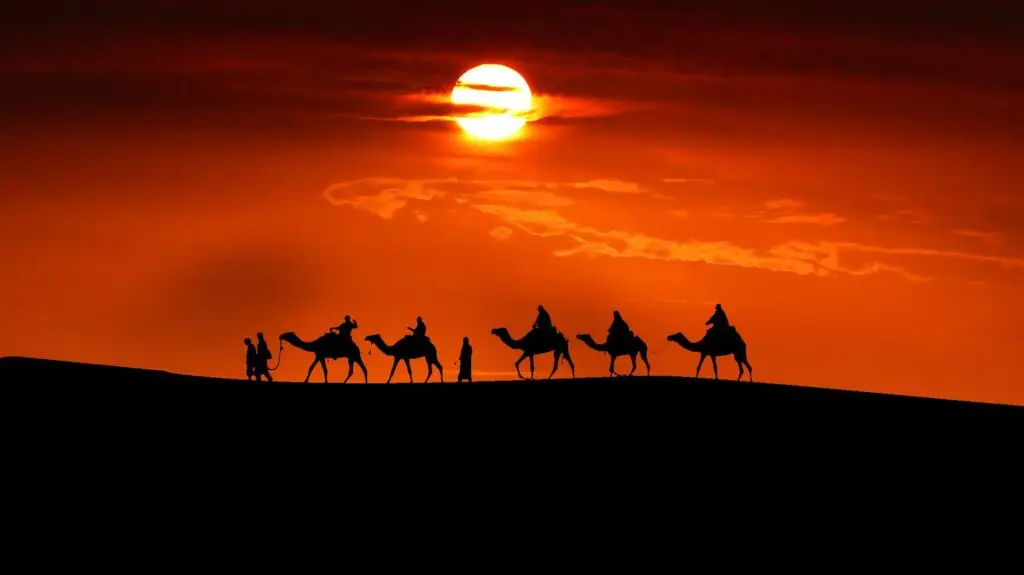
At Beersheba, on the edge of the wilderness, he stops and builds an altar. The text preserves the sacrifice as a deliberate act — not a farewell ritual performed out of grief, but a reckoning. He is about to cross a line that no patriarch of his line has crossed. God speaks in a night vision: Do not be afraid to go down to Egypt. I myself will go down with you, and I will also bring you up again. The permission is given. The promise is attached. And Jacob crosses the border with seventy persons.
What Genesis 46 and 47 record next is not a refugee story, exactly. It is something more structurally complex: the account of a single migrant family that arrived under a patron’s protection, secured the best land in the country through insider access, and watched from their enclave while the empire around them underwent the most consequential economic transformation of the ancient world.
Joseph’s management of the famine did more than preserve life. It fundamentally reordered Egypt’s relationship to land, labor, and royal authority.
In the previous installment, we examined what happened in the room Joseph cleared of witnesses before he revealed himself to his brothers — the architecture of disclosure, and what it takes for truth to make restoration possible rather than merely available. → The Reveal
Section II
When Crisis Becomes the Engine of Centralization
The pattern is not confined to Genesis.
In 1933, Franklin Roosevelt inherited an economy in collapse. Bank runs had shuttered thousands of institutions. A quarter of the American workforce was unemployed. Agricultural prices had fallen so far that farmers were burning corn for heat because it was cheaper than coal. The crisis was real. So was the opportunity it created.
As the historian William Leuchtenburg argued in his definitive account of the period, the New Deal represented the most substantial expansion of federal authority in American peacetime history — not because Roosevelt aimed to supplant capitalism, but because he judged that rescuing it required a degree of state coordination the existing order had no mechanism to supply (Leuchtenburg, 1963). The emergency provided the occasion; the expansion of state apparatus was the deliberate choice.
The comparison with Genesis 47 is not one of moral equivalence but of structural similarity: in both cases, a genuine emergency created the conditions under which a permanent reorganization of economic life became achievable in ways that would have been politically impossible under stable conditions.
Joseph’s management of the Egyptian economy follows that pattern, and Genesis 47 documents it with unusual precision for a Bronze Age text.
In the first years of famine, the Egyptians spend their silver on grain from Joseph’s storehouses. When the silver is gone, they bring their livestock — horses, flocks, herds, donkeys — and exchange them for food. When the livestock is gone, they offer the only thing remaining: their land and their labor. Genesis 47:20 states the outcome without commentary: So Joseph bought all the land of Egypt for Pharaoh. The priests’ land alone was exempted, on the grounds that Pharaoh had already granted them a fixed allocation. Every other parcel of arable land in Egypt became crown property.
The people were resettled into cities. When the famine ended and seed was distributed, they were assigned a perpetual obligation: one-fifth of their harvest to Pharaoh, four-fifths to themselves. The text records their response without irony: You have saved our lives. May it please my lord, we will be servants to Pharaoh.
The phrase deserves attention. The Egyptians accepted the arrangement not as victims of extraction but as recipients of a survival guarantee. A twenty-percent levy was lower than what many ancient city-states demanded. The seed was provided. The land tenure was permanent. The Egyptians were not enslaved in the strictly legal sense — they retained their families, their cultural identities, and four-fifths of their harvest. They simply no longer owned the soil beneath their feet.
The Norman Conquest of 1066 produced a structurally analogous outcome through violence rather than administrative arrangement. William the Conqueror’s redistribution of English landholding to his Norman barons — documented in the Domesday Book of 1086 — created a feudal order in which the native Anglo-Saxon population retained use of the land as tenant farmers while ownership passed to an imported ruling class (Fleming, 1991). The mechanism was different. The outcome rhymes.
What both episodes share is the use of a system-level shock to accomplish a permanent restructuring of property relations that would have been unachievable under stable conditions. Crisis does not merely test existing institutions. It creates the conditions under which institutions can be remade from the ground up, before the affected populations have fully processed what has happened.
The people of Egypt were grateful. They had survived. It would take several generations before the structural implications of their gratitude became fully visible — and by that time, a different dynasty would be on the throne, with no memory of the man who had made the arrangement.
Section III
Three Texts the Same Passage Asks You to Hold at Once
The first text appears in Genesis 46:3–4, before the migration has even begun:
“I am God, the God of your father. Do not be afraid to go down to Egypt, for there I will make you into a great nation. I myself will go down with you to Egypt, and I will also bring you up again.”
— Genesis 46:3–4 (ESV)
The promise is precise and layered. Jacob will become a great nation — but in Egypt, not in Canaan. He will go down and be brought up. The language of descent and ascent is not incidental. Egypt is not the destination. It is the furnace.
One strand of the rabbinic tradition preserves an awareness of the weight of this moment: what the Midrash reaches toward in its commentary on this passage is a recognition that the permission to go to Egypt was also the announcement of exile — that the divine “I will go with you” was spoken precisely because the people were entering a place where they would eventually need rescue (Genesis Rabbah 86:2). The comfort and the warning arrive in the same sentence.
The second text comes in Genesis 47:27, placed at the end of the chapter like a structural hinge:
“Thus Israel settled in the land of Egypt, in the land of Goshen. And they gained possessions in it, and were fruitful and multiplied greatly.”
— Genesis 47:27 (ESV)
The verse immediately follows the account of the Egyptians losing their land, their livestock, and their independence. The juxtaposition is deliberate and uncomfortable. While Egypt’s native population was being redistributed into cities and enrolled as crown tenants, Jacob’s family was gaining possessions in Goshen. Genesis does not explicitly condemn Israel’s prosperity, nor does it celebrate Egypt’s dispossession. It simply refuses to separate the two events.
The third text is Genesis 47:29–30, Jacob’s final request:
“When the time drew near that Israel must die, he called his son Joseph and said to him, ‘If now I have found favor in your sight, put your hand under my thigh and promise to deal kindly and truly with me. Do not bury me in Egypt, but let me lie with my fathers. Carry me out of Egypt and bury me in their burying place.'”
— Genesis 47:29–30 (ESV)
Jacob has lived in Egypt for seventeen years. He has been presented to Pharaoh, blessed him twice, watched his family grow. But at the end, he refuses to leave his bones in Egyptian soil. The land of Goshen, however fertile and protected, is not home. The arrangement was always temporary — not because Jacob was ungrateful, but because the promise attached a different geography to his future.
The three texts together produce a reading that does not resolve cleanly into comfort or warning. Jacob is promised preservation in a place he was never meant to stay. His family thrives in conditions that are degrading the people around them. And at the end, he makes his son swear on pain of death that Egypt will not be allowed to keep him.
The moral situation is not clean. That may be the point.
Section IV
The Buffer That Became a Threat
Joseph’s instruction to his brothers, before they meet Pharaoh, is one of the more surprising strategic moves in Genesis: Tell him your occupation has been livestock, so that you may settle in Goshen, for every shepherd is an abomination to the Egyptians (Genesis 46:34).
He is not advising them to hide their identity. He is advising them to deliberately leverage the very quality that makes them socially unacceptable to Egyptians. By declaring themselves shepherds — a profession the Egyptian court found ritually impure — the family would be quarantined in Goshen by cultural preference rather than political decree. The separation would be self-enforcing.
Sociologists Alejandro Portes and Rubén Rumbaut, in their landmark study of immigrant communities in America, observe that minority groups maintaining visible occupational distinctiveness in host societies tend to preserve ethnic and religious cohesion at significantly higher rates than those who assimilate into dominant economic niches (Portes and Rumbaut, 2006). The Jewish communities of medieval Europe — restricted to moneylending by canon law and therefore developing expertise that made them indispensable to kings while remaining socially isolated from Christian majorities — represent one documented iteration. The Parsi communities of Gujarat, who arrived as Persian Zoroastrian refugees in the eighth century and maintained occupational distinctiveness while assimilating linguistically and politically, represent another (Palsetia, 2001).
Joseph understood, strategically or intuitively, that cultural distance from the host society was not a liability for a people whose survival depended on preserving a specific identity across multiple generations. The abomination became the buffer.
The mechanism is not unique to ancient Israel. Modern diasporic communities often preserve identity through shared memory when physical or occupational isolation is no longer possible. A 2022 Pew Research survey found that 65% of American Jews report that remembering the Holocaust is essential to what being Jewish means to them — more than observing Jewish law, more than caring about Israel (Pew Research Center, 2022). This statistic reflects more than shared grief; it illustrates how collective memory functions as a metaphysical border when physical separation is no longer available to do the same work.
What scripture asks you to reckon with across these two chapters is the structural paradox that preservation through distinctiveness carries within it: the separation that made the surrounding society uncomfortable was deployed deliberately, as the condition of survival. The Israelites in Goshen were protected by Pharaoh’s patronage and Joseph’s political position — both of which were always temporary. They were also protected by the cultural distance that shepherding created. And that distance, once the host society felt the demographic pressure of the family’s multiplication — they were fruitful and multiplied greatly — would eventually read not as a buffer but as a threat.
The Book of Exodus begins with a new Pharaoh who did not know Joseph. The social contract that had made Goshen possible was erased from institutional memory. What remained was a visible, growing, culturally distinct minority whose separation, once a source of stability, now looked like the precondition for insurrection.
History offers no tidy resolution to this dynamic. What it offers is the record of communities navigating it under pressure — choosing between the assimilation that guarantees survival by erasing identity, and the distinctiveness that preserves identity while generating suspicion. Jacob’s family in Genesis did not resolve this tension. They inhabited it, for four hundred years, until the resolution was forced from outside.
Section V
The Bones Jacob Refused to Leave Behind
Jacob’s request in Genesis 47 is the point at which the personal and the structural converge.
He is an old man in a prosperous enclave of a foreign empire. His family has survived. His son holds the second office in the most powerful state in the ancient world. By any external measure, the migration has been a success. He has seventeen good years in Goshen. He blesses Pharaoh twice.
And then he makes Joseph swear, in the most solemn formula available to him, that his bones will not stay in Egypt.
The insistence is not sentimental. Jacob understands, as the night vision at Beersheba had told him, that Egypt is a place of sojourn — that the promise attached to his family runs through a different geography, and that even a comfortable and successful sojourn is not the same thing as home. The fruitfulness in Goshen is real and good. It is also not the point. The point is the land where his fathers lie, and the God who spoke at Beersheba, and the promise that the two would eventually be rejoined.
That insistence — the refusal to let Egypt be the end of the story — is what these two chapters are ultimately about, underneath the administrative history and the land reorganization and the sociology of diaspora. The migration that changed everything was not the one that secured Goshen. It was the one Jacob’s bones eventually made, when Moses carried them out four hundred years later, as Exodus records: Moses took the bones of Joseph with him, for Joseph had made the Israelites swear an oath: “God will surely come to your aid, and then you must carry my bones up with you from this place” (Exodus 13:19, NIV).
The exile was real. The fruitfulness was real. The discomfort of occupying a privileged position inside a system that was simultaneously reordering the lives of the native population was real — and Genesis does not resolve it. What it preserves instead is the long view: that the people who arrived as seventy persons and departed as a nation were held across four centuries by something more durable than Pharaoh’s favor or the fertility of Goshen.
Empires preserve themselves through state institutions; covenants sustain themselves through historical memory. Genesis 46 and 47 document the structural collision of both — and history leaves no doubt as to which survived intact.
The bones Jacob refused to leave behind were a form of argument. They said: this is not where the story ends.
That double knowledge — the refusal to confuse present shelter with final belonging — is what preserved them through four centuries of a foreign land’s gravity.
Jacob made Joseph swear before he died. The oath traveled through four hundred years of silence and survived.
When Moses finally walked out of Egypt, he carried the bones.
— Watchman
1 Leuchtenburg, William E. Franklin D. Roosevelt and the New Deal, 1932–1940. New York: Harper & Row, 1963.
2 Fleming, Robin. Kings and Lords in Conquest England. Cambridge: Cambridge University Press, 1991.
3 Genesis Rabbah 86:2. In Midrash Rabbah: Genesis, translated by H. Freedman. London: Soncino Press, 1939. (One strand of the rabbinic tradition reaches toward a recognition that the divine permission to go to Egypt was also the announcement of exile — that the comfort and the warning arrive in the same sentence.)
4 Portes, Alejandro, and Rubén G. Rumbaut. Immigrant America: A Portrait. 3rd ed. Berkeley: University of California Press, 2006.
5 Palsetia, Jesse S. The Parsis of India: Preservation of Identity in Bombay City. Leiden: Brill, 2001.
6 Pew Research Center. Jewish Americans in 2020. Washington, D.C.: Pew Research Center, 2022.
7 Alter, Robert. The Five Books of Moses: A Translation with Commentary. New York: Norton, 2004.
8 Brueggemann, Walter. Genesis. Interpretation: A Bible Commentary for Teaching and Preaching. Atlanta: John Knox Press, 1982.