HOOK
The Ledger That Runs Dry
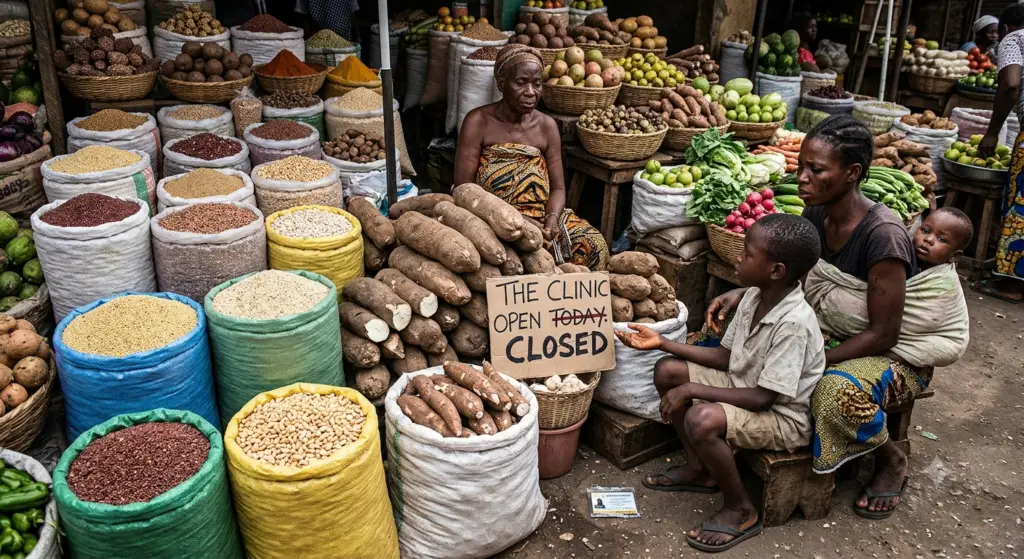
In a clinic in Maiduguri this month, a health worker will unwrap a foil packet a little larger than a business card, hand it to a mother who has walked for hours to reach the building, and mark a chart. It is a small, almost bureaucratic motion — the kind that keeps working, quietly, for as long as somebody keeps paying for it.
That packet holds a peanut paste fortified with milk powder, sugar, and micronutrients. Eaten daily for six to eight weeks, it is often enough on its own to reverse severe acute malnutrition in a child. A full course costs about a hundred dollars.1
This is the treatment that roughly a hundred and fifty nutrition clinics across Borno and Yobe states are expected to stop offering in the coming weeks — not because the children needing it have recovered, but because the funding that kept those clinics open was not renewed. Aid workers estimate the closures could leave more than three hundred thousand children under two without access to care they were, until recently, still receiving.2
Borno was classified this year at IPC Phase 5 — catastrophic hunger, the same scale used for parts of Sudan and Gaza — for the first time in nearly a decade.3 Nationally, close to three million Nigerian children under five are projected to need treatment like the one in that foil packet before the year is out.4
In the previous installment, we examined a strip of colored plastic used to measure a child’s hunger in under a minute in South Sudan. This one follows a smaller object still: a packet priced far below what most readers spent on lunch this week, and the funding decisions, made far from Borno, that quietly decide whether it reaches the arm it was made for.
HISTORICAL CASE
The Dole Rome Could Not Afford to Keep
Long before food aid had an agency or an acronym, Rome ran something recognizably similar. From the second century BC, the Roman state subsidized grain for its citizens; by the time of Augustus, an entire office — the praefectus annonae — existed to keep it moving, drawing on fleets from Egypt and North Africa on a scale that took centuries to build.5
That supply line was never only a matter of ships and warehouses. It rested on Rome’s political hold over the provinces that grew the grain, and when that hold weakened, so did the dole. In 439 AD, Vandal forces took Carthage, severing one of the two North African provinces the city depended on; a treasury already strained by the fifth century never found a reliable substitute.6 Rome’s grain dole is not proof that any single famine traces to one cause — the historical record is messier than that. What it demonstrates, more modestly, is that food security has always rested as much on political and fiscal infrastructure as on the harvest itself.
A system built to survive bad harvests was never built to survive a bad ledger.
The pattern worth noticing in Borno is narrower, and does not require naming any single decision-maker in Abuja or elsewhere: the machinery moving food from a warehouse to a hungry household is almost always a funded machinery. The grain existed. What narrowed was the corridor.
BIBLICAL LENS
What Scripture Does Not Let a Full Table Forget
Scripture makes no promise that a famine, a funding shortfall, or a closed clinic can be read as heaven’s verdict on the people caught inside it. It does insist on something narrower, and harder to escape: that a society’s actual priorities surface, sooner or later, in exactly the decisions it makes once the bill for caring for someone else comes due.
“If there be among you a poor man of one of thy brethren… thou shalt not harden thine heart, nor shut thine hand from thy poor brother: but thou shalt open thine hand wide unto him… Beware that there be not a thought in thy wicked heart, saying, The seventh year, the year of release, is at hand… and thine eye be evil against thy poor brother, and thou givest him nought.” — Deuteronomy 15:7–9
The law does not merely command generosity in the abstract. It anticipates the exact mechanism by which generosity quietly fails — a calendar, a budget cycle, a reasonable-sounding calculation about timing — and names that calculation itself as the sin. The hand does not have to slam shut. It only has to stay a little too closed, a little too long, while someone waits on the other side of it.
“Behold, this was the iniquity of thy sister Sodom, pride, fulness of bread, and abundance of idleness was in her and in her daughters, neither did she strengthen the hand of the poor and needy.” — Ezekiel 16:49
Ezekiel’s description adds another dimension to the familiar story of Sodom: pride, fullness of bread, and abundance of idleness, sitting alongside a failure to strengthen the hand of the poor and needy. Wealth and indifference are named here as closer neighbors than the more familiar version of the Sodom story usually allows.
“Whoso stoppeth his ears at the cry of the poor, he also shall cry himself, but shall not be heard.” — Proverbs 21:13
Proverbs adds the detail that makes the pattern complete: the failure begins as a failure to listen, long before it becomes a failure to act. An institution — a treasury, a donor list, a budget committee — does not decide all at once to let three hundred thousand children go without treatment. It decides, repeatedly, that this particular cry can wait for the next appropriations cycle.
Together the three texts trace one motion: the ear closes first, then the hand follows, and what a ledger records afterward is only the paper trail of that earlier, quieter decision.
The instinct behind this is not exclusively theological. Stoic writers described a similar lapse as a failure of oikeiôsis — the felt sense of moral kinship that should extend outward to strangers — and modern public ethics still argues over how much weight a failure to act should carry against an active harm. Scripture simply names the pattern earlier, and locates it in the heart before it ever reaches a policy.
None of these three texts is offered as a verdict on Borno, or on any donor, or on the reader. Scripture here is not being asked to indict the world; it is being asked to interrogate whoever is reading it — to notice which particular cry, in whatever budget or attention span governs an ordinary life, has been allowed to wait one cycle too long.
PATTERN INSIGHT
The Arithmetic Nobody Wants to Own
By the start of this year, the World Food Programme’s own reach inside Nigeria had shrunk sharply even as need was rising — a gap the agency has attributed, in its own public statements, to funding shortfalls that reached emergency nutrition programs before they reached most headlines outside the region.7 This essay is not arguing that every humanitarian dollar, once pledged, is well spent; procurement, transport, storage, and security costs eat into any budget long before a packet reaches a clinic shelf. But by the agencies’ own account, the shortfall in Borno is not a story about competing priorities inside the aid system. It is a story about a funding line that was allowed to run dry.
A hundred dollars is roughly what a modest dinner out costs in most American cities. It is also, per child, the price of reversing severe acute malnutrition over eight weeks. Multiplying that figure by three million children produces a number too clean to be an actual budget — real programs carry transport, storage, staffing, and monitoring costs no sticker price reflects — but the multiplication is worth doing once, because of what it reveals: the gap that persists in Borno is not, at its root, a gap of resources. It is a gap of priority — the same gap Deuteronomy located not in the harvest, but in the internal calculation a person makes about someone else’s need.
Something like donor fatigue is easy to mistake for prudence once a crisis has outlived its news cycle. Neither word — fatigue or prudence — quite captures what is actually being decided when a nutrition line item goes unfunded for another quarter. What is being decided is smaller and more specific: whether a hundred-dollar packet reaches a particular clinic shelf before, or after, the child who needs it stops being able to wait.
CLOSING
What the Packet Cannot Fix
A foil packet of therapeutic paste can, on its own, reverse a child’s malnutrition in a matter of weeks. It cannot explain why the supply line behind it thinned in a year when the crisis it treats grew worse. That gap between the tool and the decision that funds it was never the packet’s to answer.
Across centuries of biblical writing, one claim keeps resurfacing, almost too plain to be comfortable: that a society’s real priorities are legible less in what it says it values than in what it is still willing to fund once the applause has moved on to the next crisis. Rome’s annona and Borno’s shuttering clinics are separated by seventeen centuries and share almost nothing except this — a system does not need to be cruel to fail the people depending on it. A budget line can close in an afternoon; the mission statement it once funded can survive it by years.
A ledger, in the end, is nothing more than a record of what a household, a treasury, or a reader kept choosing to keep paying for. Scripture has never asked its readers to locate the villain in that record — only to notice, before the next quarter closes, which cry a full table has grown practiced at not quite hearing.
Sources: World Food Programme · Nigeria Health Watch · UNICEF Nigeria · World Hunger Education Service · Peter Garnsey, Famine and Food Supply in the Graeco-Roman World (1988)
1. Cost estimate for a full course of ready-to-use therapeutic food (RUTF) per child; Nigeria Health Watch, “Nigeria Must Not Let Child Nutrition Become a Budget Casualty in 2026,” April 1, 2026.
2. Nigeria Health Watch, “Nigeria Must Not Let Child Nutrition Become a Budget Casualty in 2026,” April 1, 2026 — reporting on WFP-supported nutrition clinics in Borno and Yobe at risk of closure and children under two affected.
3. World Food Programme, “Borno at Risk of Catastrophic Hunger, UN Warns,” January 2026; FAO & WFP, Hunger Hotspots: FAO–WFP Early Warnings on Acute Food Insecurity, June–November 2026 Outlook (Rome: FAO/WFP, June 2026).
4. World Hunger Education Service, “Nigeria’s Ongoing Nutrition Crises,” July 4, 2026; UNICEF Nigeria, 2026 Humanitarian Action for Children Appeal.
5. Peter Garnsey, Famine and Food Supply in the Graeco-Roman World: Responses to Risk and Crisis (Cambridge: Cambridge University Press, 1988).
6. Garnsey, op. cit.; general historical accounts of Rome’s fifth-century fiscal and territorial contraction, including the Vandal conquest of Carthage, 439 AD.
7. World Food Programme, “WFP Warns of Imminent Food Assistance Cuts in Nigeria as Violence and Hunger Surges Across the North,” January 22, 2026.
New essays every week. Delivered quietly.