HOOK
Sixteen years.
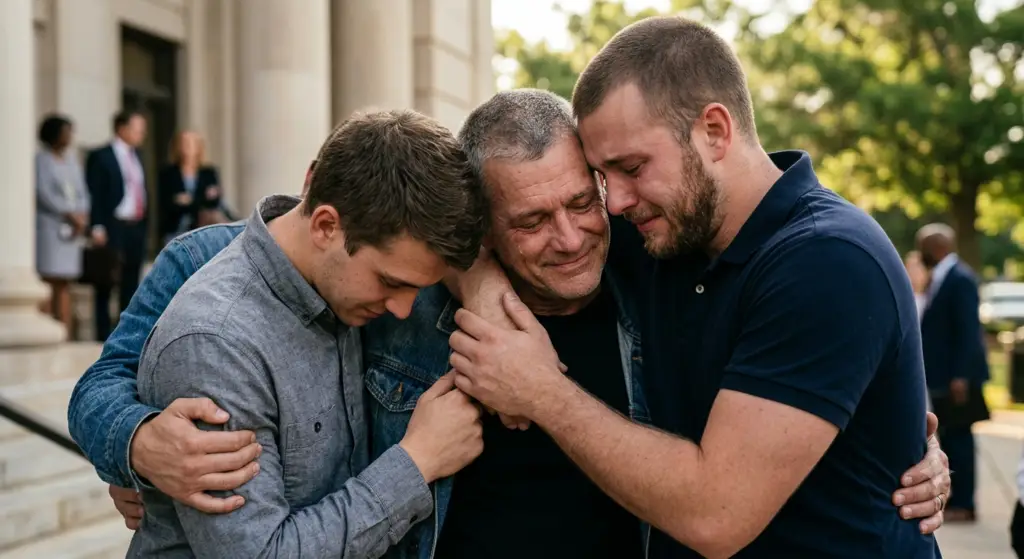
That was the distance between two signatures — one on a 2008 sentencing order, one on a 2026 judgment vacating it. Brandon Pugh, of Jonesboro, Georgia, spent the entire distance inside a conviction that belonged to someone else’s crime: a robbery he did not commit, undone only when the evidence beneath it finally gave way (Atlanta Journal-Constitution, 2026). When the second signature came, Pugh didn’t reach for the response most of us assume we’d reach for. He said he wasn’t holding a grudge. He said he was thinking about his two grown sons, and the years he still had left with them.
Two days ago, in the previous installment, we followed a woman who kept doing an ordinary task through a process built to wear her down. Pugh’s endurance ran the other direction — not forward motion, but a held breath, finally let out.
What Devil’s Island Still Explains
HISTORICAL CASE
Pugh’s story is American and current, but the shape of it is old enough to have a name in French legal history.
In 1894, a French army captain named Alfred Dreyfus was convicted of treason on the strength of a handwriting comparison that turned out to be wrong. He was stripped of rank in a public ceremony, shipped to a prison colony on Devil’s Island off the coast of French Guiana, and held there for nearly five years while journalists, officers, and eventually a novelist named Émile Zola fought to reopen a case the military establishment had every incentive to leave closed. Dreyfus was formally exonerated in 1906 — twelve years after his arrest — and reinstated into the army that had humiliated him in public.
Wrongful conviction changes shape with the tools available to produce it — a coerced confession in one century, a flawed eyewitness match or forensic technique in another. What changes far more slowly is the machinery built to catch the mistake. That’s why an 1894 case and a 2026 one still rhyme.
What historians of the affair tend to note is not just the injustice itself, but what came after: Dreyfus did not become the face of a cause the way his supporters wanted him to. He gave a brief statement, returned to service, and largely avoided the spotlight the case had built around him (Bredin, 1986). The public wanted a symbol. He wanted his life back.
The public tends to want a story it can consume from someone else’s tragedy. The person living it is usually just trying to survive the time.
That gap shows up again in Jonesboro, more than a century later. Pugh’s statement to reporters was short on outrage and long on his sons. The outrage would have been justified. It just wasn’t going to give him back sixteen years — and he seemed to already understand that a life spent relitigating the past is a life still run by the people who took it.
The Cupbearer Who Forgot
BIBLICAL LENS
“But the Lord was with Joseph… and gave him favour in the sight of the keeper of the prison.” (Genesis 39:21)
Genesis lingers on Joseph’s imprisonment longer than the plot requires. Chapters 39 through 41 hold a man falsely accused by Potiphar’s wife, forgotten by a cupbearer who promised to remember him and did not (Genesis 40:23), and left in an Egyptian prison for a stretch the text refuses to number until Pharaoh’s dream finally reaches back for him (Genesis 41:1, 14). Being forgotten, more than being imprisoned, is the wound the narrative keeps circling — and it’s the same wound underneath most wrongful-conviction stories: not just the years taken, but the years spent unremembered by a process that owed him a hearing.
Time, in a story like this, is never only duration. It becomes part of who a person is by the time it’s finally given back.
And when Joseph is finally in a position to punish the brothers who sold him into slavery — when the power has fully reversed and nothing stands between him and retribution — he tells them not to be distressed, that what they intended for harm, a larger pattern had turned toward preservation (Genesis 45:4-8). The forgiveness in that sentence is not an endorsement of what was done to him. It is Joseph declining to let his brothers keep controlling him from a distance — refusing to mortgage the years he had left to the years they had already taken. It is not a legal acquittal. It is a decision about who gets to hold the years that come after the wrong, and Pugh made a version of that same decision on a Georgia courthouse steps in June.
What a Registry Can’t Hold
PATTERN INSIGHT
Wrongful convictions don’t get corrected quickly. The National Registry of Exonerations — run jointly by several university law schools — estimates that exoneration cases involving eyewitness misidentification and flawed forensic testimony, the category Pugh’s case falls into, take well over a decade to unwind on average. That’s not neglect so much as design: appeals courts are built to defer to the original verdict, and the bar for overturning one is set intentionally high.
Registries count years. Families count birthdays, graduations, the ordinary Tuesdays that never make it into a court filing at all. A registry can tell you the average length of a wrongful sentence. It cannot tell you what a father missed of his sons growing up, because that was never the kind of thing a registry was built to hold.
Joseph’s imprisonment isn’t given a sentence length in Genesis, for the same reason. The text isn’t interested in the arithmetic. It’s interested in what a person becomes across a stretch of time nobody agreed to give him.
What the Filing Couldn’t Tell Me
CLOSING
I read the court filing twice, and the second reading didn’t clarify the legal mechanics any further than the first. What it did was show me what wasn’t there — no mention of his sons, no mention of a grudge held or set down, none of the sixteen years’ worth of interior work that apparently happened somewhere inside a cell in Georgia.
Courts can return a legal status.
They cannot return a Tuesday in 2015.
Sources: National Registry of Exonerations, University of Michigan Law School / Michigan State University College of Law, exoneration data by case type, accessed 2026. — Bredin, J.-D. (1986). The Affair: The Case of Alfred Dreyfus. George Braziller.
New essays every week. Delivered quietly.