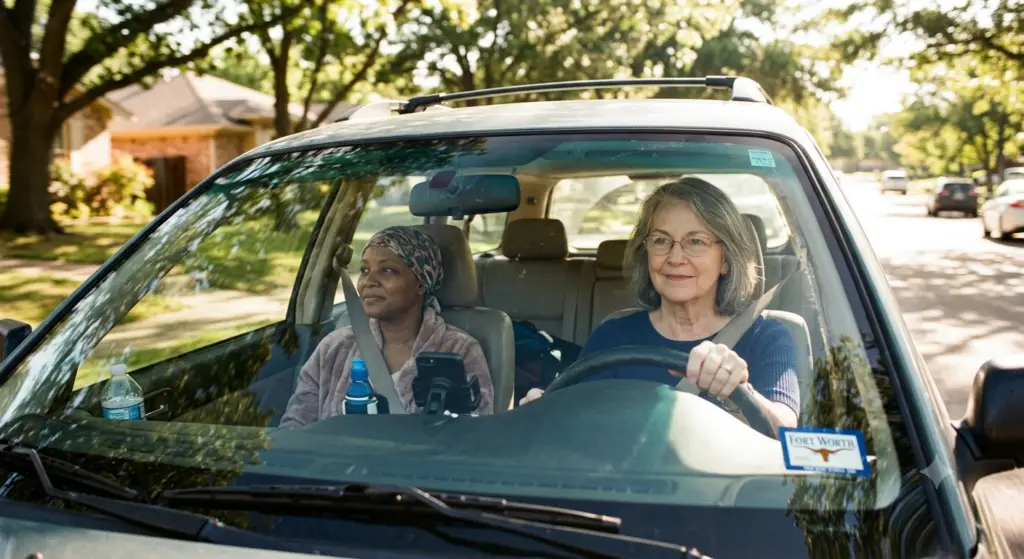
A Ride No One Was Obligated to Give
On a Tuesday morning in Fort Worth, Texas, Lyn Story — 64, retired, with a great deal of time on her hands and no particular claim on any of it — read a stranger’s post on a neighborhood app and did the thing most people only mean to do.
Apryl Goodwin, 46, had just been diagnosed with uterine cancer and had no way to get to treatment. Story offered her a ride.
Goodwin ignored the first message. A stranger offering rides to a cancer patient reads, reasonably, like a scam, or worse. Story wrote again.
I’ll take you. I mean it. As CBS News reported, she went on to drive Goodwin to more than twenty-five radiation appointments and six rounds of chemotherapy over the following year — and when Goodwin’s car broke down on the way to one of them, Story flagged someone down in traffic to get her there anyway (Wilson, CBS News, 2026).
There is nothing in the record to explain why. Retirement had simply left her with time nobody was asking her to spend on anything in particular, and she decided a stranger’s cancer was as good a use of it as any.
That is a smaller motive than a saint’s calling and a larger one than most people ever act on.
Two days ago, this space told the story of a stranger paying a bail bond he had no obligation to pay — a debt settled in cash, on a courthouse ledger, in an afternoon.
This is a quieter transaction. Nothing was owed. Nothing was recorded. What stayed with me wasn’t the mileage — it was that nobody asked her to keep going, and she kept going anyway.
Story has since taken on a third neighbor, Kevin Horrigan, who is legally blind and depends on her for rides to work.
She calls herself “a bad weather friend” — the kind who shows up, she says, precisely when the weather turns, not before (Wilson, CBS News, 2026).
When the Cities Emptied of Everyone But the Christians
In the year 251, a plague swept into the Roman city of Carthage that the ancient world would come to call, simply, the Cyprian Plague, after the bishop who documented it.
Contemporary accounts describe the dead abandoned in the streets by their own families — relatives too afraid of contagion to carry out the bodies of people they had loved the week before.
Cyprian, the city’s bishop, did something that had no precedent in the Roman world: he organized his congregation to nurse the sick and bury the dead, and he insisted the effort make no distinction between Christian and pagan.
The rich funded it; the poor staffed it. Across the empire in Alexandria, the bishop Dionysius wrote of watching pagan neighbors flee their own dying, while believers stayed and took charge of the sick, heedless of the danger to themselves (Christian History Institute, 2016).
The sociologist Rodney Stark made this pattern the center of his influential study The Rise of Christianity (1996), arguing that basic nursing care — food, water, a hand to hold — plausibly cut mortality by up to two-thirds during ancient epidemics, since so many deaths came not from disease itself but from the abandonment that followed it.
Stark’s larger claim was more provocative still: that this single, unglamorous habit of staying, repeated household by household across a burning empire, did more to reshape Rome’s religious loyalties than any doctrine anyone preached. Nobody in the third century had a name for the phenomenon Lyn Story represents. They just called it staying.
That instinct did not end with the plague. It became, over the following centuries, the reason Christian communities built the West’s first hospitals — the word itself descends from hospitia, the guest-houses medieval monasteries kept for travelers, the sick, and the dying who had nowhere else to go.
The same impulse resurfaced in 1859, when a Swiss businessman named Henry Dunant, horrified by wounded soldiers left to die on an Italian battlefield, organized local villagers to nurse friend and enemy alike, and founded what became the Red Cross. What Lyn Story did in a Nextdoor comment section sits, whether she intended it or not, at the far end of a very long line.
The plague did not ask Carthage’s Christians to feel something about their neighbors.
It asked them to show up on a Tuesday, and the Tuesday after that, for five years, until the emperor exiled the bishop who had started it.
The Neighbor Question Nobody Wants Answered
A lawyer once asked Jesus a version of the question every reader eventually asks themselves: who, exactly, counts as my neighbor?
The answer he received was not a definition. It was a story — a man left half-dead on a road, passed over by a priest and a Levite, and finally helped by a Samaritan, a man from a group his listeners had been trained since childhood to distrust.
But a certain Samaritan, as he journeyed, came where he was: and when he saw him, he had compassion on him, and went to him, and bound up his wounds, pouring in oil and wine, and set him on his own beast, and brought him to an inn, and took care of him.
— Luke 10:33-34, KJV
Jesus does not end the story by handing the lawyer a rule to file away. He answers a legal question by reshaping the man’s moral imagination — asking not who deserves to be called a neighbor, but which of the three men in the story was one to the man who fell among thieves (Luke 10:36-37).
The lawyer wanted a boundary. He got an instruction instead: go, and do likewise.
The earliest church seems to have taken Jesus’s instruction with unusual literalness. Luke’s second volume records a community in which “all that believed were together, and had all things common; and sold their possessions and goods, and parted them to all men, as every man had need” (Acts 2:44-45, KJV).
Paul later compressed the whole ethic into six words to the Galatian churches: bear ye one another’s burdens (Galatians 6:2, KJV).
None of these texts asks God to explain why illness comes to the people it comes to, or why some are surrounded and others are left alone in a waiting room.
What they insist on instead is a pattern of what belongs to the ones still standing: not commentary, but company.
What the Traffic Data Actually Measures
Every year, an estimated 3.6 million Americans forgo needed medical care specifically because they cannot get to it — no working car, no reliable transit, no one to ask, according to a 2020 analysis in the Journal of Community Health (Wolfe et al., 2020).
Among patients specifically undergoing cancer treatment, the burden compounds: a 2023 study in the Journal of the National Cancer Institute found that cancer survivors reporting transportation barriers face measurably higher emergency-room use and higher all-cause mortality than survivors who don’t (Jiang et al., 2023).
One study of underserved patients receiving multidisciplinary cancer care found that 40 percent missed at least one treatment or follow-up appointment in their first year — and patients relying on public transit were more than three times as likely to miss a treatment visit as those with a reliable ride (Cancer Therapy Advisor, 2024).
Behind almost every one of those missed appointments is an unremarkable, unrecorded fact: an empty passenger seat, and no one who thought to fill it.
The sociologist Robert Putnam spent much of his career studying what he called social capital — the informal trust and reciprocity that let neighbors act like neighbors without being asked twice.
His argument, laid out at length in Bowling Alone (2000), was that American communities do not usually collapse because their institutions fail first. They collapse because the ordinary, unglamorous habit of showing up for people outside your own household quietly disappears, years before anyone notices the institutions have nothing left to stand on.
What Putnam described as a policy problem, the earliest Christians treated as a household chore.
Every institutional fix proposed for the transportation gap — rideshare partnerships, nonemergency medical transit, hospital shuttle vans — is, in effect, an attempt to manufacture at scale what Lyn Story simply decided to do for a stranger on a Tuesday, and what a Carthaginian congregation decided to do for an entire city seventeen centuries earlier. The programs are necessary. They are also downstream of something that once didn’t require a program at all — only a person willing to remain.
The Trip That Doesn’t Show Up on Any Ledger
The bail bond this space wrote about two days ago left a paper trail — a receipt, a court date, a name on a docket.
Twenty-five trips to a radiation clinic leave nothing. No ledger records them. No court reopens the question of whether they were worth it.
That may be the actual difference between a debt and a gift: one can be measured, and the other only shows up in whether the person receiving it made it to Tuesday.
Apryl Goodwin made it to Tuesday, and then the Tuesday after that, because someone she had never met decided the answer to who is my neighbor wasn’t a definition she needed to work out in advance.
The Christian story does not open with instructions for becoming a good neighbor. It opens with God declining to stay at a distance and explain himself, choosing instead to arrive, and remain, among the people he came for.
Every smaller instance of staying since — a bishop in a plague-emptied city, a nun beside a wounded soldier, a retired nurse behind the wheel of a Honda in Fort Worth — is a faint echo of that first one.
Kevin Horrigan still can’t see well enough to drive himself to work. Lyn Story is still waiting for the weather to turn, which, for her, mostly just means showing up.
History rarely remembers the people who simply kept showing up — and yet, far more often than history admits, they are the ones who were holding everything else together.
Sources: Wilson, R. “Guardian angel drives strangers in need, asks for nothing in return.” CBS News, 2026. · Christian History Institute, “A New Era in Roman Healthcare,” 2016. · Stark, R. The Rise of Christianity, Princeton University Press, 1996. · Putnam, R. Bowling Alone, Simon & Schuster, 2000. · Wolfe, M.K. et al. “Transportation Barriers to Health Care in the United States.” Journal of Community Health, 2020. · Jiang, C. et al. “Transportation barriers, emergency room use, and mortality risk among US adults by cancer history.” Journal of the National Cancer Institute, 2023. · Cancer Therapy Advisor, “How Transportation Insecurity Impacts Cancer Patients,” 2024.
New essays every week. Delivered quietly.