PRESENT
A Building No One Alive Will See Finished
Somewhere outside Barcelona this year, construction crews are closing in on a deadline that has been coming for a century. The Sagrada Família — the basilica Antoni Gaudí gave the last decades of his life to — is scheduled to reach substantial completion in 2026. That date was not chosen at random.
It is the hundredth anniversary of Gaudí’s death.
He was struck by a tram in June 1926, on a street he probably crossed without looking, thinking about something else entirely. He had been working on the building for over forty years by then. He had built maybe a quarter of what now stands. He knew, by every reasonable estimate available to him, that he would not live to see it finished — and he built anyway, leaving instructions, plaster models, and a small army of successors he would never meet.
A hundred years is a long time to wait for a building. It is a strange kind of faith to design something you have already accepted you will not see.
HISTORY
The Speech That Reached for Nebo Instead of the Jordan
On the night of April 3, 1968, in Memphis, Martin Luther King Jr. gave a speech that has come to be known simply as “Mountaintop.” He was tired. He had been threatened, again, that day. He spoke without notes, off a fever, in a sanitation workers’ strike that most of the country had already stopped paying attention to. And near the end, without much warning, he reached back into Deuteronomy — into this exact chapter — and put himself, without quite saying so, in Moses’s position on Nebo.
He said he had been to the mountaintop. He said he had looked over. He said he might not get there with the people he had led.
He was murdered the following evening.
What makes the moment worth returning to is not the tragedy alone, though it is tragic. It is the specific choice he made. He did not reach for Joshua crossing the Jordan — the victory, the arrival, the story every movement wants to tell about itself. He reached for the man on the mountain who does not cross. A leader who knows, standing in front of the people counting on him, that the ending belongs to somebody else.
That is a strange thing to say out loud to a room full of people who need you to seem certain. It is also, historians of the period have noted, characteristic of how deliberately King had begun framing his final public words — not around triumph, but around the transfer of vision from one generation to the next.1 He did not invent that framing. He inherited it, forty chapters into a book that had been telling the same story since Egypt.
The pattern did not stop with him, either. Within days, the organization he had built had to answer the same question Israel answered at the Jordan: who carries this now, and does the movement survive the difference between its founder and whoever comes after him. Ralph Abernathy took the position King had held. The Poor People’s Campaign King had been organizing went forward without him, imperfectly, under someone who had never claimed to be his equal and did not pretend otherwise. The test was never whether the second man matched the first. It was whether the work outlived the person who started it.
SCRIPTURE
The Chapter Where Moses Stops Being the Subject
The account itself is brief, almost clipped, for a chapter that closes out five books.
“And Moses went up from the plains of Moab unto the mountain of Nebo, to the top of Pisgah, that is over against Jericho. And the Lord shewed him all the land.” (Deuteronomy 34:1–2)
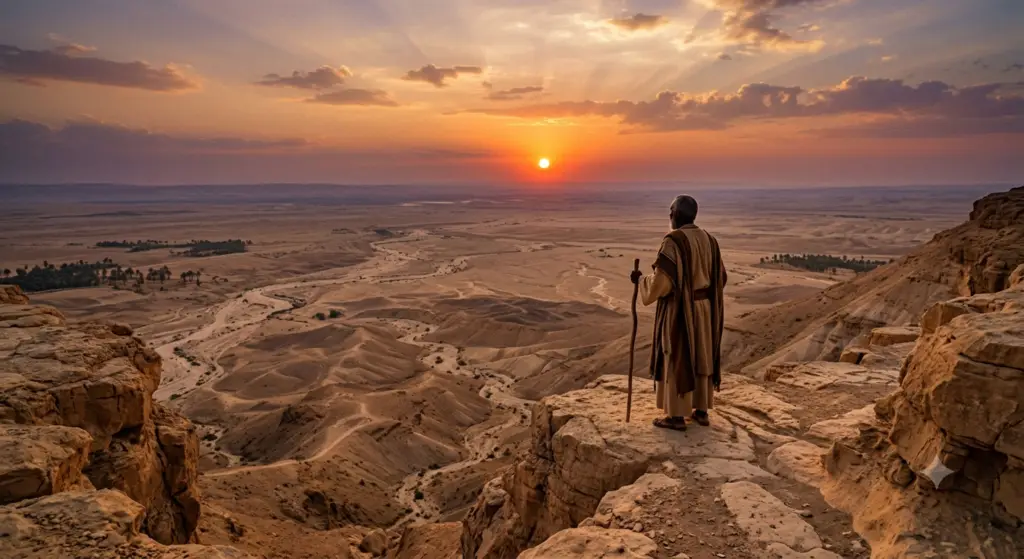
He is shown everything — every tribe’s allotment, every hill, the whole shape of the thing he has been walking toward for forty years of desert.
“And the Lord said unto him, This is the land which I sware unto Abraham, unto Isaac, and unto Jacob… I have caused thee to see it with thine eyes, but thou shalt not go over thither.” (Deuteronomy 34:4)
Deuteronomy answers the question plainly enough: Moses is kept out not because the story failed, but because of one specific moment at the waters of Meribah, decades earlier, when he struck a rock instead of speaking to it — and everything that follows on Nebo unfolds from that one decision. The text does not treat the consequence as proportionate by any modern accounting. It treats it as a boundary that even the most faithful servant does not get to negotiate around.
What is easy to miss, reading quickly, is how the grammar of the chapter itself changes once Moses reaches the mountain. For most of Deuteronomy, Moses is the subject of nearly every sentence — Moses spoke, Moses commanded, Moses set before them. On Nebo, that stops. The Lord shows him the land. The Lord tells him what he sees and what he doesn’t get to do with it. And in the chapter’s final scene, it is not Moses who buries himself.
“So Moses the servant of the Lord died there in the land of Moab, according to the word of the Lord. And he buried him in a valley in the land of Moab, over against Bethpeor: but no man knoweth of his sepulchre unto this day.” (Deuteronomy 34:5–6)
Israelite tradition read that unnamed “he” as God himself — no priest, no son, no successor standing at the graveside, only the Lord performing the last service for the man who had spent his life performing every other service for the nation. Throughout the book Moses has been the one who acts, decides, and leads. In its closing lines, he stops acting altogether, and the sentence’s grammar quietly hands the verb to someone else.
No monument follows. No marked grave for pilgrims to visit, no shrine at Bethpeor, nothing a later generation could stand in front of and mistake for the man himself. The rabbinic tradition preserves a reading that the location was hidden on purpose, so the site could never become an object people bowed to instead of the God Moses had spent his life pointing toward. Great civilizations tend to build monuments precisely so memory has somewhere to stand. This chapter removes the standing place, as if it does not trust memory to hold obedience on its own.
The absence of a grave is not the record of Moses’s failure. It is the record of God insisting on finishing, personally, what Moses could not finish for himself.
PATTERN
What Founders Almost Never Get Right
In the previous installment, we watched Moses transfer his authority to Joshua while there was still time left to correct him — a decision made long before either of them reached the mountain.
Succession is where most human institutions quietly fail, and it rarely fails for the reason people expect. Management thinkers who have spent careers studying founder-led organizations — Peter Drucker’s writing on institutional continuity, Jim Collins’s later work on what separates enduring companies from merely successful ones — return again and again to a version of the same finding: the crisis point is almost never whether the second generation is talented enough. It is whether the first generation actually manages to let go before it runs out of time to do so.
That is a narrower question than most founders think they are being asked. It is not “can you be replaced.” It is “did you actually hand it off, cleanly, while you still could.”
Deuteronomy 34 answers that question for Moses in a single, almost businesslike line, tucked in right after the mountain scene: Israel obeyed Joshua, because Moses had already laid his hands on him. The transfer had happened earlier, deliberately, while Moses could still walk beside him and correct him. By the time Moses reaches Nebo, there is nothing left to hand off. The handing-off is finished. What’s left is only the seeing, and then the leaving.
It is not only founders of civil-rights movements or unfinished basilicas who face this. A pastor spends thirty years building a congregation of eighty people in a town most people drive past without noticing, and knows the church will likely be smaller, not larger, under whoever takes the pulpit next. A farmer’s son inherits four hundred acres and the debt that came with keeping them, and has to decide whether preserving his father’s land looks the same as his father would have wanted it to. A teacher retires after four decades having shaped exactly none of the students she taught into famous people, and trusts — without much evidence beyond the trusting itself — that something of what she gave them is still standing in rooms she will never enter again. None of these people get a mountain with a view of the whole promised outcome. Most people don’t. They get a smaller version of the same choice Moses made: build something, hand it off honestly, and accept that what happens to it afterward is no longer theirs to determine.
CLOSING
The Map Left Behind
Joshua’s greatness lay precisely in refusing to become another Moses. His first recorded act as leader is not a victory speech. It is standing on the same riverbank Moses never got to cross, holding instructions he did not write, in front of the same uncertain crowd Moses had spent forty years failing to fully convince. He does not try to out-Moses Moses. He simply does the next thing the map in his hands tells him to do, and the crossing happens.
There is a kind of dignity available to the second name in a story that the first name never gets — the dignity of not having to originate anything, only to be faithful with what was handed to you. Gaudí never saw a finished nave; the crews closing out his basilica this year are working from his plaster models, guessing at some of his intentions, filling gaps he left because he ran out of decades. King never reached the promised land he meant by the phrase; the movement’s second and third generations built what they could from what he’d already said out loud, imperfectly, the way Abernathy did.
Moses is shown the whole map from the mountain and told, plainly, that seeing it is the part that belongs to him. The crossing belongs to somebody else. The chapter does not treat that as a tragedy needing resolution. It treats it as the ordinary shape a long, faithful life is allowed to take — one person plants, another waters, and the growing happens on a schedule nobody involved gets to fully witness.
Faithfulness, in the end, may be measured less by whether a person finishes what they started than by whether the people who come after them can still read the map they left behind.
¹ King’s deliberate structuring of his final speech around themes of vision-without-arrival, rather than triumph, is discussed in Taylor Branch, At Canaan’s Edge: America in the King Years, 1965–68 (Simon & Schuster, 2006).
New essays every week. Delivered quietly.