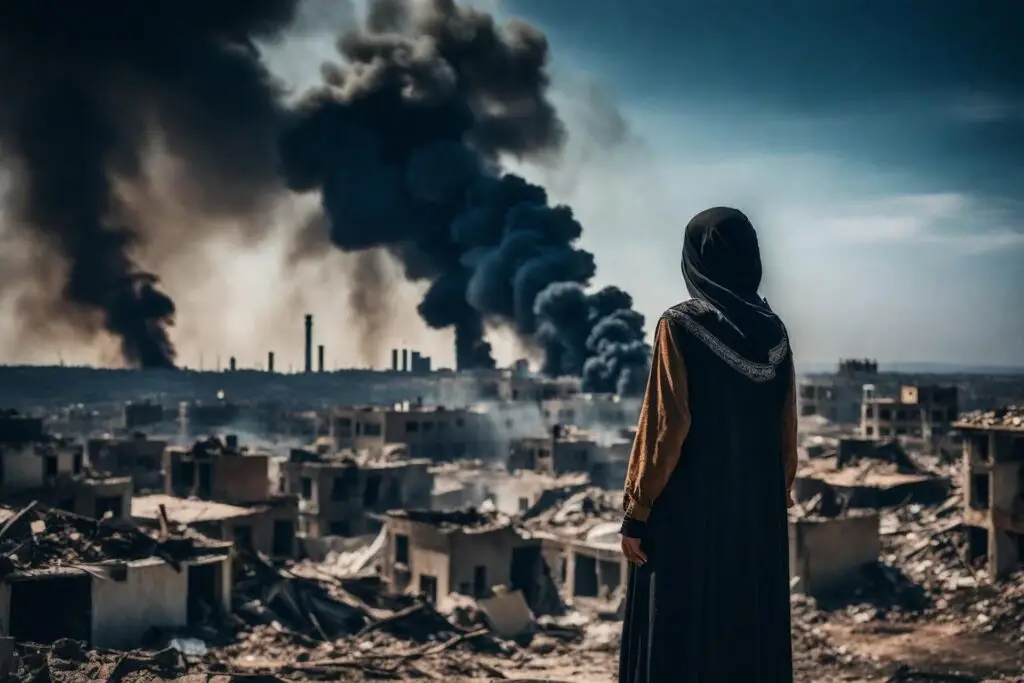
A Pharmacy on a Tehran Street Corner
Watching the footage out of Tehran last week, one small detail wouldn’t let go of me: a pharmacy, still standing at one corner, its shelves visible through a blown-out window, glass glittering on the sidewalk like frost. It wasn’t the biggest building destroyed that week, or the most dramatic image — but it stayed with me, the way a small detail sometimes outlasts the large ones.
Since the war between the United States, Israel, and Iran opened in earnest this past February, Iran’s Red Crescent Society has reported that more than thirty medical facilities — hospitals, clinics, pharmacies — have been struck, alongside dozens of schools.1 UNICEF, tracking the same months, has counted over a thousand children killed or wounded across the region, with hundreds of thousands more displaced from the only ground they’d ever known.2
I don’t bring this up to make an argument about the war itself, who started it or who was justified. That’s not this blog’s business, and I try to stay out of it.
What I keep circling back to is something older and stranger: the fact that so many ancient legal codes — Israel’s included — spent an enormous amount of energy regulating the body. Not just behavior, not just belief, but skin, discharge, wounds, camp latrines, the treatment of the sick and the dead. Bodies, in these texts, were never incidental. They were the place where a society’s real convictions showed themselves, whether or not anyone said so out loud.
So here’s the question underneath the footage of that pharmacy: when a body is broken — by disease, by war, by neglect — what does a society do with it? And does the answer say more about that society than any of its official documents ever could?
What Solferino Taught the World
Go back further than this year, further than this century, to a June evening in 1859 near a small town in northern Italy called Solferino.
A Swiss businessman named Henry Dunant arrived there by accident, on his way to a meeting with Napoleon III, and found roughly forty thousand men lying dead or wounded across the fields, with almost no medical structure in place to help them. Dunant organized what local villagers he could find — women, mostly, since the able-bodied men were gone — into makeshift teams, and for days they carried water and bandaged wounds without regard for which uniform a man wore.
What Dunant witnessed at Solferino became the seed of something enormous. Within five years, delegates from sixteen nations met in Geneva and produced the first international treaty in history built specifically to protect the wounded, the sick, and the medical personnel who cared for them — regardless of which side they belonged to.
The historian Geoffrey Best, writing on the long development of the laws of war, described this as one of the rare moments where a purely humanitarian instinct hardened into binding law rather than staying a sentiment.5 A hospital tent, under this new code, was not just a building. It was something closer to sacred ground — off-limits by international agreement, marked so that even an enemy would know to leave it alone.
That instinct — that the sick and wounded occupy a category the ordinary logic of war cannot touch — did not begin in 1864. It’s far older than Geneva, and far older than the Red Cross armband.
Centuries before Solferino, a different siege produced a different kind of eyewitness. Our primary source for the Roman siege of Jerusalem in the year 70 is Josephus, a Jewish military commander turned historian who watched the city starve from the inside and later wrote the fullest surviving account of the war between Rome and Judea. That siege was deliberately designed to starve a city into submission rather than storm it outright, and what Josephus described as the collapse of ordinary human bonds under famine — families hiding food from each other, the sick left where they fell — reads less like ancient history and more like a template. Siege warfare, from Jerusalem to Leningrad to the encircled towns of this year’s war, has always understood something dark and practical: that the fastest way to break a people is to attack their bodies’ most basic needs — food, water, wound care — and let the rest follow.
Which raises an uncomfortable continuity. The tools have changed enormously — precision munitions instead of encircling armies, drone strikes instead of catapults — but the underlying calculation, in some conflicts, has not moved very far at all. A pharmacy on a Tehran street corner and a besieged house in first-century Jerusalem are separated by two thousand years and almost nothing else.
The Legal Architecture of a Body
Go back further still — past Geneva, past the fall of Jerusalem, to a time before anything resembling international law existed at all. Ancient Israel, wandering in the wilderness centuries before either of those moments, had already built an entire legal architecture around the body — one that reads, on first pass, like the strangest section of the Torah to a modern reader, full of skin conditions and camp hygiene and rules about touching the dead.
Leviticus spends two full chapters on the diagnosis and management of skin disease, and the instructions are strikingly procedural — almost clinical — for a religious text. This is what caught me when I first sat down with this passage: it doesn’t read like ritual. It reads like a protocol.
“And the leper in whom the plague is, his clothes shall be rent, and his head bare, and he shall put a covering upon his upper lip, and shall cry, Unclean, unclean. All the days wherein the plague shall be in him he shall be defiled; he is unclean: he shall dwell alone; without the camp shall his habitation be.”
— Leviticus 13:45–46, KJV(In plain terms: the diagnosed person tears their clothing, covers their face, and calls out a warning — then lives outside the camp for as long as the condition lasts.)
It would be easy to read this as pure exclusion — a community protecting itself by casting out the sick. But the text doesn’t stop there. The priest is required to keep re-examining the person, week after week, watching for change, for healing, for the possibility of return (Leviticus 14). Quarantine, in this system, is not a life sentence. It’s a procedure with a door back in — the purpose was containment, not abandonment.
The same body-consciousness shows up in the laws governing the military camp itself:
“Thou shalt have a place also without the camp, whither thou shalt go forth abroad… for the LORD thy God walketh in the midst of thy camp, to deliver thee, and to give up thine enemies before thee; therefore shall thy camp be holy: that he see no unclean thing in thee.”
— Deuteronomy 23:12, 14, KJV(In plain terms: waste disposal happens outside the camp, because the camp itself is treated as consecrated ground.)
Even in the brutal, high-stakes environment of ancient warfare, the text insists on basic sanitation — not as an afterthought, but as a matter of holiness. Whether the underlying motive was ritual purity or practical necessity is a real question, and probably an unresolvable one; what the text does make clear is that the camp’s physical cleanliness and its spiritual standing were never treated as separate questions.
And then there’s a sharper, more accusatory verse, aimed not at ordinary people but at the leaders responsible for them:
“The diseased have ye not strengthened, neither have ye healed that which was sick, neither have ye bound up that which was broken… but with force and with cruelty have ye ruled them.”
— Ezekiel 34:4, KJV(In plain terms: those responsible for the flock let the sick go untreated and the injured go unbandaged — and ruled by force instead.)
Here the body becomes evidence. “Shepherd” in this passage is a leadership metaphor — it names whoever is entrusted with the care of a people, not any single office. Whether that’s a king, a government, or some other structure, the standard is the same: judged not by its stated ideals but by what it did or failed to do for the sick, the injured, the broken body in front of it.
None of these texts are offered here as prophecy about any specific nation in any specific war. That’s not how this pattern works, and it’s worth resisting the pull to force it into that shape. What they offer instead is something closer to a diagnostic lens — a way of asking what a community’s treatment of the vulnerable body has always revealed, in every era this pattern has repeated.
A Moral Fingerprint, Counted in Attacks
It’s worth stepping back from any single conflict and looking at the wider data.
The World Health Organization has maintained a global monitoring system since 2018 specifically to track attacks on health care during conflict — hospitals struck, clinics obstructed, ambulances blocked, medical workers killed or abducted. A peer-reviewed analysis of that system’s records found more than eight thousand documented attacks across twenty-two countries between 2018 and the end of 2024, with the trend worsening sharply year over year rather than improving.3 In 2025 alone, the WHO logged close to five hundred separate incidents across thirteen countries and territories4 — which comes out, on average, to something like an attack on a hospital, clinic, or medical worker roughly every day of the year, somewhere in the world.
Those aren’t background statistics. Each entry on that list is a version of the same pharmacy, the same shattered window, repeated in a dozen different languages and time zones — logged across conflicts as different from one another as Ukraine, Sudan, Gaza and Lebanon, Myanmar, and now Iran. No single country or war owns this pattern; that’s rather the point.
What the data makes visible, almost accidentally, is a kind of moral fingerprint. Some conflicts show relatively contained damage to medical infrastructure — care remains difficult but possible. Others show the opposite pattern: health care becomes a target in itself, not collateral damage but strategy, the body treated as a lever to be pulled rather than a limit to be respected.
That distinction — target versus limit — is exactly the line the ancient text keeps drawing. The camp law in Deuteronomy doesn’t say war is gentle; it assumes the opposite, that war is brutal and dangerous. What it insists on is a boundary inside the brutality: certain things remain off-limits even in the middle of conflict, because a camp that ignores its sick and its sanitation has already told you what it actually believes about the value of a body.
Bring that lens back to Ezekiel’s shepherds, who stand condemned not for going to war but for what they did with the wounded once war had already happened. The accusation isn’t abstract. It’s inventory: the diseased not strengthened, the sick not healed, the broken not bound up. It’s a checklist a modern surveillance system would recognize instantly, even filtered through language three thousand years older than satellite imagery.
Every civilization, it turns out, eventually writes its theology onto the human body — whether or not it calls it theology at all.
The Body Was Never Incidental
I keep returning to that pharmacy on the Tehran street corner — glass on the sidewalk, shelves half-visible through the frame of a blown-out window. I don’t know the full story of that building, who used it, whether the people who ran it made it out. I’m not sure the details change the point I keep landing on anyway.
What the ancient camp laws understood, and what Dunant stumbled into by accident outside Solferino, is that a society’s relationship to the broken body is never a footnote to its history. It’s closer to the thesis statement. Leviticus, Deuteronomy, Ezekiel weren’t writing military strategy or public health policy. They were writing a mirror, held up to whatever nation happens to be reading.
I’m not sure this resolves cleanly. Maybe it shouldn’t. The camp law promises a door back in for the excluded; the modern data suggests that door is being propped shut more often than held open — sometimes in the same year, sometimes in the same week.
In the previous installment, we examined a different kind of body-knowledge — the trained hands that rebuilt Notre-Dame and the craftsman Exodus names in the same breath as creation itself. The Craftsman God Chose → That was a story about what a society builds. This one is about what a society is willing to let fall apart.
1 Iran’s Red Crescent Society, cited via regional reporting, 2026 — on schools and medical facilities struck since the war’s outbreak in February 2026.
2 UNICEF, situation report, March 2026 — child casualties and displacement figures across Iran, Lebanon, Israel, and Kuwait since the conflict’s escalation.
3 World Health Organization, Surveillance System for Attacks on Health Care (SSA), analyzed in a 2026 peer-reviewed study covering 2018–2024 — 8,000+ documented attacks across 22 countries, with Ukraine and the occupied Palestinian territory among the most heavily affected.
4 World Health Organization, Surveillance System for Attacks on Health Care (SSA), 2025 incident count, cited via UN briefing, 2025.
5 Best, G. (1980). Humanity in Warfare. Columbia University Press.