The Fault Line · Part 4-5
Rome minted the coin. The book outlasted the empire that sought to erase it.
Section I
What Titus Left Standing, and What He Did Not
On the ninth day of the Jewish month of Av — Tisha B’Av — the fasting begins before dawn. The date corresponds, according to the tradition, to the burning of the First Temple by the Babylonians in 586 BCE and the destruction of the Second by Rome in 70 CE. These are not held as coincidental. Whether the calendar convergence is historical precision or theological interpretation, the tradition holds both catastrophes inside a single mourning, as though the pattern itself were the lesson, not the event.
In April of 70 CE, the Roman general Titus arrived at Jerusalem with four legions — the Fifth, Tenth, Twelfth, and Fifteenth — and encircled the city during Passover. The timing was, as Josephus noted, logistically exploitative: the festival had drawn pilgrims who were now sealed inside the walls by the Roman circumvallation, straining food and water supplies before a single ram struck stone. The siege lasted five months. What followed inside those walls — faction warfare among Jewish groups, famine severe enough that Josephus described people fighting over scraps of leather, the progressive Roman advance through outer wall, middle wall, the Antonia Fortress, and finally the Temple precinct itself — belongs to the most documented catastrophes of the ancient world precisely because Josephus was there, recording it as a Roman client who had been a Jewish commander first.
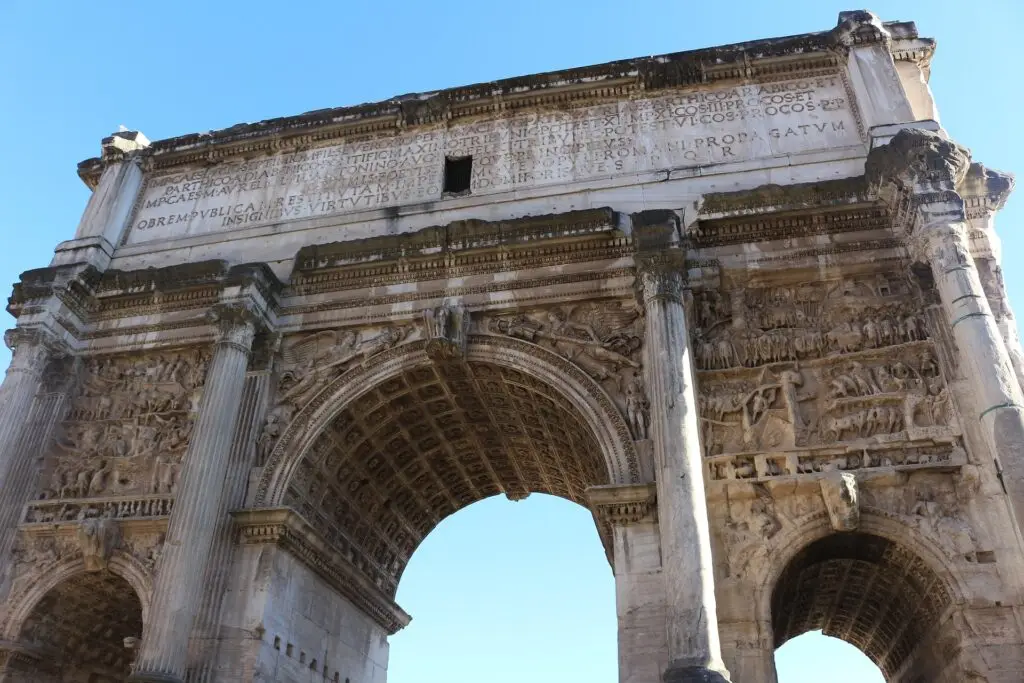
The Temple burned in late summer, on the tenth of Av by the Jewish reckoning. Whether Titus intended to destroy it remains a point of scholarly debate: Josephus claimed he gave orders to spare it; other ancient accounts suggest the fire spread in combat and the general approved its destruction after the fact. What is not disputed is what came next. Roman soldiers stripped the Temple precincts of their contents, including the great menorah — the seven-branched lampstand — which was carried back to Rome and carved in relief on the Arch of Titus, where it remains visible on the Via Sacra today. The stones were dismantled so completely that, as Jesus had described in the Olivet Discourse roughly forty years earlier, not one would be left upon another.
The city fell entirely by early September. Rome held a triumph the following year. New coinage was struck: Judaea Capta — Judea captured. The phrase was useful propaganda. It was also, as it turned out, premature.
In the previous installment, we examined the Maccabean revolt — the village priest who chose his knife over compliance, and the question the Hasmonean dynasty never fully answered about what survives the dominant order. Read Part 4-4: The Hammer and the Temple →
Section II
The City That Would Not Stay Captured
To understand what 70 CE did to Jewish history, it helps to understand what it was being asked to destroy.
The Temple in Jerusalem was not merely a religious institution in the sense that the modern West uses that word. It was the economic, political, liturgical, and symbolic center of Jewish life — the structure that organized time through its sacrificial calendar, that organized space by orienting prayer and pilgrimage toward a single geographical point, that made Jewish identity publicly coherent. The High Priest functioned in something closer to a head-of-state capacity. When the daily offering — the tamid — was stopped permanently in 70 CE, the question was not merely whether Judaism would survive. It was whether Judaism as a structured form of life had any mechanism left to survive with.
The destruction accelerated a diaspora that had begun centuries earlier. Even before 70 CE, a vast Jewish population had already taken root across the Mediterranean world — in Babylon, in Alexandria, in Rome itself. The Bar Kokhba revolt of 132–135 CE, crushed with enormous Roman force, completed the geography of dispersion: Hadrian renamed the province Syria Palaestina, plowed Jerusalem under, and built a Roman city named Aelia Capitolina over its ruins. The land bridge that had anchored the covenant community’s identity was closed by imperial decree.
What happened next is one of the most consequential institutional transformations in the history of religion.
Before the walls fell, a Pharisaic rabbi named Yohanan ben Zakkai had himself smuggled out of the city in a coffin — the only way to exit, since the zealot factions controlling Jerusalem killed anyone who attempted to flee, suspecting defection. He was carried through the gates in darkness, past the Roman sentries, and brought to Vespasian’s camp. The Talmud preserves his conversation with Vespasian in Tractate Gittin (56a–b), a document compiled several centuries after the events it describes and therefore not reportage in the modern sense; one strand of the rabbinic tradition reads it as a composite of historical memory and theological interpretation. What the account records is Yohanan’s request: not for Jerusalem to be spared — he apparently judged that battle already lost — but for the coastal town of Yavneh and its scholars, and for the preservation of the family of the rabbinic leadership.1
Vespasian agreed. Yavneh was a small town south of what is now Tel Aviv, unremarkable enough that a Roman general processing the logistics of a regional conquest could grant the request without apparent hesitation. It was there that Yohanan reconstituted the Sanhedrin and began the process of rerouting Jewish religious life away from Temple-centered practice toward something that could survive without a Temple, without a city, without a land.
The transformation took generations. But its structural innovation can be stated concisely: what had required a priest, an altar, and a specific geographical location was systematically translated into what could be carried in a book, practiced in any room, and transmitted across any distance. The sacrifice of atonement became, through rabbinic interpretation, replaceable by acts of repentance, study, and loving-kindness. The synagogue — already existing in diaspora communities — became the portable institution of Jewish life. The prayer facing Jerusalem replaced the pilgrimage to Jerusalem.
Rome’s coinage announced Judaea Capta. What the empire failed to account for was that you cannot capture a book.
The line from Yavneh to the modern State of Israel is not a short one, and it is not a straight one. It runs through nineteen centuries and some of the darkest passages in European history. The theological grammar of return was maintained in prayer, in calendar, in annual mourning — but the political outcome depended on circumstances no rabbi at Yavneh could have predicted: the rise of European nationalism in the nineteenth century, the emergence of Zionism as a secular as much as religious movement, the catastrophe of the Holocaust, the politics of British Mandate Palestine, and a UN partition vote in November 1947.
For nearly nineteen centuries, diaspora Jewish communities closed the Passover Seder with the same phrase: L’shanah haba’ah b’Yerushalayim — next year in Jerusalem. The phrase held, in compressed form, an orientation rather than a program. When Theodore Herzl convened the First Zionist Congress in Basel in 1897, he was translating a liturgical grammar into a political agenda. The longing it mobilized was ancient. The machinery it deployed was thoroughly modern.
On May 14, 1948, David Ben-Gurion proclaimed the first sovereign Jewish state in roughly two millennia. Yet the deeper historical rhythm that ran beneath that moment remained what it had always been: the annual mourning of Tisha B’Av, the fast renewed each year over a destruction that nineteen centuries of prayer had refused to accept as the final word.
Section III
Three Texts on Walls, Mourning, and the Direction of Return
The first scripture is from Matthew’s account of the Olivet Discourse — Jesus’s words spoken in the final week of his public ministry, within sight of the Temple he was describing:
“Truly, I say to you, there will not be left here one stone upon another that will not be thrown down.” (Matthew 24:2, ESV)3
The interpretive question — whether this was addressed to the events of 70 CE, to a future eschatological event, or to both simultaneously in a form of telescoped prophecy — has occupied Christian readers since the early church and remains genuinely open. While theological interpretations of the discourse vary widely, the physical reality of the destruction matched the literal weight of the words with chilling precision: the gold that melted between the stones in the fire was retrieved by Roman soldiers who dismantled the structure stone by stone to reach it.
The second scripture is Psalm 137, composed in the context of the Babylonian exile but functioning across Jewish history as the canonical text of exile itself — and therefore of 70 CE as much as 586 BCE:
“By the waters of Babylon, there we sat down and wept, when we remembered Zion. On the willows there we hung up our lyres. For there our captors required of us songs, and our tormentors, mirth, saying, ‘Sing us one of the songs of Zion!’ How shall we sing the LORD’s song in a foreign land? If I forget you, O Jerusalem, let my right hand forget its skill!” (Psalm 137:1–5, ESV)
The Psalm’s power is not theological abstraction. It is phenomenological — it describes, with unusual directness, the experience of dispossessed people being asked to perform their culture for those who destroyed it. The harps hung in the willows are an image of suspended vocation: we cannot do what we were made to do here, in these conditions, for this audience. The oath — if I forget you, O Jerusalem, let my right hand forget its skill — is not sentiment. It is a covenantal commitment to maintain orientation under conditions specifically designed to dissolve it. Diaspora communities returned to that Psalm for nineteen centuries, year after year, in languages the writers of the Psalm had never heard. They did not forget.
The third scripture is Ezekiel 37 — the vision of the valley of dry bones, composed during the Babylonian exile, and carried forward in both Jewish and Christian reading as the archetypal text of national resurrection:
“He said to me, ‘Son of man, can these bones live?’ And I answered, ‘O Lord GOD, you know.’ Then he said to me, ‘Prophesy over these bones, and say to them, O dry bones, hear the word of the LORD. Thus says the Lord GOD to these bones: Behold, I will cause breath to enter you, and you shall live.'” (Ezekiel 37:3–5, ESV)
The vision’s immediate referent, as Ezekiel makes explicit in verses 11–12, is the house of Israel in exile, who say that their hope is lost and their bones are dried up. The theological question the vision poses — whether national restoration is a human project, a divine act, or some entanglement of both — is not one the text resolves cleanly. What it establishes is that the condition of apparent finality does not close the category of return. Empires issue Judaea Capta pronouncements. The bones, according to Ezekiel, hear something else.
Section IV
What Nineteen Centuries Carry
The structural innovation of Yavneh — religion made portable — is the most consequential institutional design decision in Jewish history. It is also, from the perspective of political theory, something close to a paradox.
Most civilizations that lose their territorial anchor lose their coherence within a few generations. The mechanisms of cultural transmission — language, religious practice, communal identity — are ordinarily sustained by proximity, by institutions embedded in specific places, by the weight of geography. Remove the geography, scatter the community across a dozen languages and legal regimes, and the typical outcome is absorption into the surrounding culture. This is what happened to the ten northern tribes after the Assyrian conquest in 722 BCE. They disappeared. The historical record does not preserve their institutional successor.
The durability of Jewish identity has therefore attracted attention not only from theologians but from sociologists, historians, and scholars of diaspora studies — precisely because it departs so markedly from the more common historical pattern of gradual assimilation. The dispersed community did not assimilate. It adapted in ways that preserved the core while changing the forms, again and again, across radically different host cultures.
What happened to the Jewish community after 70 CE was structurally different from the common pattern of dispersal and dissolution, and the difference was Yavneh.
Yohanan ben Zakkai’s request to Vespasian — give me this town and its scholars — was, from a Roman administrative standpoint, so modest as to be nearly invisible. What the request represented, from inside the tradition, was a pivot from a land-based to a text-based civilization: a bet that Torah study, halakhic practice, and communal memory could perform the functions that Temple sacrifice and geographical continuity had previously performed. The bet held for nineteen centuries in conditions that should have broken it repeatedly — through the Crusades, through the expulsions of medieval Europe, through the Ottoman period, through the pogroms of Eastern Europe, and into the twentieth century’s most concentrated attempt to destroy it entirely.
Contemporary survey data illustrate the same structural continuity at the other end of that timeline. The Pew Research Center’s 2020 survey of Jewish Americans found that 82 percent of respondents said that remembering the Holocaust was essential to their Jewish identity; 72 percent said that caring about Israel was essential; 43 percent said that observing Jewish law was essential (Pew Research Center, Jewish Americans in 2020, 2021).2 The wide variation across those categories reflects the genuine internal diversity of contemporary Jewish identity. But across the range — from the secular to the strictly Orthodox — the orientation toward historical memory, and specifically toward the memory of dispossession and return, runs as a structural constant.
The connection from the destroyed Temple to the State of Israel is neither clean nor inevitable, and intellectual honesty requires saying so plainly. Zionism as a political movement was shaped by secular European nationalism as much as by religious longing; Herzl himself was not observant. The establishment of the state in 1948 was a product of Holocaust devastation, British Mandate politics, UN partition votes, and a war fought by several Arab armies within hours of Ben-Gurion’s declaration. The theological grammar of return does not collapse those contingencies into prophecy, and it should not. The distinction between historical pattern and prophetic fulfillment matters, and collapsing it serves neither careful reading nor honest argument.
Judaea Capta lasted as long as Rome lasted. The community Rome dispersed preserved its core identity across impossible odds, eventually providing the cultural memory and theological grammar upon which modern statehood would draw — however differently from what Yohanan ben Zakkai could have imagined. The disproportion between that coin and that outcome is, at minimum, a pattern that asks to be read with care.
The pattern cuts more than one way. Ezekiel 36 — the chapter immediately before the dry bones — is a demanding account of the moral conditions the returned community is expected to inhabit. The vision of national restoration is paired, in the prophet’s own structure, with the vision of national accountability. The return is not presented as unconditional. The pattern, read whole, is not a promise of possession. It is a call to the moral seriousness that possession requires.
Section V
The Coin and the Book
The Arch of Titus still stands on the Via Sacra in Rome. Tourists photograph it daily. The relief carving of the menorah being carried in triumph through Roman streets is clearly visible, worn by seventeen centuries of weather but unmistakable in its form. Rome built the arch to commemorate a permanent victory. It is now a historical artifact of an empire that no longer exists, visited by citizens of a state established by the community the arch was built to celebrate defeating.
This is not a triumphalist observation. The nineteen centuries between the arch and the state included expulsions, forced conversions, pogroms, and the systematic murder of six million people in the middle of the twentieth century. The community that maintained its orientation through those centuries paid an incalculable cost for doing so. The pattern is not a guarantee of easy return. It is a record of what sustained return under conditions that should have made it impossible.
The Hook opened with Tisha B’Av — the fast that holds both Temple destructions inside a single mourning, as though the pattern itself were the lesson. The convergence, whether historically precise or theologically constructed, encodes a claim: that the same pattern repeated carries the same instruction. The tradition that survived Babylon survived Rome. The tradition that survived Rome survived the medieval expulsions. The tradition that survived those found itself, in the twentieth century, at its darkest hour and its most consequential reconstitution within three years of each other.
What Yohanan ben Zakkai carried out of Jerusalem in that coffin was not a plan, not a manifesto. It was a request modest enough that Vespasian granted it without apparent hesitation — a town and its scholars, the space to keep studying, the continuation of the argument that is, on the rabbinic account, the mechanism by which the tradition stays alive.
Empires often imagine that walls preserve civilizations. Yavneh suggested something else: civilizations survive when memory can travel farther than stone.
Footnotes
1 The primary ancient account of the 70 CE siege is Flavius Josephus, The Jewish War, Books V–VI (composed approximately 75–79 CE). Josephus was present at the siege as a Roman client; his account is essential and contested, as his position created incentives for selective emphasis. For a scholarly assessment of Josephus as a source, see Shaye J.D. Cohen, Josephus in Galilee and Rome: His Vita and Development as a Historian (Leiden: Brill, 1979). The account of Yohanan ben Zakkai’s escape and request is preserved in Babylonian Talmud, Tractate Gittin 56a–b, compiled approximately 500–600 CE. For the standard scholarly treatment of the Yavneh transition, see Jacob Neusner, A Life of Yohanan ben Zakkai, Ca. 1–80 C.E. (Leiden: Brill, 1962). The Arch of Titus relief depicting the menorah procession remains visible on the Via Sacra, Rome; for its significance in Jewish memory, see Steven Fine, The Menorah: From the Bible to Modern Israel (Cambridge: Harvard University Press, 2016). ↩
2 Pew Research Center. Jewish Americans in 2020. Washington, D.C.: Pew Research Center, May 11, 2021. The figures cited — 82% (Holocaust remembrance essential), 72% (caring about Israel essential), 43% (observing Jewish law essential) — are drawn from the survey’s Jewish identity chapter. Available at pewresearch.org. For the broader historical context of the diaspora, see Encyclopædia Britannica, “Jewish Diaspora” (updated May 2026). ↩
3 Biblical citations follow the English Standard Version (ESV) unless otherwise noted. Key passages: Matthew 24:2; Psalm 137:1–5; Ezekiel 37:3–5. On Theodor Herzl and the First Zionist Congress, see Walter Laqueur, A History of Zionism: From the French Revolution to the Establishment of the State of Israel (New York: Schocken Books, 2003). For the transformation from Temple-based to rabbinic Judaism, see Lawrence H. Schiffman, From Text to Tradition: A History of Second Temple and Rabbinic Judaism (Hoboken: Ktav Publishing House, 1991). ↩