The Fault Line · Part 3-2
Isaiah 45, the Cyrus Cylinder, and the Question of What Survives Exile
Section I
The Road to Pasargadae
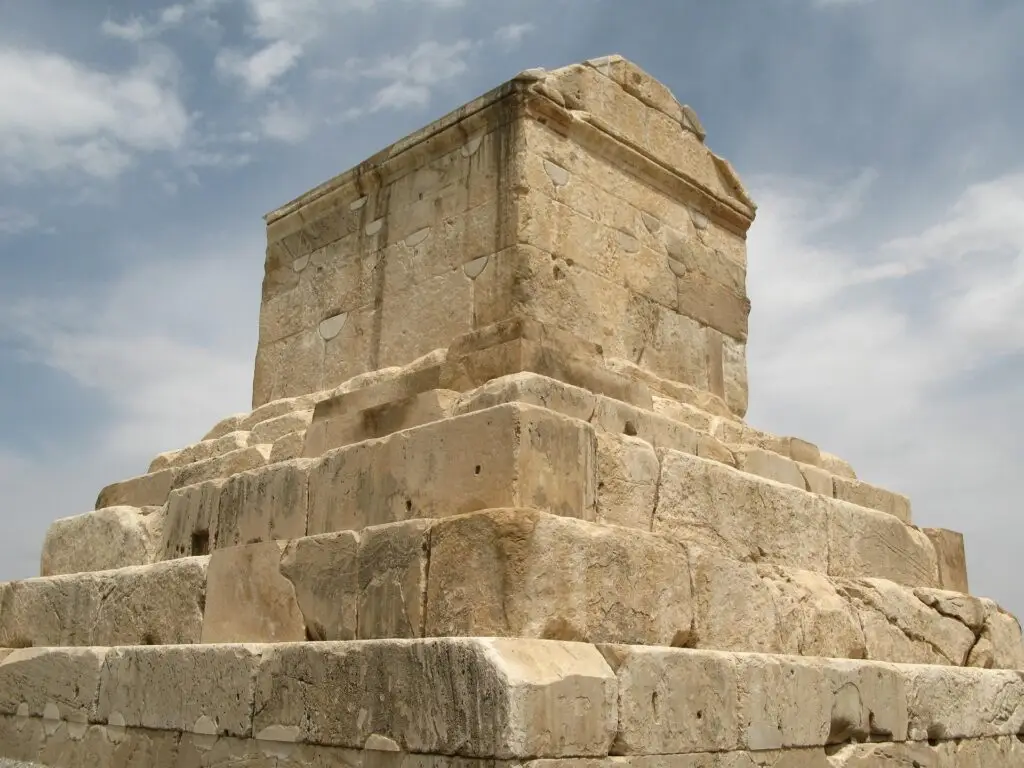
On October 29, 2025, Iranian security forces sealed the main roads leading to Pasargadae, where the tomb of Cyrus the Great has stood for twenty-five centuries. It was the annual observance that Iranians have taken to calling Cyrus the Great Day — not on the official calendar, not permitted to proceed without interference. Thousands had planned to gather at the tomb. The roads were closed. The people were turned back.
The Islamic Republic did not invent this anxiety. For roughly five decades, the government established by Ayatollah Khomeini has treated the memory of Cyrus with something between discomfort and active suppression — removing pre-Islamic Persian figures from school curricula, banning the name Kourosh from birth records in some periods, watching with alarm as young Iranians flooded Persepolis during Nowruz while mosques stood empty. A leaked 2024 Culture Ministry survey found that 85 percent of respondents believed Iranians had grown less religious than five years earlier (INSS, 2025). By the time the road to Pasargadae was sealed in October 2025, the act carried the character of a government arguing with its own past.
Roads matter only to those who have something worth carrying along them. The question of what the exiles carried — and what survived the carrying — is older than the Islamic Republic by twenty-five centuries. It is the question at the center of Isaiah 45.
What the Islamic Republic fears about Cyrus is also, in part, what the Hebrew Bible preserved about him. The sixth-century Achaemenid king stands in Isaiah as the only non-Israelite figure to receive the title mashiach — anointed, the same word applied to the kings of Israel, the same word from which the Greek Christos derives. It is one of the most theologically freighted designations in the entire prophetic literature, given here to a man who, by the text’s own acknowledgment, did not know the God who named him. That designation, and the events surrounding it, is the subject of this installment.
In the previous installment, we examined how Sargon II’s administrative machinery erased the northern kingdom — not through massacre but through paperwork, deportation, and the deliberate dissolution of a people’s identity into the landscape of empire. Read Part 3-1: The Empire That Came to Stay →
Section II
The King Who Walked Into Babylon Without a Fight
In October 539 BCE, Cyrus the Great entered Babylon. He did not, by most ancient accounts, need to fight his way in.
The Babylonian Chronicle — a cuneiform administrative record held today in the British Museum — describes the fall of Babylon in terms that read less like a siege and more like a transition of management. The city’s last king, Nabonidus, had alienated the Babylonian priestly establishment by neglecting the cult of Marduk in favor of the moon deity Sin. When Cyrus arrived, the priests appear to have been more prepared to welcome him than to resist. The Cyrus Cylinder, a nine-inch baked clay artifact also held in the British Museum (BM 90920), records Cyrus’s version of events: Marduk himself had called Cyrus by name to take the throne (Finkel, The Cyrus Cylinder, 2013).3
The Cyrus Cylinder has been described, in modern usage, as the world’s first charter of human rights — a framing enthusiastically promoted by the Pahlavi dynasty, referenced by a United Nations spokesperson during the cylinder’s 2013 American tour, and taken up by the Iranian diaspora as evidence of a tolerant pre-Islamic Persian identity. The British Museum’s former director, Neil MacGregor, called it “the first attempt we know about running a society, a state with different nationalities and faiths.” The comparison is not without basis: Cyrus reversed the Assyrian and Babylonian policy of forced deportation, restored sanctuaries, and allowed displaced peoples to return to their homelands.
But the historians who study it most closely are careful. The Livius ancient history project’s analysis notes that the Cyrus Cylinder conforms closely to established Babylonian building-inscription conventions — that Cyrus was presenting himself to his new Babylonian subjects using their own rhetorical frameworks, claiming divine sanction in the language his audience expected. C.B.F. Walker of the British Museum described it as essentially a sophisticated building inscription rather than a general declaration of principle. The German historian Josef Wiesehöfer observed that the portrayal of Cyrus as a champion of human rights reflects modern political construction as much as ancient historical fact.3
What Cyrus did, the evidence suggests, was what worked. And what worked was tolerating local religious and cultural practice rather than suppressing it. The Persian administrative logic was the inverse of the Assyrian. Where Sargon had restructured — deporting, resettling, dissolving identities — Cyrus restored. Where Assyrian strategy eliminated the social networks enabling resistance, Persian strategy neutralized resistance by accommodating it. Both were imperial strategies. One ran on erasure. The other ran on incorporation.
The result, for the Jewish exiles scattered across the empire since Nebuchadnezzar’s deportations of 597 and 586 BCE, was extraordinary. Cyrus issued a decree — recorded in Ezra 1:2–4 and confirmed by the Aramaic archival copy in Ezra 6:3–5 — authorizing the return of the Jewish exiles to Jerusalem and the rebuilding of the Temple, with imperial financing. The sacred vessels Nebuchadnezzar had carried from the Temple to Babylon were to be returned. Sheshbazzar, a prince of Judah, was appointed to lead the first wave of returnees.
A Later Tradition Worth Noting
What Josephus described in Antiquities of the Jews (11.1.2) was the tradition that Cyrus had been shown the relevant passages in Isaiah — the prophecy naming him by name, composed some 150 years before his birth — and that this encounter explained his favorable disposition toward the Jews. Most historians regard the account as a later Jewish tradition rather than a verifiable historical event. Whether or not it preserves a historical encounter, what it preserves is the interpretive weight the ancient community placed on the coincidence: that the name Koresh appears in Isaiah 44:28 and 45:1, naming a foreign king by name, designating him God’s shepherd and anointed, before Persia existed as an empire.5
After fifty years of exile, the decree meant that the road home was open. Dust. Smoke. The road runs south, and this time the people are walking toward what they had been told they would never see again.
Section III
Isaiah 45 and the Theology of the Unlikely Instrument
The forty-fifth chapter of Isaiah opens with a statement that would have been, to any reader in the ancient world, theologically provocative to the point of strangeness:
“Thus says the Lord to his anointed, to Cyrus, whose right hand I have grasped, to subdue nations before him and to loose the belts of kings, to open doors before him that gates may not be closed.” (Isaiah 45:1, ESV)
The word anointed — Hebrew mashiach — carried covenantal weight that had no parallel in how any ancient Near Eastern text would address a foreign monarch. It was the language of David, of the Davidic covenant, of the expectation that God’s purposes moved through the chosen lineage. To apply it to a Persian king who, as the text immediately clarifies, was entirely unaware of the God who had named him — “I am the Lord, and there is no other, besides me there is no God; I equip you, though you do not know me” (Isaiah 45:5, ESV) — was a statement not about Cyrus’s piety but about the reach of divine action. The one who moved empires was not constrained by whether the instrument of that movement recognized him.
The second passage that frames the decree is Isaiah 44:28:
“who says of Cyrus, ‘He is my shepherd, and he shall fulfill all my purpose’; saying of Jerusalem, ‘She shall be built,’ and of the temple, ‘Your foundation shall be laid.'” (Isaiah 44:28, ESV)
The scholarly debate about these verses — which turns on whether a prophet writing in the eighth century could have named a sixth-century king, and how one accounts for that if he did — has generated a library of its own, from John Goldingay’s commentary on Isaiah to the critical scholarship of John Blenkinsopp (Blenkinsopp, Isaiah 40–55, 2002).1 The interpretive frameworks are various. What is not disputed is that the Hebrew text names Koresh and that the historical Cyrus issued the decree described. The connection between the word and the event was precise enough to become the community’s primary explanatory frame for why a pagan emperor had acted, from their perspective, as an agent of covenant restoration.
The third passage is Ezra 1:1, where the narrator explicitly links the decree to the fulfillment of Jeremiah’s prophecy about the length of the exile:
“In the first year of Cyrus king of Persia, that the word of the Lord by the mouth of Jeremiah might be fulfilled, the Lord stirred up the spirit of Cyrus king of Persia, so that he made a proclamation throughout all his kingdom and also put it in writing.” (Ezra 1:1, ESV)
The phrase stirred up the spirit — Hebrew he’ir ruach — appears also in Isaiah 45:13 and in the account of the craftsmen who built the Tabernacle in Exodus. It describes not coercion but an internal movement whose external source is claimed to be divine. Cyrus acts from his own will and his own imperial logic. The narrative claims that his will and that logic are themselves instruments. The empire does not know it is serving a purpose that will outlast it.
The same principle extends in the other direction: the text does not require that every beneficent historical development be read as direct divine intervention. What Isaiah 45 insists on is architecturally more interesting — that the God who governs history is not dependent on the acknowledged loyalty of those through whom history moves.
Section IV
Two Ways to Run an Empire, and What Each One Leaves Behind
The data on the return from exile is, like most data about ancient population movements, incomplete and contested. Ezra 2 provides a detailed census of those who returned with the first wave under Sheshbazzar and Zerubbabel: 42,360 people, plus 7,337 servants, plus 200 singers (Ezra 2:64–65, ESV). H.G.M. Williamson’s critical commentary on Ezra-Nehemiah notes that this figure is almost certainly a composite assembled over several decades of return, not a single expedition count — but the order of magnitude is consistent with what we know of the exile community’s size (Williamson, Ezra, Nehemiah, 1985).4
Against Sargon’s 27,290 deportees from the northern kingdom — whose communities never returned as an identifiable covenantal entity — the Babylonian exile produced a return that rebuilt Jerusalem, reestablished the priestly community, and assembled a scriptural canon. The contrast is worth pausing on. Two deportations, a century and a half apart. One produced something close to permanent erasure of an organized community. The other produced restoration and, eventually, the texts that would become the foundation for three of the world’s major religious traditions.
It would be too clean, however, to say the northern kingdom simply vanished. This does not mean that every descendant of the northern tribes disappeared from history. Many were absorbed into Judah before and during the Assyrian campaigns; others formed the populations that later coalesced into Samaritan communities. The point is not biological disappearance but the loss of a coherent covenantal identity — no prophetic literature preserved, no psalms from Halah or Habor, no organized community that identified itself as the continuation of the northern covenant.
What accounts for the difference between the two exiles is not the scale of the deportation but the coherence of the community that survived it.
The southern kingdom produced in exile the opposite of dissolution. The book of Ezekiel was written by the Chebar River. The book of Daniel reflects the experience of a young man in Nebuchadnezzar’s court who maintained practices that cost him considerably. The Psalms of ascent, compiled in part during this period, carry both the grief of displacement and the insistence on memory: “If I forget you, O Jerusalem, let my right hand forget its skill!” (Psalm 137:5, ESV). The exilic community did not dissolve. It crystallized.
And it was into a crystallized community that Cyrus’s decree arrived. The road was open, and there were people ready to take it — people who had kept something intact through fifty years of displacement, who knew exactly where they were going and what they intended to do when they arrived.
The decree is given; but only those who have something to carry can make the journey.
Briant’s landmark study of the Achaemenid Empire notes that Persian imperial tolerance was not principally a moral policy but a management strategy — that empires govern most effectively when they minimize the energy expended on suppressing local culture and redirect it toward extraction and administration (Briant, From Cyrus to Alexander, 2002).2 Cyrus had done the calculation. What this means is that the return was enabled by Persian pragmatism, not Persian piety. The infrastructure of restoration was provided by an empire that had no theological stake in whether the Temple was rebuilt.
This is the pattern the prophetic literature keeps returning to. Assyria, the rod of anger, did not know it was a rod. Cyrus, the anointed shepherd, did not know he was a shepherd. The movement was not through acknowledged instruments but through historical actors pursuing their own logics — and those logics, in the prophetic reading, were themselves within a larger frame.
The modern Iranian debate over Cyrus reflects the same question in another register. What aspects of a civilization survive periods of ideological transformation, and what remains available for recovery when political conditions change? The young Iranians gathering at Persepolis, the security forces blocking the road to Pasargadae, the competing claims of the Islamic Republic and the nationalist diaspora — all of them are arguing, in effect, over which parts of the Persian inheritance survived the transformation of 1979, and what it means to carry that inheritance now. The ancient question and the contemporary one run along the same fault line.
The pattern Isaiah traces is not a comfort to passive waiting. It is a demand for coherence maintained under conditions of pressure, without guarantee of the timing of any decree.
Section V
What Gets Carried, and Where the Road Goes
The road to Pasargadae was sealed in October 2025. The people were turned back from the tomb of the king who had, twenty-five centuries earlier, opened the road to Jerusalem.
There is an irony in this that the Islamic Republic did not intend to generate. The regime that blocked access to Cyrus’s tomb did so because Cyrus has become, for young Iranians, a symbol of the pre-Islamic Persian identity they are reaching back toward as an alternative to the theocratic present. The ancient king is being claimed as a counternarrative. And the regime that fears that counternarrative sealed the road to prevent the claim from being made in public.
What none of the competing parties in contemporary Iranian politics — neither the regime nor the nationalists nor the diaspora — fully controls is what Cyrus actually was. He was an imperial administrator whose tolerance policy was pragmatic, whose Cyrus Cylinder was a building inscription as much as a manifesto, and who was named by a Hebrew prophet as God’s anointed without ever meeting the God who named him. He was claimed by three different Iranian regimes in the twentieth century as evidence for three mutually incompatible political programs. He was, simultaneously, the instrument of restoration for an exilic community whose coherence had made restoration possible.
The Judean exiles who took the road back to Jerusalem did so with the Temple vessels Nebuchadnezzar had taken — returned by imperial order, carried by hand across the same geography that conquest had crossed in the opposite direction. Those vessels were not accidentally preserved. They were deliberately kept, catalogued, stored in the treasury at Babylon as items of sufficient value to warrant accounting. The empire that had taken them as war trophies stored them well enough that they could be returned.
What could not be taken or stored or catalogued was the community’s insistence on knowing what they were — what they were not, what they were waiting for. That was carried in memory, in text, in the persistence of practice under conditions designed to erode it. When the road opened, there was something to put on it.
Empires could catalogue the vessels. They could not catalogue what the exiles had learned to carry without them.
Footnotes
1 Blenkinsopp, Joseph. Isaiah 40–55: A New Translation with Introduction and Commentary. Anchor Bible, vol. 19A. Doubleday, 2002. The standard modern critical commentary on Deutero-Isaiah, with full analysis of the Cyrus oracles in chapters 44–45 and the scholarly debate over authorship and dating. ↩
2 Briant, Pierre. From Cyrus to Alexander: A History of the Persian Empire. Translated by Peter T. Daniels. Eisenbrauns, 2002. The definitive modern scholarship on Achaemenid administration; the analysis of Persian tolerance as imperial management strategy is drawn from chapters 2–4. ↩
3 Finkel, Irving, ed. The Cyrus Cylinder: The King of Persia’s Proclamation from Ancient Babylon. I.B. Tauris, 2013. The authoritative scholarly edition of the cylinder, with essays by British Museum curators on its text, reception history, and the limits of the “human rights charter” framing. C.B.F. Walker’s essay is particularly relevant to the building-inscription reading. ↩
4 Williamson, H.G.M. Ezra, Nehemiah. Word Biblical Commentary, vol. 16. Word Books, 1985. The standard critical commentary on the return from exile, with detailed analysis of the census figures in Ezra 2 and the composite character of the return narrative. ↩
5 On the tradition that Cyrus was shown Isaiah’s prophecy: what Josephus described in Antiquities of the Jews (11.1.2) is a narrative explanation for Cyrus’s favorable disposition toward the Jews. Most historians regard it as a later Jewish tradition rather than a verifiable historical encounter. The tradition’s significance lies less in its historical status than in what it reveals about how the community understood the relationship between Isaiah’s words and Cyrus’s decree. ↩
6 INSS (Institute for National Security Studies). “From Islamic Republic to Iranian Republic.” INSS Insight No. 2060, December 2, 2025. Analysis of the Cyrus the Great Day events of October 2025 and broader secularization trends in Iranian society; the 85 percent survey figure is drawn from this report.
7 Biblical citations follow the English Standard Version (ESV) unless noted. Key passages: Isaiah 44:28; 45:1–5; Ezra 1:1–4; 2:64–65; 6:3–5; Psalm 137:5.