PRESENT DAY
A Drought With No Declaration of War
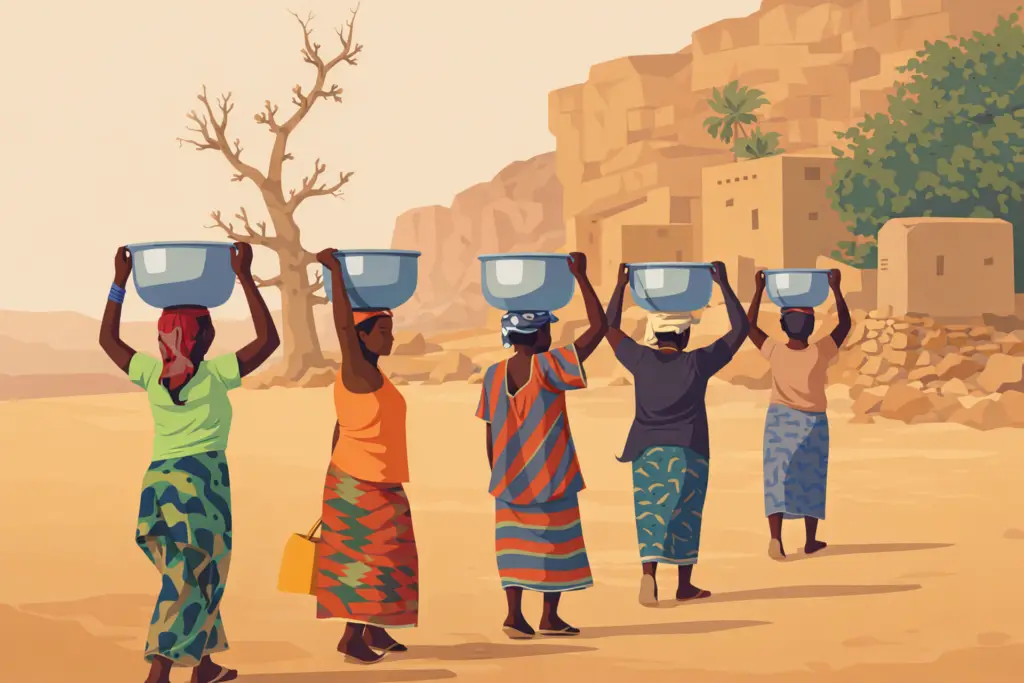
In the Grand Sud of Madagascar, the rain has not properly returned in four years. Farmers in Ambovombe and Amboasary describe fields where maize should stand shoulder-high by April, but this April there is only cracked red earth and the brittle stalks of a crop that gave up in March.
According to data released by FEWS NET in April 2026, the region has recorded one of the driest stretches in four decades — not a single storm, not a single flood, nothing to interrupt the slow arithmetic of thirst since January.
This is not a famine caused by an army. No general has ordered a siege. No government has embargoed a port. And yet, by the World Food Programme’s own reckoning, more than 1.6 million people across southern Madagascar are living with acute food insecurity, and over 110,000 children are already in the emergency phase of hunger (WFP, 2026).
By “no villain,” this series does not mean the causes are simple. It means something narrower: there is no single actor, no clear hand on the lever, that a reader could point to and hold responsible. Aid workers have started describing what is happening here in terms that would have sounded strange a generation ago — some have called it a famine with no real precedent, driven almost entirely by climate rather than conflict.
There is something almost disorienting about a catastrophe with no villain. We are trained, especially those of us who watch the news for patterns, to look for the hand behind the disaster — the dictator, the blockade, the corrupt minister skimming the grain trucks.
Madagascar offers none of these. What it offers instead is a harder question. If the crops fail because the sky simply stopped delivering rain, whose fault is a child’s empty stomach? And if no single culprit exists, does that mean no one is responsible?
In our previous exploration of the private economy of scarcity, we followed a woman in a different corner of the world who had learned to sell water for bread — one bucket, one coin at a time. Madagascar tells that same story, but at the scale of an entire nation, and it asks whether scarcity without an enemy is somehow easier, or harder, to bear.
HISTORICAL PARALLEL
The Blight That Was Natural, The Starvation That Was Not
To understand what a famine without a villain actually looks like, it helps to travel back to Ireland in 1845, where a fungus — Phytophthora infestans — arrived in the potato fields and did what fungi do. It rotted the crop in the ground, offering no warning and asking no permission.
By any strict definition, the blight itself was a natural disaster, indifferent to empire and indifferent to class. The famine that followed, however, was something else entirely.
Ireland in the 1840s was, on paper, food-abundant. Grain, livestock, and butter continued moving out of Irish ports throughout the worst years of the hunger, bound for markets in England, because the export economy was never built to notice starving tenant farmers (Ó Gráda, 1999).
Historians continue to debate the relative weight of ecological disaster, British policy, and the structural poverty that had left Irish tenant farmers dependent on a single crop long before the blight arrived. This series does not need to settle that argument. What matters here is the pattern the argument itself reveals: a natural failure becomes a human tragedy at the point of distribution, not at the point of disaster.
The fungus was blameless. The ships loaded with oats leaving Cork harbor while children starved twenty miles inland were not a matter of weather.
Madagascar in 2026 is not identical to Ireland in 1845 — there is no colonial export economy siphoning grain from starving provinces, no laissez-faire ideology dressed up as economic law. If the tragedy of the past was born from the malice of governance, the tragedy of the present is born from something colder still — the quiet arithmetic of systemic apathy.
WFP’s own operations in Madagascar are currently short by roughly $18.3 million, a gap that has already forced the agency to reduce planned lean-season assistance to just ten percent of the people it originally intended to reach (UN News, 2026). This shortfall exists inside a genuinely crowded field of global emergencies competing for the same finite pool of humanitarian funding — Sudan, Gaza, Haiti, and a dozen other crises are drawing on the same donors at the same time. The drought did not create Madagascar’s funding gap. But the ordinary, unglamorous work of deciding what to fund, and what to fund less, did.
SCRIPTURE
What Scripture Does With a Famine That Has No Enemy
Scripture, it turns out, has surprisingly little interest in identifying the villain behind a famine. It is far more interested in what a community does once the famine has arrived.
“And the seven years of plenty, that was in the land of Egypt, were ended. And the seven years of dearth began to come, according as Joseph had said: and the dearth was in all lands; but in all the land of Egypt there was bread.” (Genesis 41:53–54)
Joseph’s famine in Genesis is never framed as a moral verdict against Egypt. It is framed as a forecasting problem and a storage problem — a crisis survived not through blame but through foresight, through the unglamorous work of building granaries in the years when no one wanted to think about hunger yet.
“Then she arose with her daughters in law, that she might return from the country of Moab: for she had heard in the country of Moab how that the LORD had visited his people in giving them bread.” (Ruth 1:6)
Ruth’s story begins mid-famine, with Naomi’s family already having crossed into Moab as economic refugees. Scripture does not spend a verse asking who caused the famine in Bethlehem. It simply follows what the hungry did next, and finds, eventually, grace waiting for them in a foreign field.
“Hear this, O ye that swallow up the needy, even to make the poor of the land to fail… that we may buy the poor for silver, and the needy for a pair of shoes; yea, and sell the refuse of the wheat?” (Amos 8:4, 6)
Genesis and Ruth are narrative — they show what faithful people did inside a famine. Amos is prophetic judgment — it names what a system did to people because of one. Different genres, the same moral grammar.
It would be easy to read Amos as a story about individual fraud — a few dishonest merchants shaving their scales. But the deeper target of his indictment is the marketplace itself, the machinery that quietly converts scarcity into opportunity for whoever is already positioned to profit from it. That is closer to Madagascar’s present moment than any single villain could be: not a merchant cheating a scale, but a global system of attention and finance that moves, almost mechanically, toward whichever crisis is loudest that month — leaving a quieter, four-year drought to compete for what is left.
Scripture does not require that every catastrophe be interpreted as divine judgment; it does, however, insist that societies eventually reveal the moral conditions under which they have chosen to live.
Read together, these three passages sketch something closer to a pattern than a doctrine: the famine itself is rarely scripture’s real subject. The real subject is always what a community does with its granaries, its roads, its extra portion, once the rain stops.
THE PATTERN
The Numbers Southern Madagascar Cannot Afford to Wait On
Two numbers are enough to hold the shape of this crisis. Nearly forty percent of Madagascar’s children suffer chronic malnutrition nationwide, and more than eighty percent of the population lives on less than $2.15 a day — a threshold so narrow that a single failed harvest can push a household from hardship into catastrophe within a season (WFP, 2026).
These are not abstractions. They describe a farmer walking two or three hours for water that used to be a ten-minute walk from home, and a mother choosing which of her children eats first because there is not yet enough for both.
Numbers like these tend to blur into a kind of statistical fog — the mind protects itself from a million faces by refusing to picture any of them. But when we retreat into that fog, responsibility does not disappear. It evaporates, diffused across so many distant actors that no single one of them feels its full weight.
A psalm of lament works differently than a spreadsheet. It insists on staying with the specific ache long enough for it to mean something.
Joseph’s granaries were not built during the famine — they were built during the seven fat years, when no one wanted to think about scarcity yet. That is the uncomfortable center of the pattern Scripture keeps returning to: foresight is a form of love that has to be exercised before it is needed, or it arrives too late to matter.
Madagascar’s drought has now lasted four years, long enough that this is no longer a story about a single bad season. It is a story about whether the wider world builds its granaries early, or waits — as export ships waited in Cork harbor, as the merchants of Amos waited for a hungry buyer — until the emergency has already announced itself in the bodies of children.
CLOSING REFLECTION
A Famine Without an Enemy Still Asks Something of Us
There is a strange mercy hidden inside a famine with no single villain: it removes the easy exit of outrage. No one gets to spend their compassion on being angry at a dictator or a blockade.
What is left, instead, is the older and less satisfying work Scripture keeps circling back to — building the granary before the seven lean years arrive, walking the extra mile toward the family that has already crossed into someone else’s field looking for grain.
In our previous exploration of the private economy of scarcity, we watched a woman turn scarcity into a private economy, one bucket of water sold at a time, simply to survive a single street in a single city. Madagascar’s drought is that same transaction, scaled up to the size of a nation and stripped of any single enemy to negotiate with — only the sky, the soil, and the slow decisions of everyone watching from somewhere the rain still falls.
The blight in Ireland was never really the tragedy. What people did with their granaries while the blight ran its course — that was the tragedy. And it is also, mercifully, the same granary Joseph built in Egypt three thousand years earlier: a decision made in the years of plenty, waiting to be made again, by every generation the rain eventually forgets.
1. Ó Gráda, C. (1999). Black ’47 and Beyond: The Great Irish Famine in History, Economy, and Memory. Princeton University Press.
2. World Food Programme. (2026). Madagascar Country Page. wfp.org
3. FEWS NET. (2026). Madagascar Food Security Outlook Update, April–September 2026. fews.net
4. UN News. (2026, February). World News in Brief: Madagascar Hunger Crisis. news.un.org