S1 — HOOK
On July 28, a new monument opened on the National Mall, built almost entirely out of light. It holds no stone tablets — only screens, and on those screens, the names of more than 41 million Americans who have served in uniform since the country’s founding.1
The problem it was built to solve is older than any screen. A record can be complete and still go unread. A name can be stored with perfect precision and still mean nothing to the person standing in front of it. Light and stone are both, in the end, wordless — neither becomes a record until somebody speaks over it. Civilizations do not remember because they preserve information. They remember because someone keeps turning what was preserved back into a question, and someone else keeps answering it.
Thirty-four hundred years earlier, twelve men carried a different kind of record out of a riverbed: ordinary stones, stacked with no inscription at all. The instructions that came with that pile still describe the problem more precisely than most monuments built since — and they pick up a story already in progress. In the previous installment, we followed the two spies Rahab sheltered on her roof in Jericho. This installment steps back to just before that city comes into view, to the river the nation had to cross first, and the stones twelve men pulled from its bed so that no one crossing that ground later could do so without asking why.
S2 — HISTORICAL CASE
A Memorial That Nearly Missed Its Own Centennial
Kansas City raised more than two and a half million dollars in ten days in 1919 — roughly fifty million in today’s dollars — to build a monument to the dead of the First World War. President Coolidge dedicated the finished Liberty Memorial in 1926 before a crowd estimated at 150,000. This year marks a century since that dedication.
It is worth noting what kind of war this memorial was built to hold. The First World War left America with no clean second act — no clear sequel of vindication the way the Second World War would later provide the culture, no single villain the country kept retelling to itself. That may be part of why, a lifetime later, a costly and celebrated monument could slide into four years of closure almost without public notice.
By the early 1990s the tower had deteriorated badly enough that the city closed it in 1994. It stood that way for four years — a landmark still technically standing, functionally forgotten — until Kansas City voters approved a dedicated sales tax in 1998 to restore it.2
What Stone Alone Does Not Guarantee
The stone itself had never stopped being stone. What lapsed, for four years, was the community’s willingness to keep asking what it was for. That gap is the part a dedication speech rarely mentions: durability of material and durability of meaning are two different problems, and solving one does not solve the other.
Whoever shaped Israel’s crossing of the Jordan seems to have understood that difference before it had a name.
S3 — BIBLICAL LENS
Twelve Stones from the River
The Jordan does not part the way the Red Sea parted. There is no wind driving it back overnight, no wall of water held for readers to picture later. The priests carrying the ark simply step into the water, and the river — described as overflowing its banks, at flood stage, the least convenient week to attempt a crossing — stops upstream while the riverbed goes dry under their feet (Joshua 3:15–16). They stand there until the entire nation has crossed.
Before anyone leaves that riverbed, Joshua gives an order that has nothing to do with reaching the other side any faster:
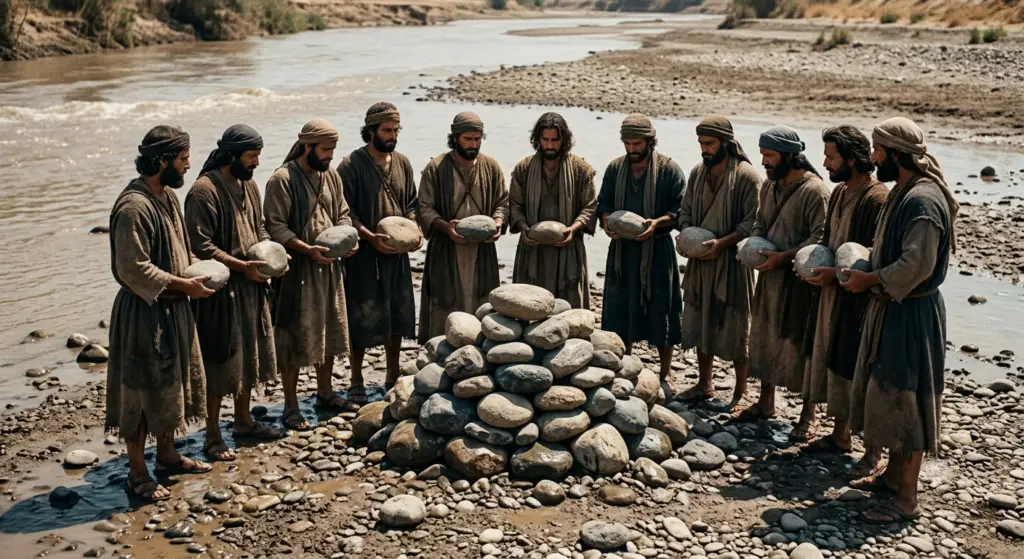
“Take you twelve men out of the people, out of every tribe a man, and command ye them, saying, Take you hence out of the midst of Jordan, out of the place where the priests’ feet stood firm, twelve stones, and ye shall carry them over with you, and leave them in the lodging place, where ye shall lodge this night.” (Joshua 4:2–3, KJV)
Twelve men, one per tribe, each hauling a single stone out of ground that would be underwater again within the hour. Not a quarry commission. A pile assembled in one afternoon by whoever happened to be standing closest to the water when the order came.
Then comes the sentence that turns the pile into something else:
“That this may be a sign among you, that when your children ask their fathers in time to come, saying, What mean ye by these stones? Then ye shall answer them, That the waters of Jordan were cut off before the ark of the covenant of the LORD.” (Joshua 4:6–7, KJV)
The Hebrew behind that question is worth pausing on: mah ha-avanim ha-eleh lakhem — “what are these stones to you.” The law does not script the parent’s opening line. It scripts only the child’s curiosity, arriving first, uninstructed. The later rabbinic tradition would build an entire Passover liturgy around that same asymmetry — a child’s four questions, asked before any adult has spoken, fixed as the opening of the Seder itself. Whatever shape that later liturgy took, the instinct is already present at Gilgal: the text assumes the question comes unprompted, and only then hands the answer to whoever is standing there to give it.
The narrative gives these stones a striking function. Set up as a cluster at Gilgal, they carry no legend a passing traveler could simply read — at least in the logic the text presents. Whatever the stones were meant to do, they were not meant to explain themselves. The explanation was built to live in a person, not in the object, which meant the record’s survival depended on that conversation happening again in every generation that followed.
The Same Clause, Asked a Second Time
Forty years earlier, on the night Israel left Egypt, a nearly identical clause had already been written into the law surrounding Passover:
“And it shall come to pass, when your children shall say unto you, What mean ye by this service? that ye shall say, It is the sacrifice of the LORD’s passover.” (Exodus 12:26–27, KJV)
Same structure, same trigger phrase — what mean ye — attached this time to a meal rather than a monument. The generation that left Egypt built a question into its exit; the generation that entered Canaan built the same question into its arrival. Between those two bookends lies the wilderness — the one generation, according to the text, that did not cross.
What follows at Gilgal keeps this from settling into pure sentiment. Before the stones are even dry, the men of Israel are circumcised — an entire generation born in the wilderness, never marked by the covenant their fathers had carried out of Egypt (Joshua 5:2–7). The text calls this rolling away the reproach of Egypt (Joshua 5:9): a public, physical threshold no one could cross into the land without submitting to first.
Then, camped at that same Gilgal on the plains of Jericho, they keep the Passover — the very meal whose institution had carried the “what mean ye” clause forty years earlier (Joshua 5:10). The manna stops the next morning. They eat bread grown in the land itself for the first time in their lives (Joshua 5:11–12). A generation that had waited its whole life for a promise made to its grandparents sat down, finally, to eat the thing it had been promised.
S4 — PATTERN INSIGHT
What Storage Does Not Do
The wilderness generation did not simply forget what it had seen. Numbers and Deuteronomy are specific about the failure, and it is not a failure of information: unbelief, rebellion, fear of the report the twelve spies brought back (Numbers 14:1–4; Deuteronomy 1:32). They had witnessed the plagues, the sea, the fire on the mountain — enough to remember. What never happened was for that memory to govern what they feared in the present. Memory without trust is just an archive nobody consults when it matters.
The sociologist Maurice Halbwachs argued, nearly a century ago, that memory is never purely private — it survives only inside groups that keep rehearsing it together, in language, ritual, and place (Halbwachs, 1925/1992). The Egyptologist Jan Assmann later sharpened that claim: what he called communicative memory lives in living witnesses and tends to fade within about three generations, while cultural memory survives only where a community has deliberately built rituals, texts, or monuments meant to outlast any single witness (Assmann, 1995). An archive is not automatically cultural memory in that sense. It becomes cultural memory only once a community keeps performing it.
Researchers who study how nations remember their own wars have measured a version of the same gap. Subjects were asked to recall the ten most important events of the Civil War, the Second World War, and the Iraq War. Across all three conflicts, most individual events were recalled by fewer than a quarter of respondents (Zaromb, Butler, Agarwal, & Roediger, 2014).3 Knowledge did not fail all at once. It thinned generation by generation, the further an event sat from anyone left to answer for it.
I keep coming back to how ordinary the mechanism turns out to be. Memory does not usually die from an event. It dies from the absence of a reason to keep repeating it out loud.
That reframes the real contrast here — not stone against screen, but storage against transmission. A screen can hold forty-one million names with far more precision than any stone cluster ever could, and still lose the thing a stone was built to protect, if fewer descendants ever stop long enough to ask what any single name cost. An archive answers a query. A living memory has to be re-performed by someone who was not there, standing in front of someone who asked. Kansas City’s own memorial, closed and unread for four years, is proof the two can fail independently of each other — the stone stayed intact the entire time.
Scripture’s design was never to build something that could not be forgotten. Nothing built by hands clears that bar, stone or screen alike. It was to build something that could not be quietly passed without a question attached — odd enough, placed deliberately enough, that a child would ask on their own, and a nation would be obligated to answer.
S5 — CLOSING
What the Stones Were For
The twelve stones sat at Gilgal for generations, still there “unto this day” at the time the text was written (Joshua 4:9). No inscription was ever added. The stones stayed illiterate on purpose, because their design depended on someone else doing the talking.
Every generation since has faced the same small decision Israel’s children faced at Gilgal — whether a strange object in the landscape is worth stopping for, and whether the answer, once given, is worth carrying to the next child who asks. A tower in Kansas City sat dark for four years before its own descendants chose to reopen it. A wall of light on the National Mall now holds forty-one million names that will only mean what someone keeps choosing to explain. Stop explaining, and even the grandest monument stops being a memorial — it becomes only shaped rock, or a database no one thinks to query.
The Jordan closed back over that riverbed within the hour. The stones on the bank never moved again.
1. Claire Jenq and Emely Miranda-Aguilar, “‘Read their names, remember their stories’: National Military Monument honors service members past and present,” Stars and Stripes, July 29, 2026.
2. National WWI Museum and Memorial, “Marking 100 Years: Liberty Memorial Centennial,” 2026.
3. Franklin Zaromb, Andrew C. Butler, Pooja K. Agarwal, and Henry L. Roediger III, “Collective memories of three wars in United States history in younger and older adults,” Memory & Cognition 42 (2014): 383–399.