The Watchtower Files
A Field Nobody Asked Permission to Enter
By the time the combines showed up, Greg Coleman had already stopped expecting them.
He’d told his neighbors, plainly, that the wheat might just sit. A diagnosis of colon cancer does that — it doesn’t just take the season, it takes the reflex of asking for help, because farmers in that part of Nebraska are not, as a rule, people who ask. Coleman farmed the way most of his neighbors farmed: alone in the cab, alone with the numbers, alone with whatever the doctor had said that week.
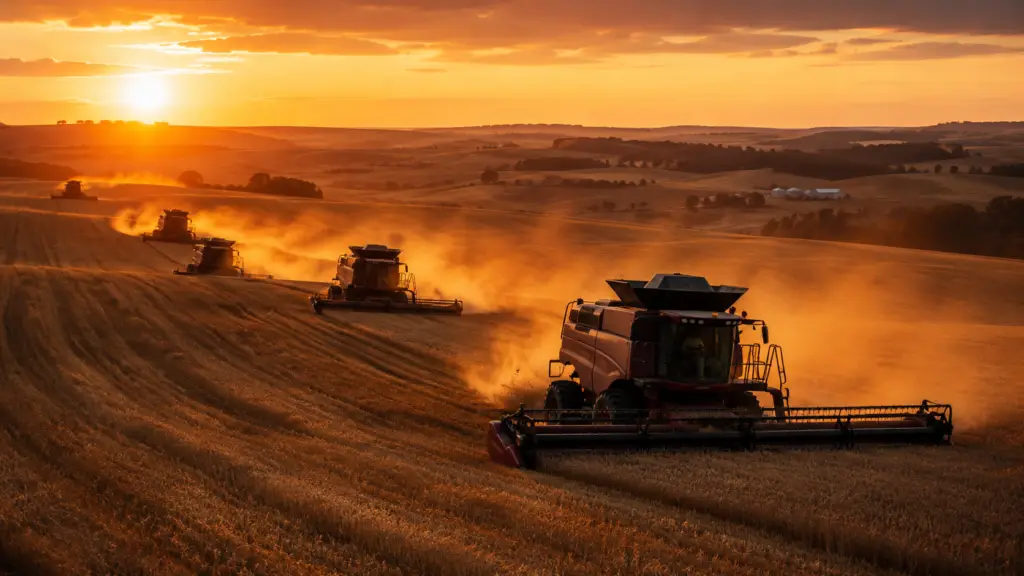
Then one morning that changed. Trucks came down the county road in a line that had no business forming itself. According to local reporting, close to ten families arrived with their own combines and grain carts. Nobody had sent an invitation. Somebody had simply made a phone call, and the call had made another call, the way water finds the low ground without a map.
In the previous installment of this series, we followed a man who forgave the person responsible for his son’s death — a story about the debt that gets canceled on purpose, at cost, by one person’s decision. This one runs in a different direction. Nobody here forgave a debt. They simply refused to let one come due. The wheat that should have taken three weeks of a sick man’s failing strength came down in a single day, crew after crew rotating through roughly 160 acres every couple of hours, until 1,000 acres that had no legal claim on anyone’s time were finished before supper.
What stays with you isn’t the tonnage. It’s the ordinariness of it — the fact that nobody filmed it for a lesson, nobody asked Coleman to say something inspirational into a microphone. They just came, cut the grain, and mostly went home.
The Barn That Went Up Overnight
There’s an older name for what happened in that field, even if nobody used it that day.
For much of the nineteenth century, a farm family on the American frontier could not build a barn alone. The frame was too heavy, the beams too long, the deadline set by winter too unforgiving to negotiate with. So a custom formed instead: the barn raising. Neighbors — sometimes from ten, twenty, even sixty miles off — arrived on an agreed morning with tools, teams of oxen, and food enough to carry the group through nightfall.
As one chronicler of early Pennsylvania farm life put it, the custom wasn’t uniform — it varied by region, by ethnic community, by how isolated a settlement was, and it’s worth resisting the urge to flatten it into one tidy system. But across most accounts, one thing holds: in many rural communities, the barn raising was less an act of exceptional generosity than an acknowledgment of mutual dependence. Skill, labor, and time functioned as a kind of informal currency long before cash reliably did. You helped raise your neighbor’s barn because your own, sooner or later, would need raising too. It was kindness, but not kindness alone — underneath it sat something closer to an unspoken contract everyone had agreed to without signing anything.
Alexis de Tocqueville, touring the country a few decades before wheat like Coleman’s was even planted, had a name for that instinct: self-interest properly understood — the shrewd, unsentimental discovery that helping a neighbor today is insurance for a self helped tomorrow. Wendell Berry, writing much later from his own Kentucky farm, would have recognized it instantly; he spent a career arguing that no one, least of all a farmer, is as self-sufficient as the myth insists.
That’s worth naming plainly, because it isn’t quite what happened in Coleman’s field. A barn raising, and Tocqueville’s self-interest alike, assume reciprocity — that the favor might, someday, run the other way. Cancer doesn’t make that promise. Most of the crew cutting Coleman’s wheat knew he might not be well enough to return it next season, or any season. Whatever that morning was, it had moved past mutual aid into something Scripture has an older word for — grace — and the difference turns out to matter more than it first appears.
What the Grain Un-Gleaned by Ruth Still Says
“And Ruth the Moabitess said unto Naomi, Let me now go to the field, and glean ears of corn after him in whose sight I shall find grace… And her hap was to light on a part of the field belonging unto Boaz.” (Ruth 2:2-3, KJV)
The “corn” in that older English isn’t maize — it’s grain generally, barley in Ruth’s case. Long before anyone in Nebraska thought about wheat, an older set of laws had already tried to legislate this same instinct into permanence. A landowner in ancient Israel was told not to reap the corners of his field or go back for the sheaf he’d missed — that margin belonged, by design, to the widow, the foreigner, the poor.
But read past the opening verses and Boaz does more than comply. He tells Ruth not to glean in anyone else’s field. He orders the young men not to touch her. He lets her drink from the water his own workers drew. Later, he tells his workers to pull extra grain from the bundles and leave it for her — not owed, not legislated, simply given. The law required the field to stay open at its edges. Boaz turned an obligation into something closer to hospitality.
It’s worth distinguishing this from modern charity or welfare, which mostly operate through structures built to stay separate from the people they serve. The gleaning law didn’t create a program to administer. It cracked the boundary of ownership itself, just at the edges, and left it open on purpose — closer to a small, permanent wound in the idea of private property than to a policy.
That’s the same seam running through Coleman’s field. A custom, or a law, can require a community to leave a margin open. It cannot require a hundred and sixty acres an hour, ten families showing up unpaid, a debt nobody intends to collect. That part has to be chosen, past whatever the code obligates.
“Bear ye one another’s burdens, and so fulfil the law of Christ.” (Galatians 6:2, KJV)
Centuries later, a very different kind of letter — written to a scattered, quarreling group of new believers in Galatia — used almost transactional language for the same instinct. Not “feel sympathy for one another’s burdens.” Bear them. Take physical weight off another person’s shoulders and carry it, for a while, as your own.
“Two are better than one; because they have a good reward for their labour. For if they fall, the one will lift up his fellow: but woe to him that is alone when he falleth; for he hath not another to help him up.” (Ecclesiastes 4:9-10, KJV)
Reciprocity and grace aren’t the same thing, and this essay hasn’t tried to pretend otherwise. But they share a refusal — of the idea that a person is, or should be, a sealed and self-sufficient unit. A Moabite widow gleaning behind strangers, a first-century church told to carry each other’s weight, a Nebraska crew with nothing to gain from Coleman’s field: the same refusal, expressed in two different registers — one that expects return, one that doesn’t.
Scripture resists any tidy formula that turns a hard season into a verdict handed down from above. What it will not permit, though, is the comfortable idea that a community’s character is invisible until tested — because the field, the corner of Boaz’s harvest, the debt nobody collected, all suggest the opposite: a people’s true condition is exactly what surfaces the moment someone in it can no longer stand on their own.
What the Ledger Cannot Hold
If you went looking for a national statistic on how often this happens — how many acres get harvested each year by neighbors instead of hired hands — you’d come up mostly empty. The USDA tracks yield per acre, commodity prices, farm debt. It has no line item for a phone call that starts with “did you hear about Greg” and ends with sixty people showing up unannounced.
Modernity is exceptional at pricing transactions. It is nearly blind to obligations fulfilled before anyone agreed on a price. That’s not really a flaw in the accounting — it may be closer to the reason this kind of aid still exists at all. The moment a favor gets priced, it tends to stop being the thing it was.
Coleman’s field isn’t an outlier so much as a recurring shape — the same shape found in a Kansas wheat harvest organized for a farmer with pancreatic cancer, the same shape found in a Washington field where sixty neighbors finished three weeks of work in six hours for a man with stage 4 melanoma. Different states, different diagnoses, the same instinct arriving on the same kind of morning, uninvited.
Scripture’s gleaning law was never framed as charity to be tallied and reported. It was framed as a boundary the field itself had to leave open — a thing that, by definition, resists being counted, because counting it would turn it back into a transaction.
The Debt Nobody Will Let You Repay
Coleman’s daughter told a reporter, after that day, that words couldn’t quite hold what the community had done for her family. It’s common enough to say something like that; it might even sound like reflex more than a real sentence. But sit with it a moment and it says something more specific than gratitude — that the gift arrived too large to be paid back in kind, and everyone present already knew it, and came anyway.
There’s a danger in romanticizing this kind of dependence, worth naming before closing. Rural communities can be generous and suffocating in the same year. The same networks that show up for a harvest can also enforce a narrow kind of belonging on anyone who doesn’t fit it. Mutual dependence isn’t automatically virtuous just because it reads warmly on the page. But the opposite conviction — that a person should, in principle, need no one — isn’t neutral either. It’s a quieter kind of failure, one that doesn’t announce itself until the season a person can no longer work the field alone.
That’s the hinge the whole story turns on, and it’s the same hinge Ruth stood on in Boaz’s field: real help was never meant to balance the books. It was meant to interrupt them. None of it works if the receiving side is expected to settle the account later.
None of this is a promise. Scripture doesn’t guarantee a community will show up — plenty of its own stories are about the ones who didn’t. Coleman’s field isn’t proof that grace always arrives on schedule. It’s one morning, in one county, when it did. It’s a fair question for anyone living inside the newer arrangement too — the remote log-in, the delivery app, the door that stays locked out of habit rather than fear — not because those things are wrong, but because they make it easier to forget the question is still being asked. What Coleman’s field leaves behind isn’t a formula. It’s a harder question than the one this essay started with — not whether God sees a hard season, but whether the people around you have been given permission to be part of the answer, and whether you would let them.
1. On the varied but broadly reciprocal character of frontier barn raisings, see historical accounts collected in Encyclopedia.com’s overview of American barn-raising customs and Stevenson Whitcomb Fletcher’s Pennsylvania Agriculture and Country Life, 1640–1840 (Pennsylvania Historical Commission).
2. Description of pioneer mutual aid as an informal economy of traded skill, tools, and labor, per regional histories of 19th-century Ontario frontier settlement.
3. Custom-harvest and crew-cost benchmarks are tracked in USDA and extension-service farm risk-management publications. Additional reporting drawn from the Fremont Tribune’s coverage of the Merna, Nebraska community harvest.
New essays every week. Delivered quietly.