A Man Who Bowed in Order to Look
What would it take for a general to surrender on purpose? Not to spare his men or to save a city, but only to be looked at by the enemy long enough to look back.
In 612, a Goguryeo statesman named Eulji Mundeok walked into the camp of an invading Sui army. The Korean chronicle says he came under a pretense of submission, intending to see how matters stood inside the enemy’s lines (Samguk Sagi, 1145).1 The Chinese history says the Sui commanders had planned to seize him if he appeared, and that he got away (Book of Sui, 636).2
I have returned to that scene more often than to the battle that follows it. A battle can be summarized; this was one man’s decision, made in a place where the other side may already have been waiting for him, and where looking harmless was the only cover he had chosen.
In the previous installment, we stood in a council room in Constantinople where the only question was whether an emperor should take the harbor. Salsu begins at the other end of that question, with a man who walked toward the danger and then, in the Korean tradition’s telling, retreated from it seven times in a single day.
Each Man His Own Supply Wagon
Emperor Yang’s campaign of 612 was meant to overwhelm. The Chinese histories give a nominal force of about 1.13 million combat troops, with support troops numbering roughly twice that, and say it took some forty days for the army to march out. Modern scholars treat such totals with caution, and some estimates run far lower.
What matters for Salsu is narrower. When the main force stalled before the fortress of Liaodong, Yang detached a strike column of roughly 305,000 men under the generals Yuwen Shu and Yu Zhongwen, with orders to bypass the siege and reach Pyongyang.
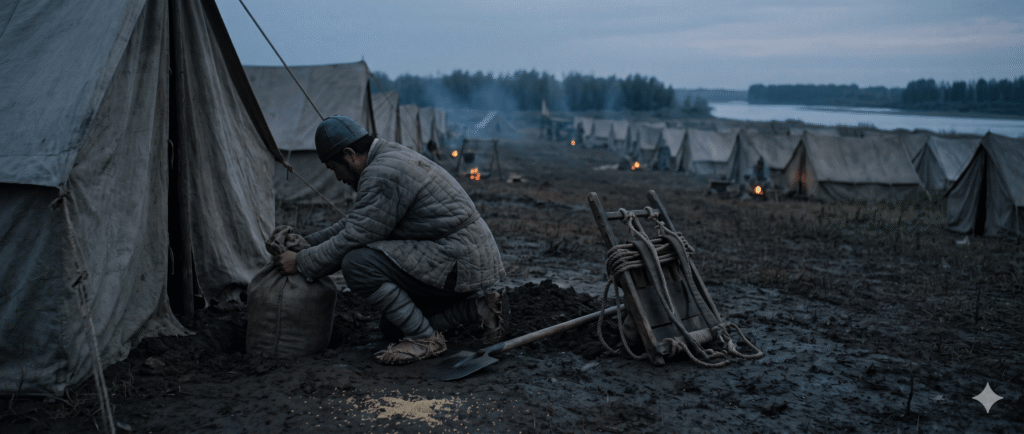
Supply was the column’s chronic problem. Yang’s answer was to order each soldier to carry his own food, which added enormously to what every man already bore. Sima Guang’s Zizhi Tongjian (1084) preserves the detail that soldiers, unable to manage the load, buried part of their grain at night instead of hauling it forward.3
This was the army Eulji entered. According to the Korean chronicle, a Sui official argued against detaining an envoy who came in submission, the commanders relented, and they thought better of it too late; he had already crossed the Yalu.
The Book of Sui, compiled under the dynasty that replaced the Sui, adds a detail that matters more than the escape. On seeing how hungry the soldiers were, Eulji resolved to wear them down further. “Scouting” is my word for what he did. The sources say only that he looked, and that what he saw shaped his plan.
The pursuit that followed ran on a series of small successes. The Chinese history counts seven engagements won by the Sui, and the Korean tradition says Goguryeo’s troops gave way on purpose, seven times in a single day. Each win drew the column farther from its supplies, to within about thirty li of Pyongyang. Eulji then sent word of feigned submission and, in the Korean tradition, a poem that praised the Sui generals’ brilliance and suggested they had won enough to stop.
They could not take the city, and they could not stay. When the column turned back, Goguryeo troops struck its rear as it crossed the Salsu, usually identified with the modern Cheongcheon River. The Korean chronicle says only about 2,700 of the 305,000 reached the Sui lines again, a figure some records put slightly higher. It should be read as a chronicle’s number, not a verified headcount.
Later popular retellings describe Goguryeo damming the river and releasing it on the crossing. The earliest accounts I have consulted say nothing of a dam. They describe something less theatrical and more crushing: a column already in disorder, struck in the middle of a crossing.
Yuwen Shu and Yu Zhongwen were taken back in chains and stripped of rank. Yang launched two more campaigns, in 613 and 614, and the dynasty fell in 618. Historians commonly count the Goguryeo wars among the strains that broke it, though not as the only one (Xiong, 2006).4
A Chariot Army and an Ancient River
The Book of Judges also tells of a commander who came with more than his enemy could match. Sisera led nine hundred chariots of iron (Judges 4:3), against a people with little to put in the field beside them. Before the battle, Deborah says something odd about how it will unfold:
“And I will draw unto thee to the river Kishon Sisera, the captain of Jabin’s army, with his chariots and his multitude.”Judges 4:7 (KJV)5
The verb is draw. Sisera is not met where his chariots are strongest. He is pulled toward ground where they stop being an advantage. The song that follows records the outcome in a single line:
“The river of Kishon swept them away, that ancient river, the river Kishon.”Judges 5:21 (KJV)
A psalm turns such episodes into a confession:
“There is no king saved by the multitude of an host: a mighty man is not delivered by much strength.”Psalm 33:16 (KJV)
The two stories are not twins. Judges credits the luring to God, speaking through Deborah, while the chronicles of Salsu credit it to a man’s calculation. What they share is narrower: both unsettle the assumption that visible strength decides the outcome.
In each, the source of an army’s confidence became the source of its exposure: iron chariots beside a river that swept them away, a soldier’s own provisions on a road that kept lengthening. Psalm 33 does not read this as a lesson in tactics. It is a confession about the limits of human power, that kings, armies, and sheer mass cannot guarantee their own rescue.
One further caution. Judges records Jael’s deception of Sisera and praises it, but a narrative’s approval is not an instruction to imitate. The same restraint applies to Eulji. We can understand his ruse without treating every successful deception as a virtue.
When an Order Outlives Its Army
Set the figures down plainly. A column of 305,000, by the Korean chronicle’s account, brought back about 2,700. The arithmetic deserves loose handling, but the Chinese history gives the same order of magnitude, and the direction of the story is not in doubt.
Two easy explanations compete for those numbers, logistics and cunning. They read better as layers of one event. Supply decides how long a column can keep advancing.
Judgment decides how accurately its commanders understand that limit. An opponent’s strategy decides what a misjudgment will cost. The Sui column had the first problem, made the second error, and met the third.
The detail I cannot get past is how ordinary the burden was. A soldier asked to shoulder his own food was not facing a dramatic hardship, only a heavy bag on a long road. The buried grain was not by itself the cause of the defeat. It was a sign that the plan had grown heavier than the men could bear.
The command could still order an advance. It could no longer assume the men had the strength to sustain one. The order to advance outlasted the army’s ability to obey it.
An earlier essay here read Scripture’s accounts of provision as a relay more than a transaction, and followed a washerwoman whose arthritic hands could not lift the last six dimes across a bank officer’s desk, so someone else carried them for her (Ten Dimes). Yang’s order ran the other way. It answered a failing supply line by handing the problem to each man alone, as a weight on his own back.
The question from Constantinople carries over, though it changes shape. It is not whether a person moves toward danger or away from it, but whom the movement protects and who ends up paying.
From a distance, Goguryeo’s repeated withdrawals look like flight. Their purpose, as the chronicles frame it, was the reverse: to keep Goguryeo able to resist while the invading column wore itself thin. Nothing about this makes the withdrawals cheap, only easier to praise at a distance than to order in the moment.
The same arithmetic shows up in a recent essay on contentment, which asked who else stands downstream when someone decides what is enough. At Salsu, the plan’s measure of enough was set in a tent far from the road. The men downstream of it, conscripts whose names no chronicle kept, were the ones who carried it.
The Grain Left in the Ground
Return to the tent. The Sui commanders, as the Chinese history tells it, had meant to take him and did not. What he carried out of that camp, if the Book of Sui is right, was a single observation: the men were hungry.
I trust the men with shovels more than the men with maps. A map reports the planned road, while grain and fatigue report whether the road can be walked.
This is no rule that commanders are blind and soldiers wise. At Salsu, the map and the grain never met. The record is partly a record of what an army will overlook about its own people in order to keep moving.
None of this makes the story clean. A man lied his way into an enemy camp, the lie worked, and the lie is a large part of why the story is remembered. Scripture does not tidy that discomfort away, and neither should we.
The general who surrendered on purpose had put a question to the Sui camp, and by the tradition’s own telling, part of the answer was already underground.
1. Kim Pu-sik, Samguk Sagi (1145), vol. 44, “Biography of Ŭlchi Mundŏk”: the pretended submission, the seven retreats, the poem, the survivor figure.
2. Book of Sui (completed 636), annals of Emperor Yang and biographies of Yuwen Shu and Yu Zhongwen: the plan to seize Eulji, his observation of the troops’ hunger, the seven engagements, the survivor figure.
3. Sima Guang, Zizhi Tongjian (1084), entries for 612: the supply burden and the burial of grain.
4. Victor Cunrui Xiong, Emperor Yang of the Sui Dynasty (SUNY Press, 2006): the Goguryeo campaigns and the dynasty’s collapse.
5. Scripture quotations are from the King James Version.
New essays every week. Delivered quietly.