The Dimes She Could Not Lift
On Saturday, March 7, 2026, under an overcast sky, a ribbon was cut outside a house on Miller Street in Hattiesburg, Mississippi, opening it to the public as a museum (University of Southern Mississippi [USM], 2026; WDAM, 2026).1 The house had been the home of Oseola McCarty, a washerwoman, and the day would have been her 118th birthday. Inside, storyboards, photographs and keepsakes now tell the story of a woman who took in other people’s laundry for roughly three-quarters of a century (Lundy, 2017).2
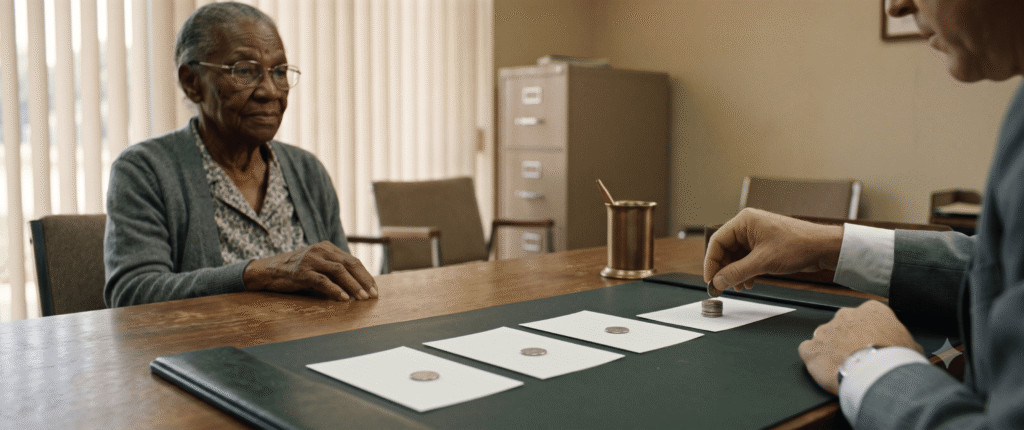
Among those who spoke was Paul Laughlin, a retired trust officer at Trustmark Bank. He described a summer afternoon in 1995 when McCarty, then eighty-seven, walked into his office already knowing where her savings should go: to her church, to three cousins, and to the university down the road (USM, 2026).1 To help her divide it, he set out ten dimes, each standing for a tenth of what she had, along with index cards bearing the names of the beneficiaries.
She set the first dime on the card for Friendship Baptist Church, then one on each cousin’s card. Then, as Laughlin remembered it, she looked up and told him, “My arthritis won’t let me lift the rest, you put them there.” He placed the remaining six on the university’s card, sixty percent of her life’s savings.
Most of what has been written about McCarty concerns the sum. What held me longer was the table: the last six-tenths of a lifetime’s savings crossing it by another person’s hand, because arthritis had left her unable to place them herself. What follows traces where those dimes were headed, and what had stood at the other end of that road for most of her life.
The Campus She Had Never Entered
McCarty was born on March 7, 1908, in Shubuta, Mississippi, and raised largely by her grandmother, who moved the family to Hattiesburg in 1916 and kept the household going by taking in laundry (Lundy, 2017). In the sixth grade McCarty left school to look after an ailing aunt. By the time the aunt recovered, she later told the university’s news service, her classmates had gone ahead, and she did not return (Contemporary Black Biography).3 She had wanted to be a nurse (USM, 2023).4 Stephanie Bullock Ferguson, the first McCarty scholar, said at the museum opening that McCarty wanted students to have the opportunity she herself was not given (USM, 2026).1
What she did instead was wash. She laundered and ironed for some of the most prosperous households in Hattiesburg until arthritis stopped her in 1994 (Marquez, 2025).5 She never owned a car, and she pushed a shopping cart nearly a mile to buy groceries; the air conditioner she finally bought ran only when she had company (Lundy, 2017). By her own account, the coins went first under the lining of a child’s doll buggy, and her church offering came out before anything else was saved, a rule she made for herself (McCarty, Guideposts).6
Rick Bragg’s 1995 profile in the New York Times listed the occasions her work prepared other people for and never invited her to, closing with “graduations she never saw” (Bragg, 1995, as excerpted by Nieman Storyboard).7 For most of her life, the university down the road was closed to people like her.
She lived blocks from the campus and did not set foot on it until August 1995, when she came as a guest of honor to the fall convocation (Lundy, 2017). Nothing I found suggests she ever applied there; the closing of that door was the school’s policy, and she lived on the far side of it. Under its earlier name, Mississippi Southern College, the school turned away Clyde Kennard, a Black Army veteran from nearby Eatonville, in 1955 and again in 1959 (MDAH; Mississippi Freedom Trail).8 In 1960 he was arrested over five bags of stolen chicken feed worth twenty-five dollars, convicted, and sentenced to seven years. He was paroled with cancer in 1963 and died that year. Nearly forty years after the trial, the man whose testimony convicted him admitted the case had been a sham, and in 2006 a circuit court exonerated him (Mississippi Secretary of State; Mississippi Freedom Trail).8 The first Black students enrolled in 1965 (MDAH).8
Another essay here stood in a New Orleans classroom that same year, where the threshold was a first-grade desk (The Second Desk). In Hattiesburg the threshold was a college application, and the road from it ran through a courtroom. An essay here on the Dreyfus Affair and the prophet Amos asked why institutions defend a wrong verdict once admitting error seems costlier than continuing it (When the Prudent Keep Silent); Kennard’s file, which stood uncorrected until 2006, sits near that question.
McCarty’s money came thirty years after the first Black students enrolled, and it did not settle that history. It arrived inside it, with a stated preference for Black students who could not otherwise afford to attend (Lundy, 2017; Marquez, 2025).
Two Coins, Macedonia, and Bread on the Water
Three passages sit near this story, and each does a different job: one measures a gift, one asks who chose it, and one keeps the time.
The first comes just after Jesus warns about scribes “which devour widows’ houses” (Mark 12:40, KJV).9
And he called unto him his disciples, and saith unto them, Verily I say unto you, That this poor widow hath cast more in, than all they which have cast into the treasury: For all they did cast in of their abundance; but she of her want did cast in all that she had, even all her living.
Mark 12:43–44 (KJV)
Placed beside that warning, the scene is read two ways. Some hear praise for the widow. Addison Wright argued in 1982 that it is closer to a lament over a system that takes a widow’s last coins, a reading other commentators find strained (Wright, 1982).10 Either way, a reader cannot admire a poor person’s sacrifice without asking about the arrangement around it.
McCarty’s gift differed in nearly every outward respect. She kept enough to live on, provided for her church and her cousins before she named the university, and made the plan herself, with a lawyer who checked that she still wanted to go ahead (McCarty, Guideposts).6 That pause before an irrevocable trust (Contemporary Black Biography)3 mirrors the one an earlier essay here defended in a drug reviewer who would not approve until the evidence arrived (The Signature She Withheld): there the pause held back a yes, and here it made sure a yes was meant. In this passage the gift is weighed against what the giver has left, not against the size of the pile.
How that in a great trial of affliction the abundance of their joy and their deep poverty abounded unto the riches of their liberality. For to their power, I bear record, yea, and beyond their power they were willing of themselves.
2 Corinthians 8:2–3 (KJV)
Paul describes churches in Macedonia, and the phrase to hold onto is the last one: they were willing “of themselves.” The question it raises is who chose. McCarty’s own account is plain. After a dime for the church and one for each cousin, she said, the six that remained were for a dream she had always had (McCarty, Guideposts).6 Her banker remembered her arriving with the beneficiaries already named (USM, 2026).1
Cast thy bread upon the waters: for thou shalt find it after many days.
Ecclesiastes 11:1 (KJV)
Readers have taken this verse as an image of seaborne trade and as a call to open-handed giving, and the essay need not choose. What it keeps in either case is time. The verse does not say where the bread will be found, or in whose hands. A woman who began saving as a child with a doll buggy and made her last allocation at eighty-seven was working on that long a clock, and the clock outlasted her.
Her social life centered on her church and her Bible (Lundy, 2017), but nothing I found shows her reaching for any of these verses to explain what she did. They are the lens I bring, not hers.
Nothing in this story makes the lost schooling or the closed door part of a plan, and Scripture does not ask us to read hardship as a judgment on the person who bears it. It does keep insisting that a community, over time, shows whom it shut out and whom it chose to carry.
A Relay Run Over Thirty Years
Three figures mark the stretch. In 1995 she designated $150,000 for the university, out of savings that accounts place between $250,000 and $280,000 (Lundy, 2017). Local business leaders matched it almost at once, and within four years more than six hundred donors in over thirty states had raised the fund to nearly a quarter of a million dollars (Lundy, 2017). In March 2025 the USM Foundation announced that the endowment had reached $1 million, enough for twenty scholars to receive $2,000 each year, and by March 2026 it had supported 142 students in all (USM Foundation, 2025; USM, 2026).11
Numbers like these tempt a reader toward the arithmetic of compounding. That reading is not false, but it leaves out who did the growing. A share of everything after 1995 belongs to strangers who answered her.
Scripture’s accounts of provision tend to run the same way. Manna came by the day and spoiled when hoarded (Exodus 16:19–20). The edges of a field were left unharvested for someone else to glean (Leviticus 19:9–10). Paul spent part of his ministry carrying a collection from churches in Macedonia and Achaia to the poor among the saints in Jerusalem (Romans 15:26). Provision, in these texts, behaves more like a relay than a transaction.
The hand that starts a relay seldom crosses the line. McCarty saw one leg of hers. The first recipient of the scholarship, Stephanie Bullock, grew close to her benefactor, and McCarty told her that her one wish was to see Bullock graduate. Bullock graduated in May 1999; McCarty died at home that September (Lundy, 2017).
Laid out plainly, her method looked less like heroics than bookkeeping. She began as a child and kept at it for decades, set the church’s share aside first, put the beneficiaries’ names on paper, and asked a lawyer to confirm that she meant it. She declined requests to put her name on a building while she lived. Asked why she lived so plainly while giving her savings away, she replied with a smile, “I am spending the money on myself” (Lundy, 2017).
Two facts have to be held together here. Her money opened a path for 142 students by the university’s count. And the university that received it had, for much of her life, denied entry to Black students (Lundy, 2017); its campus now holds buildings in two names, Kennard-Washington Hall, dedicated in 1993, and a residence hall that bears hers (Mississippi Freedom Trail; Lundy, 2017). A gift can open a way without undoing what made the way necessary.
What Six Dimes Could Carry
In the previous installment, we followed Emily Roebling, whose labor waited more than a century for its record (The Telescope in Brooklyn Heights). McCarty was honored in her own lifetime, and the honors still left the older question standing: why that door had been shut at all.
On the March morning of the ribbon-cutting, the detail the crowd was handed was not the $150,000. It was a pair of hands. Hands that had earned every dollar on the table reached the moment of giving and could place only four of the ten dimes.
The dimes she could not lift crossed the table in someone else’s hand, and they have kept moving: to twenty scholars a year, to the donors who answered her, to a house on Miller Street with a ribbon cut in front of it.
On that table each dime was ten cents and a tenth of a lifetime’s savings at once. Six of them opened, for students who came after her, the door she never walked through as a student, and what they began now rests with the people who answered her.
- USM News, “Oseola McCarty House Museum Depicting Life and Legacy of Former Washerwoman and Nationally Renowned Philanthropist Now Open to the Public,” March 7, 2026; WDAM, “Sixth Street District honors Hattiesburg philanthropist by opening McCarty House,” March 8, 2026.
- Karen Saucier Lundy, “Oseola McCarty,” Mississippi Encyclopedia, Center for the Study of Southern Culture, University of Mississippi, published July 11, 2017, updated April 14, 2018.
- “McCarty, Oseola 1908–,” Contemporary Black Biography, reproduced on Encyclopedia.com.
- USM News, “USM Salutes Renowned Benefactor Oseola McCarty on 115th Birthday,” 2023.
- Susan Marquez, “Mississippi Legends: Oseola McCarty, an Unlikely Philanthropist,” Magnolia Tribune, April 27, 2025.
- Oseola McCarty, first-person account, “Oseola McCarty Created a Scholarship Fund—One Load of Laundry at a Time,” Guideposts.
- Rick Bragg, “All She Has, $150,000, Is Going to a University,” New York Times, August 13, 1995, as excerpted in Nieman Storyboard, “Featured Fellow: Rick Bragg,” 2013.
- “Clyde Kennard: A Little-Known Civil Rights Pioneer,” Mississippi History Now, Mississippi Department of Archives and History (MDAH); Mississippi Freedom Trail marker, Kennard-Washington Hall, University of Southern Mississippi; Mississippi Secretary of State, Mississippi Bicentennial history series, sos.ms.gov.
- Scripture quotations are from the King James Version (public domain).
- Addison G. Wright, “The Widow’s Mite: Praise or Lament,” Catholic Biblical Quarterly 44 (1982): 256–265. For a dissent, see Elizabeth Struthers Malbon, In the Company of Jesus: Characters in Mark’s Gospel (Westminster John Knox, 2000), 176.
- USM Foundation, “Oseola McCarty’s Legacy of Generosity Reaches $1 Million Milestone,” March 2025; USM News, March 7, 2026.