Hook
The Man Who Ran a Bridge From a Window
On the night of July 4, 2026, a fire broke out on the Brooklyn Bridge while the city’s fireworks show was still under way. The span had been closed to traffic, and firefighters were seen dousing the flames shortly before ten o’clock. No one was reported hurt (AP, 2026).1
It was the nation’s 250th birthday, and a bridge 143 years old spent a few minutes of it wrapped in smoke. Smoke makes headlines. I keep returning to a detail that never has.
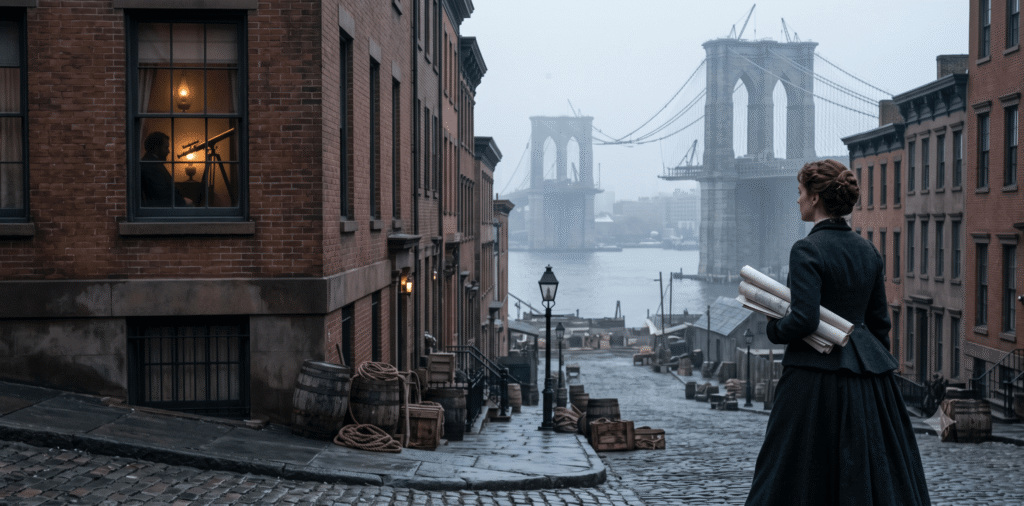
After Washington Roebling and his wife moved into a house with a view of the bridge in 1877 (HISTORY.com, 2025),2 the man who held the title of chief engineer did much of his work from a bedroom window. By most accounts he watched the construction through a telescope and wrote out notes and directions for the engineers below (Museum of the City of New York).3 He could not go down himself. The illness that kept him there had begun in 1872.
His wife went down the hill in his place.
Emily Warren Roebling carried those notes to the site, handled his correspondence with bridge officials, and was a constant presence at the meetings where the project’s future was decided (Juravich, 2018; Encyclopedia.com).4,5 The bridge carries the family’s name. This essay is about the distance between a window and a worksite, and about what a record does with the person who walks it.
Historical Case
The Title That Stayed Put
The design was John Roebling’s, and the project nearly ended with him. An accident on the site in 1869 led to tetanus, and he died less than a month later. His son Washington, thirty-two years old, became chief engineer (Juravich, 2018).
Washington was a hands-on engineer, and he worked beside his crews in the caissons, the pressurized chambers sunk beneath the East River, at a time when the danger of surfacing too fast was not understood. The decompression sickness that followed nearly paralyzed him and left him unable to bear bright light, loud noise, or crowded rooms for years (Juravich, 2018). He kept the title and kept giving the directions. Nothing in the record makes him a figurehead; the design and the intention were still the Roeblings’.
Emily’s work, though, was larger than a courier’s. According to Marilyn Weigold’s biography, she studied higher mathematics, the strength of materials, catenary curves, and cable construction, and she answered engineers’ questions so well that many businessmen assumed she was the chief engineer (Weigold, 1984, as summarized by Encyclopedia.com).5 When questions about Washington’s fitness arose in the early 1880s, she spoke for him before the American Society of Civil Engineers (Encyclopedia.com).
She also worked to keep the extent of his illness quiet, in part, Juravich notes, because Brooklyn’s mayor, Seth Low, wanted to replace him with a friend (Juravich, 2018). The record does not say more about why. Protecting a husband, protecting a family’s standing, and navigating a society wary of a woman at a worksite are all plausible, and the sources do not rank them.
By the end, the chief wire engineer on site was telling audiences at Cooper Union that he spoke from her notes (McCullough, 1972, as cited in Juravich, 2018).6 At the opening on May 24, 1883, Congressman Abram Hewitt called the bridge a monument to a woman’s devotion and to her capacity for a higher education she had been kept from. Emily was given the first carriage ride across the finished roadway, a rooster in her lap as a sign of victory, though accounts differ on whether it came on opening day or just before (HISTORY.com, 2025).
Biblical Lens
Digging Again and Keeping the Name
Genesis gives the most exact picture of what this story asks a reader to hold.
And Isaac digged again the wells of water, which they had digged in the days of Abraham his father; for the Philistines had stopped them after the death of Abraham: and he called their names after the names by which his father had called them.
Genesis 26:18 (KJV)7
The sentence contains two acts. Isaac does the labor of reopening wells that enemies had stopped, and he keeps his father’s names for them. The digging is his; the names are Abraham’s.
The chapter does not end there. Isaac’s servants dig again in the valley, strife follows over two wells, and he names them for the quarrel. At the third, where no one contests him, he says the Lord has made room (Genesis 26:19–22). Inheritance, in this reading, carries two obligations: to keep faith with what was named before you, and to dig where no name has been set yet.
John’s Gospel supplies a narrower principle.
I sent you to reap that whereon ye bestowed no labour: other men laboured, and ye are entered into their labours.
John 4:38 (KJV)
Jesus says this to his disciples at the edge of a Samaritan harvest, and the verse is not about credit. It asks only that whoever reaps know whose labor came first.
Zechariah adds a third note, with a limit. The prophet promises that Zerubbabel’s hands, which laid the foundation of the temple, will also finish it (Zechariah 4:9). The bridge passed through three Roeblings, so the structure does not match. What the verse lends is the weight of finishing: someone has to carry the work to its end, even when the hands are not the ones that began it. Its limit teaches something too: a work this size is finished by a chain of hands, never by one.
I found no sign that Emily Roebling described her work in biblical terms. These verses are this essay’s lens, not hers.
Nothing in the record turns Washington Roebling’s illness into a verdict on him or on his bridge; compressed air does what compressed air does. Scripture’s attention falls elsewhere, on how a household or a city treats the person who steps into a gap. A society’s ledger of credit is also a quiet confession of what it chose to value.
Pattern Insight
Where the Work Went While the Title Stayed
From 1869 to 1883 the title never changed hands; Washington was chief engineer to the end. While it held still, the work moved, from the caissons to a sickroom, from his hands to hers. The question is how the record kept up.
A telescope is a good instrument for a man who cannot enter a worksite. It brings the work close without letting him touch it, and it makes one thing unavoidable: someone else has to carry the seeing back down the hill.
The record kept up slowly and unevenly. The chief wire engineer read from her notes. Hewitt praised her at the opening. A plaque on the South Tower, dedicated in 1951 to the bridge’s builders, gives her top billing, and in 2018 a block of Columbia Heights near her old home was renamed for her (Juravich, 2018). Juravich also notes that she was never officially employed as an engineer and never claimed the title.
One private letter complicates the picture. In 1898 she wrote to her son that she had “more brains, common sense, and know-how” than any two engineers she had met, and that without her the bridge would never have carried the name Roebling (Juravich, 2018). Three things should be kept apart here. The first is what she wrote. The second is what it shows, a private sense of her own part beside a public tact. The third is what a later reader makes of it; Juravich reads the tact as a strategy for protecting her family, and that is his interpretation, which one letter cannot settle.
Inheriting a task is not the same as inheriting the credit. The first is handed over at a sickbed or in a will, and the second is assigned later by speakers, clerks, and plaque-makers. Responsibility therefore divides in two. The person who steps into another’s work owes fidelity: to study the original intent until it can be carried without improvising, and to exercise authority without pretending to own it. The institution that benefits owes a record of who decided what, written while the work is still being done.
Unrecorded work is not a virtue because it is unrecorded; it is a debt the record has not yet paid.
Other essays here have followed work that stayed outside the frame: a crossing guard thanked decades later for accidents that never happened (The Raised Hand at Second and Coal), and a teacher who stayed beside one small desk (The Second Desk). Emily’s case adds a harder detail. Everyone who needed to see the work saw it, and the record still lagged.
Closing
The Distance Between a Window and a Worksite
In the previous installment, we followed Frances Kelsey, a reviewer whose power was a signature she would not give (The Signature She Withheld). Emily Roebling’s was closer to the opposite: authority exercised under a title that was never hers. Both worked inside institutions that had not planned for them, and both did what the paperwork assumed someone else would do.
She did not wait for the record. At fifty-five she took up the legal study Hewitt had said women were kept from, passed New York University’s Women’s Law Course in 1899, and won its essay contest with a paper called “A Wife’s Disabilities,” which argued that the men writing marriage law were unwilling to add to wives’ independence (Juravich, 2018). Nothing I have found says she meant it as an answer to Hewitt. It is tempting, though, to read the later years as Isaac in the valley: a woman who had spent a decade digging under another man’s name, now digging where no name had been set. That is my reading, and she left no such account.
On the evening of May 24, 1883, Washington Roebling reportedly watched the opening ceremonies from a chair by his window (EBSCO Research Starters).8 A fire would climb onto the same span 143 years later, and the headline would be the smoke.
A telescope brings a faraway worksite close and cannot walk there. For more than a decade, someone did.
- Associated Press, “Fire breaks out on Brooklyn Bridge during New York’s fireworks show,” July 4, 2026.
- HISTORY.com Editors, “Brooklyn Bridge opens,” last updated May 28, 2025.
- Museum of the City of New York, Mapping NYC, “Brooklyn Bridge.”
- Nick Juravich, “Emily Warren Roebling: Building the Brooklyn Bridge and Beyond,” New-York Historical Society, Women at the Center, May 30, 2018.
- Encyclopedia.com, “Roebling, Emily Warren,” summarizing Marilyn E. Weigold, Silent Builder: Emily Warren Roebling and the Brooklyn Bridge (Associated Faculty Press, 1984).
- David McCullough, The Great Bridge (Simon & Schuster, 1972), as cited in Juravich (2018).
- Scripture quotations are from the King James Version (public domain).
- EBSCO Research Starters, “Brooklyn Bridge Opens.”
New essays every week. Delivered quietly.