Hook
A Date Chosen by Others Still Has to Be Kept by Someone
On Wednesday, October 7, Jewish communities across the Washington area marked three years since the Hamas attack on Israel, among them an evening gathering at a synagogue in Northwest D.C. (WJLA, 2026). The head of the region’s Jewish Community Relations Council told a local station that antisemitism has grown exponentially since that day, and that its effects now reach everything from classrooms to government work (WJLA, 2026). In Britain, the Community Security Trust counted 1,926 anti-Jewish incidents in the first half of 2026, the second-highest first-half total in its records (CST, 2026).
A detail from the coverage has outlasted the figures. A Montgomery County father said that this year, more than ever, it matters to tell his grandparents’ story, and that he sees a common trait between their time and ours (WJLA, 2026). The connection is his to draw. What this essay borrows from him is only the shape of the evening: a date fixed by someone else’s act, taken back by the people who must live after it.
Scripture has one book almost entirely occupied by a date of that kind, and it is an odd book to carry the weight. The Hebrew text of Esther never names God. In the previous installment, we closed on a governor praying to be remembered (And Their Children). Esther is set earlier, in a Persian capital, and records no prayer at all. What its characters have instead is a lot, a letter, a fast, and a calendar.
Historical Case
The Day Was Chosen Eleven Months Early
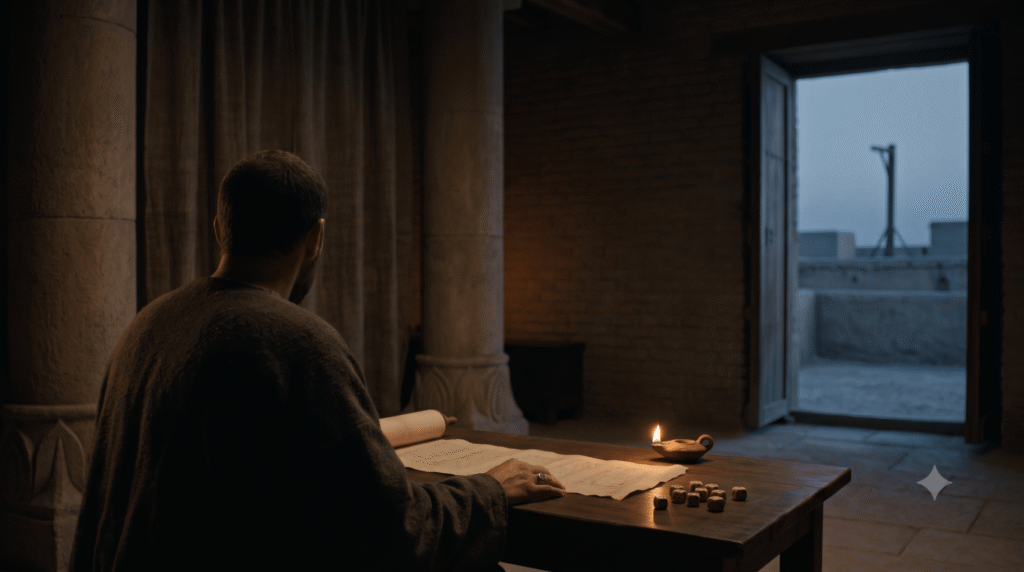
Esther is a book of rooms: a banquet hall, a harem, a city gate, a gallows. The king in these rooms is Ahasuerus, whom Greek sources call Xerxes, ruler of a hundred and twenty-seven provinces from India to Cush (Esth 1:1). Two Jews of the Diaspora enter his court. Mordecai is introduced through a genealogy running back to Kish and a note about the exile under Jeconiah (2:5–6). The Hebrew grammar leaves open whether that deportation of 597 BCE was his own or an ancestor’s, and the chronology makes the second likelier. His cousin Hadassah, whom the court calls Esther, enters the king’s household and, on Mordecai’s instruction, tells no one her people (2:7–10, 20).
Haman the Agagite is raised above every other official (3:1). Mordecai will not bow to him, and the text gives no reason (3:2). Haman, finding one man too small a target, resolves to destroy the whole people (3:5–6) and has the pur, the lot, cast before him in the first month (3:7). The decree goes out on the thirteenth day of that same month (3:12) and names the thirteenth of Adar, the twelfth month, as the day of killing (3:13). The date was set eleven months ahead, with a clerk’s patience. Haman reads chance as favorable. The book spends its remaining chapters showing chance cut the other way.
To the king he describes “a certain people,” scattered and set apart, with laws unlike all others, and he does not name them (3:8). Silver and the king’s signet ring complete the arrangement (3:9–10). Then comes the verse that slows any reader down: the couriers ride out, the king and Haman sit down to drink, and the city is thrown into confusion (3:15).
Mordecai puts on sackcloth, and mourning spreads through every province the edict reaches (4:1–3). Esther’s first answer is reasonable. Whoever approaches the king uninvited dies unless he extends the scepter, and she has not been summoned in thirty days (4:11). Mordecai replies that relief will rise “from another place” and asks who knows whether she came to the kingdom “for such a time as this” (4:13–14). He names no god. Later rabbinic writers used “the Place” as a name for God, but whether Mordecai does, the text does not say. Esther asks the Jews of Susa to fast three days, and then she will go in: “if I perish, I perish” (4:16). She is about to become the one who must say the word first, a cost we traced in an essay on Hannibal’s request for terms at Zama.
On the night Haman’s gallows stands finished (5:14), the king cannot sleep (6:1). He has the chronicles read, and the reading lands on a plot Mordecai once exposed, a good deed no one paid for (6:1–3). Within hours Haman, who came to ask for Mordecai’s hanging, is leading Mordecai through the city square on the king’s horse (6:4–11). The narrator names no miracle. A king sleeps badly, a scroll is opened, a man walks in at the wrong moment, and nobody says who arranged it.
Biblical Lens
Deuteronomy 31:18 — “And I will surely hide my face in that day…” (KJV)
A silence the canon had already anticipated, and named.
Esther 6:1 — “On that night could not the king sleep…” (KJV)
An event that carries weight without being labeled.
Esther 9:28 — “…these days should be remembered and kept throughout every generation, every family, every province, and every city…” (KJV)
What a people builds when it cannot fully explain its outcome: a calendar.
One verse, read slowly, changes the temperature of the room. Deuteronomy 31:18 is not cited anywhere in Esther. A reader who holds the whole canon in mind may hear it anyway, and that is the reader’s inference, not the narrator’s claim. The rabbinic tradition preserves a pun hearing “Esther” in the “I will hide” of that verse (b. Hullin 139b). It is wordplay and not exegesis, but it shows early readers sensing the shape of the silence.
Esther does not teach that every catastrophe is a verdict from heaven; the book never says so, and neither should we. It does show, with an almost clerical patience, that a society’s choices (who seals the order, who sits down to drink, who is left to fast) end up disclosing the moral terms on which it chose to live.
Pattern Insight
What a Scattered People Did Between the Date and the Day
CST’s own report adds context a headline total can hide. The 1,926 incidents are the second-highest first-half count it has recorded, behind 2,019 in 2024, and more than the whole of 2022, the last full year before October 7, 2023. Its 135 assaults are a record for any six months, up 82 percent on a year earlier (CST, 2026; Jewish News, 2026). CST ties its sharpest jumps to the war with Iran, which began on February 28, when the weekly count rose 71 percent, and to a stabbing in Golders Green in April (Sky News, 2026). Reporting also rises partly because more people report. These are figures about Britain, and they establish scale only. They cannot say what a scattered minority does between a threat and its outcome.
That interval is the one Esther occupies, and the book treats it as a problem of calendars. Three dates stand in it: an imposed date, an endured date, a date taken back. The first is the lot and the ring, power writing time. The second is the long stretch in which the people know the day and cannot yet know the outcome. The third is where the Closing returns.
The endured date asks for ordinary tools. The first is concealment. For years Esther keeps her origins unspoken (2:10, 20), and in an empire just told that the Jews are different, invisibility is sensible. Hiding serves for ordinary days; it fails once the date is set. Mordecai tells her the palace will not shelter her (4:13), and when she finally speaks, she speaks in the plural: “we have been sold” (7:4).
The second is a wait with an edge. Esther asks for three days of fasting and then acts, whatever the outcome (4:16). Set that beside Saul’s seven days at Gilgal, which he could not hold (1 Sam 13:8–9), and the twenty-seven days an Athenian general drew out of an eclipse at Syracuse (The Twenty-Seven Days). One man broke his wait and the other invented his. Esther sets the length of hers herself, tells the community, and goes in. The book mentions no temple in Susa, no priest, no sacrifice. It offers one literary portrait of Diaspora life: a people held together by a shared practice and a shared deadline.
The third is law answered by law. An edict sealed with the king’s ring cannot be revoked (8:8), so the date stays on the calendar, and what the people receive is a second edict. It is issued on the twenty-third of Sivan (8:9), about ten weeks after the first, and it lets them gather and defend themselves on that same thirteenth of Adar (8:11–12). The date was not cancelled. It was answered.
I will not pretend the ninth chapter sits easily beside the fourth, and three things that can be said about it should stay apart. What the text says is that the second edict’s wording echoes the first almost word for word, destroy, kill, annihilate (3:13; 8:11), and that it permits plunder, though the Hebrew of its phrase about children and women is ambiguous. Chapter 9 then reports hundreds killed in Susa, a second day granted at Esther’s request, the hanging of Haman’s ten sons (9:6, 12–14), and a far larger number in the provinces (9:16). Three times it adds that the Jews laid no hand on the plunder (9:10, 15, 16). Readers have long heard an echo in that detail. Haman is an Agagite, Mordecai a descendant of Kish like Saul, and Saul’s failure was sparing Agag and keeping the spoil (1 Sam 15:8–9).
Commentators divide over what to make of this: a lawful defense, a stylized mirror of Haman’s plan, a revenge fantasy of the powerless. This essay does not settle the dispute. Its own judgment is narrower. The refusal of plunder shows a line being drawn, but it does not launder the rest. The vocabulary of annihilation, once used, is learned, and the book records that without comment.
Whether any of it is providence is exactly what the book declines to say. Set out in order, the facts are these: a king sleeps badly, a scroll is read, a servant reaches the page about Mordecai, and Haman walks in just then. The book’s irony is as busy as its coincidences. Haman, asked what should be done for the man the king delights to honor, assumes he means himself (6:6–9). The gallows built for Mordecai is used for Haman (7:10). The day meant for the Jews’ destruction is “turned to the contrary” (9:1, KJV). A reader may take such symmetry as craft, as design, or as both, and the narrator does not say. Michael Fox has argued that the silence is a deliberate feature of the book’s design and leaves the question of God’s role for the reader to carry (Fox, 1991). The book allows the inference of a hidden hand and refuses to let that inference harden into a guarantee.
Dietrich Bonhoeffer is a conversation partner here for one question only: what does faith do when no answer is handed over? In his letter of July 16, 1944, he wrote, “Before God and with God we live without God,” and pointed to a God who lets himself be pushed out of the world onto a cross (Bonhoeffer, 1971). He was not reading Esther, and nothing here makes Esther a book about the cross. If there is a lesson in this, it arrives sideways: the canon has room for the long interval, and for what people do in it.
Closing
What the Book Leaves Behind Is a Calendar
Return to the evening in Northwest Washington. A date chosen by others still has to be kept by someone, and the third date, the date a people takes back, is where Esther ends. Mordecai writes a letter and Esther confirms it (9:20–32). It commands a yearly observance of the fourteenth and fifteenth of Adar: days of feasting, of gifts sent to one another, and of gifts to the poor (9:22). The lot Haman cast gives the festival its name, Purim (9:26), so the instrument of the plan becomes the label of its undoing.
Set that beside the plunder. The second edict permitted it, and the Jews refused it three times (9:10, 15, 16). The first institution they build is a feast of giving. The book never says one caused the other, and the pairing is the reader’s to weigh. It does leave a modern reader three questions to carry out of the room. Who gathers a whole people into a single threat, and in what words (3:8)? Who gives the order, and who stays in the city to bear it (3:15)? And can memory be kept apart from the care of the poor (9:22)? They are not Jewish questions alone. Any society that has been frightened, or has frightened others, may put them to itself.
Then the book ends on a note about taxation (10:1–3). A scroll that never names God closes on an imperial ledger and a man in the king’s service. A reader may find that anticlimactic. It may also be the book’s quietest claim, that the long interval between a decree and its outcome is lived inside ordinary institutions and ordinary days. Nehemiah closed with a man asking God to remember him. Esther closes with a people who made sure they would remember.
Nothing in this reading turns the Washington evening, or the British statistics, into a chapter of Esther. They remain what they are: living communities deciding how to keep a date they did not choose. The scroll never says who kept watch over Susa the night the king could not sleep. It says only that the days were remembered, and that the poor were not forgotten on them.
- WJLA 7News, “Washington, DC-area Jewish communities reflect on Oct. 7 attacks and aftermath,” Oct. 2026, wjla.com.
- Community Security Trust, Antisemitic Incidents Report, January–June 2026, cst.org.uk; Jewish News, “CST records sharp rise in antisemitism for first half of 2026,” 2026, jewishnews.co.uk; Sky News (via PA), Aug. 5, 2026, coastfm.co.uk.
- Michael V. Fox, Character and Ideology in the Book of Esther (University of South Carolina Press, 1991).
- Dietrich Bonhoeffer, Letters and Papers from Prison, ed. Eberhard Bethge (Macmillan, 1971), letter to Bethge, July 16, 1944.
- Babylonian Talmud, Hullin 139b.
New essays every week. Delivered quietly.