Hook
A victory arch that credits a god and gives no name
There is a name missing from the best-known monument to Constantine, and I have found its absence harder to stop noticing than any word that is carved there.
The Arch of Constantine stands beside the Colosseum, more than twenty meters of marble, much of it salvaged from older monuments. The Senate dedicated it in 315 to mark the victory over Maxentius three years earlier. Its inscription says that Constantine, instinctu divinitatis, by the prompting of a divinity, and by the greatness of his mind, avenged the state on a tyrant and all his faction.[1]
The Latin never says which divinity. No cross appears on the arch; the reliefs show older emperors, older gods, and the sun in his chariot.
In September 2024, lightning struck the arch during a storm and knocked fragments of marble to the ground. The Colosseum Archaeological Park said all of them were recovered and secured.[2]
In the previous installment, we watched a camp verify a surrender through the one messenger whose errand was to be believed. The Milvian Bridge brings the same difficulty to a story that Christians have told for seventeen centuries.
Historical Case
What the sources saw, and when they wrote it down
By the autumn of 312, Constantine had crossed the Alps and taken northern Italy city by city, and he was marching on a capital held by a rival behind thick walls. Ancient writers give Maxentius the larger army, though ancient headcounts are the least dependable part of any battle account.[3] Lactantius, a Christian rhetorician writing within a few years of the events, says Maxentius had stayed inside Rome because soothsayers warned that he would perish if he left.
Then, at the games marking the anniversary of his reign, the crowd shouted that Constantine could not be overcome. Shaken, Maxentius had the Sibylline Books searched and was told that on that day the enemy of the Romans would perish.[4] An oracle of that shape serves whoever reads it first.
Lactantius gives Constantine a sign as well: a dream in which he is told to mark the heavenly sign of God on his soldiers’ shields. The mark, as Lactantius describes it, is a letter X with a vertical stroke through it, bent at the top.[4] That is the whole of his account: a dream, a mark painted on shields, and a victory he credits to the hand of the Lord.
Eusebius tells it differently, and tells it twice. In his Ecclesiastical History, probably completed within a few years of the battle, Constantine prays, and Maxentius’s drowning is read as Pharaoh’s: the chariots cast into the sea, the enemy sinking like a stone. The sky does not appear in it.[5]
In his Life of Constantine, written after the emperor’s death, the vision comes earlier, on a march through Gaul: a cross of light above the sun at midday, words bidding him conquer by it, and then a dream in which Christ tells him to make a standard.[6] Eusebius says the emperor later described all of this to him and confirmed it with an oath. His modern translators, Averil Cameron and Stuart Hall, caution against merging this vision with Lactantius’s dream.[6]
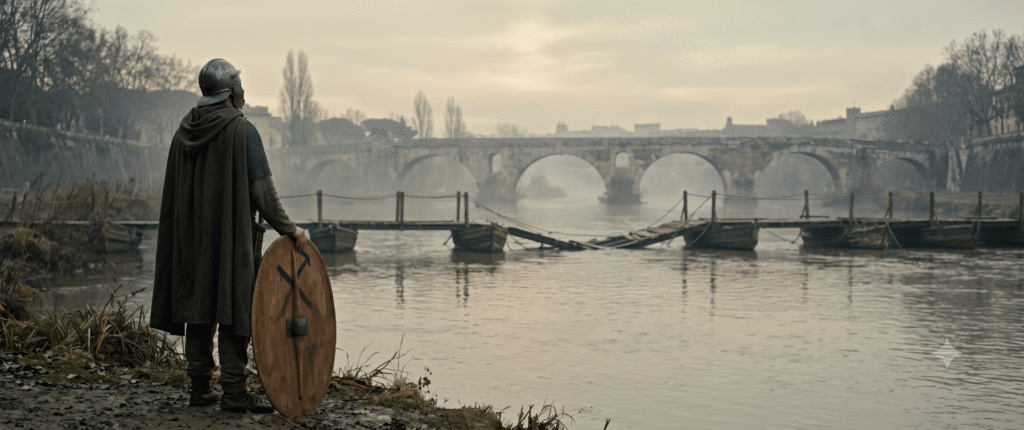
The fight itself was short. Maxentius’s army was driven back against the Tiber, and the bridge gave way. Eusebius, and Zosimus after him, describe a bridge of boats built to be broken, a trap meant for Constantine; the sources differ on the details and agree on the end, which is that Maxentius was lost in the river.[5]
Constantine entered Rome the next day. A victory settles who held the field. It does not settle what anyone saw before it.
Biblical Lens
A voice on the road, and a man sent to meet it
Acts 9 does not test Constantine’s faith, and it should not be asked to. It is the New Testament’s best-known conversion narrative, and it stands beside his story so naturally that the comparison repays a slower reading, with the narrative’s own structure as the subject. Saul is nearing Damascus with letters authorizing arrests when light from heaven stops him and a voice asks why he is persecuting it:
“Saul, Saul, why are you persecuting me?” (Acts 9:4, ESV)
The men traveling with him hear the voice and see no one, and Saul is left blind for three days. Then Luke does something easy to read past: he gives a second man a vision of his own. Ananias, a disciple in Damascus, is sent to the very person whose name he dreads, and the Lord tells him that Saul has already seen Ananias coming:
“a man named Ananias come in and lay his hands on him” (Acts 9:12, ESV)
Ananias is not a witness in any courtroom sense. Both visions reach us through Luke, so what the chapter offers is a structure of narrative, not evidence in the forensic sense. Through Ananias, Saul’s private encounter enters the life of a community that had every reason to doubt it, and his hesitation stays in the text.
He has heard from many what this man did to the believers in Jerusalem, and he says so. The reply names the commission by its cost:
“how much he must suffer for the sake of my name” (Acts 9:16, ESV)
Then the scales fall from Saul’s eyes and he is baptized (Acts 9:17–18). The chapter records a beginning, not a finished life.
This is not a text that invites us to call a drowned army heaven’s verdict, or a marble arch heaven’s receipt. Its steadier habit is to show that a people’s choices surface in time, in what they build and in what they agree to call holy.
Pattern Insight
A vision with one surviving narrator
Lay the dates in a row. The battle falls in October 312. In 313 an anonymous Gallic orator praises the emperor in terms of a divine prompting and does not name Christ; in 315 the Senate does the same in marble.[7]
Neither text is a diary. One is a speech in praise of a ruler, the other a public inscription, and each speaks in the language of its genre. Scholars read the arch’s phrase differently. One study traces it to Rome’s vocabulary of divine prompting and takes it as the Senate’s own rendering of the vision story, in words a mostly pagan Senate could carve; others hear in the same words an evocation of Rome’s pagan past.[1]
The Unconquered Sun kept a place on Constantine’s coinage as well: the legend SOLI INVICTO COMITI, “to the Unconquered Sun, the Companion,” was still being struck in 317, five years after the bridge, though coins are messages to a public, not windows into a man.[8]
He convened the Council of Nicaea in 325, and he was baptized in 337, on what proved to be his deathbed, twenty-five years after the river.[9] Delaying baptism was common enough in the fourth century that it proves little by itself.
Set that sequence beside the way the sky-vision reaches us. It enters the surviving record through Eusebius’s Life, and Eusebius’s source, by his own account, was the emperor. He adds that the army saw it too, and he anticipates doubt by saying that what followed vouched for the story.[6]
No soldier’s version survives. That does not mean none was ever told; it means the record offers a single route to the event. And victory is a strange witness: it confirms that something worked, not what was seen.
Scholars have not agreed on how the pieces fit. Peter Weiss argued that the vision of Apollo in a panegyric of 310 and Eusebius’s cross are one event, a solar halo seen in Gaul and read first through one religion and later through another. Raymond Van Dam calls that reductionist, and others accept it.[10]
None of this makes the vision a fabrication, and none of it lets us watch Constantine’s mind. A man can see something, tell it honestly, and have memory and a quarter century of success rearrange it. The narrower point concerns evidence. A vision whose only surviving narrator is its chief beneficiary can be believed, but it cannot be corroborated from the surviving record.
Acts 9 is built differently, and the difference lies in narrative structure, not in sincerity. Saul’s story comes with Ananias’s reluctance written into it, and with a cost the whole city can see. Within the same chapter, those who might have expected his loyalty are watching Damascus’s gates in order to kill him, and his friends lower him over the wall at night in a basket (Acts 9:23–25).
It would be unfair to audit an emperor by a tentmaker’s ledger. A persecutor could set down a warrant; an emperor could not set down his legions, his Senate, or his treasury, and the question for a ruler is less what he felt than what he did with the instruments only a ruler holds. After 313 those instruments included the return of confiscated church property, a policy Constantine and Licinius agreed on in an empire still overwhelmingly pagan.[11]
Different stations carry different prices. Saul’s story reaches us with its cross-examination attached; Constantine’s reaches us with a banner.
Closing
A sign is measured by what it is allowed to interrupt
Return to the arch and its missing name. It is tempting to hear the word divinity as hedging by frightened courtiers. The better reading, I think, is plainer: the phrase belonged to the public language of its moment, wide enough for a Senate that still honored the old gods and for a ruler who was learning a new name.
The width of that phrase may be the most accurate record of 312 that anyone carved. It tells us how a victory could be spoken of in Rome in 315, and it stops there.
Acts offers a different instrument, and its subject is how change is written down, not who changed more. Saul’s road interrupted nearly everything he had planned: his errand, his eyesight, his standing among the men who had trusted him. Constantine’s sign interrupted less in the moment, since it joined a march already underway, painted on the shields of men already moving toward Rome.
In the years that followed it did interrupt some things, among them persecution within his realm and the seizure of church property, and it left others, like the sun on the coinage and the baptismal font, to a slower clock.[9][11] Another essay here set Josiah’s thirteen years of reform against Manasseh’s fifty-five years of habit; Constantine’s empire had centuries of its own. Whether the sum is conversion in the full sense is something the sources let us argue and do not let us settle.
[1] Corpus Inscriptionum Latinarum VI 1139; translation after Amanda Claridge, Rome: An Oxford Archaeological Guide (Oxford University Press). Mentis magnitudine renders “by greatness of mind,” a phrase of civic praise, not a specifically Christian virtue. On the phrase’s sources: Linda Jones Hall, “Cicero’s instinctu divino and Constantine’s instinctu divinitatis,” Journal of Early Christian Studies 6.4 (1998): 647–671; for a different reading, Noel Lenski, “Evoking the Pagan Past: Instinctu divinitatis and Constantine’s Capture of Rome,” Journal of Late Antiquity 1.2 (2008): 204–257; also Jaś Elsner, Imperial Rome and Christian Triumph (Oxford University Press, 1998).
[2] Associated Press and Reuters, reports of Sept. 3–4, 2024, on the lightning strike at the Arch of Constantine.
[3] Zosimus, Historia Nova 2.15, writing in the early sixth century, gives roughly 98,000 men to Constantine and 188,000 to Maxentius; modern historians treat totals on this scale with deep suspicion.
[4] Lactantius, De Mortibus Persecutorum 44, ed. J. L. Creed (Clarendon Press, 1984).
[5] Eusebius, Historia Ecclesiastica 9.9; the comparison with Exodus 15 and the bridge of boats recur in Vita Constantini 1.38; Zosimus, Historia Nova 2.15.3–4.
[6] Eusebius, Vita Constantini 1.26–32, trans. Averil Cameron and Stuart G. Hall (Clarendon Press, 1999); Raymond Van Dam, Remembering Constantine at the Milvian Bridge (Cambridge University Press, 2011).
[7] Panegyrici Latini 12(9), in C. E. V. Nixon and Barbara Saylor Rodgers, In Praise of Later Roman Emperors (University of California Press, 1994).
[8] Roman Imperial Coinage, vol. 7, Constantine and Licinius, A.D. 313–337, ed. P. M. Bruun (Spink, 1966); issues of 317 from the Rome and Trier mints carry the legend.
[9] Eusebius, Vita Constantini 4.61–64; Timothy D. Barnes, Constantine and Eusebius (Harvard University Press, 1981).
[10] Peter Weiss, “The Vision of Constantine,” Journal of Roman Archaeology 16 (2003): 237–257; Panegyrici Latini 6(7) (310), Nixon and Rodgers; Van Dam, Remembering Constantine, 12 n. 18.
[11] Lactantius, De Mortibus Persecutorum 48, and Eusebius, Historia Ecclesiastica 10.5, preserve the text. The conventional “Edict of Milan” is a letter issued by Licinius at Nicomedia in June 313, implementing the agreement reached with Constantine at Milan; it is not a freedom of religion in the modern sense.
New essays every week. Delivered quietly.