Hook
A decree can end a marriage and leave the question standing
There’s a particular kind of silence that follows a signature: the moment after a name meets paper and before either person knows what the paper has done. Every courtroom has heard it. A pen lifts, a radiator ticks somewhere behind the bench, and two people study their own hands.
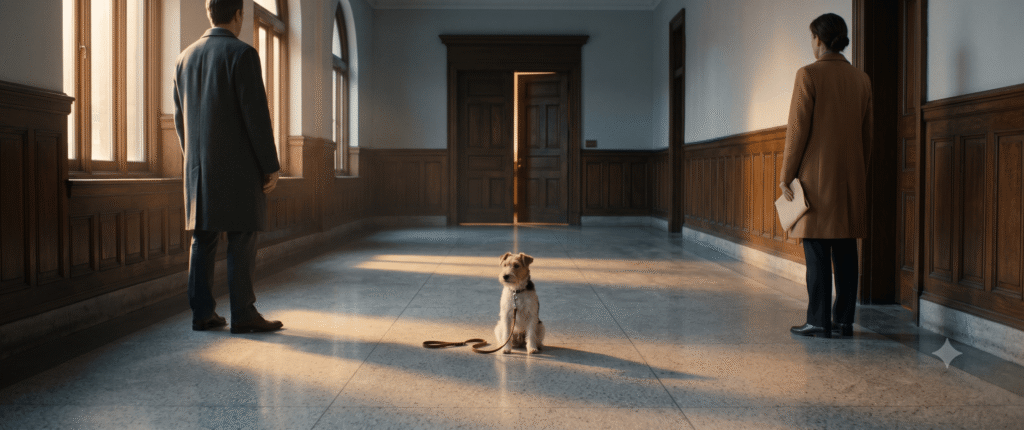
On October 21, 1937, American theaters began showing a comedy set almost entirely in the interval before that silence, the ninety days between a divorce hearing and a final decree. In Leo McCarey’s The Awful Truth, Jerry and Lucy Warriner, played by Cary Grant and Irene Dunne, each suspect the other of a betrayal neither can prove. He has an alibi that doesn’t quite hold, and she has a music teacher who turned up at the wrong hour. In court the only thing they truly contest is a wire-haired terrier named Mr. Smith.
The judge’s test is almost cruelly simple: the dog will go to whichever of them he answers when called. Lucy wins by hiding a toy in her hand, and Jerry is granted visiting rights. A dog is not a symbol that can be split down the middle. He is a living creature who must be fed and walked on both sides of the line, an obligation that outlives the marriage that produced it.
That is the film’s first lesson about evidence. Even the verdict is a little rigged, and no one seems to mind, because the real question was never who was unfaithful. It is what becomes of two people who keep demanding proof from each other when proof is exactly what neither one has.
Historical Case
A comedy that could not say what it meant
Under the Production Code, enforced since 1934, a Hollywood film could suggest infidelity far more easily than depict it. In The Awful Truth, what actually happened stays at arm’s length: an alibi, a late hour, a hat left in the wrong room. The marriage comes apart over what each partner believes the other has done.
Stanley Cavell gave this genre a name, the comedy of remarriage, and read such films as stories in which a couple finds its way back into marriage after a rupture (Cavell, 1981).1 As I read him, the talk is the marriage: the quick, quarrelsome conversation is where the pair tests whether they can still surprise one another. What follows is my own gloss, not his. Jerry and Lucy each believe they know the other too well to need an explanation, and the divorce is the price of finding out otherwise.
There is one detail that never makes it into the plot summaries. The court that dissolves the marriage also grants Jerry visiting rights, and much of the film’s second half runs through that small clause. Without meaning to, the law has built a hinge into the wall it was raising.
McCarey and his cast improvised a good deal of the picture, according to the American Film Institute’s catalog,2 and Grant is reported to have tried to leave the production over the method. The result is a comedy in which people seem to be finding their way in front of us. Evidence can settle what happened; it cannot decide what two people will do with the truth once they have it.
The rival suitors confirm it. Jerry drifts toward a socialite named Barbara Vance, and Lucy toward Dan Leeson, an amiable oilman from Oklahoma. Both are decent people, and neither is the problem.
Trust is not a preference that can be handed to a better-qualified candidate. It is closer to a shared language, built from private jokes, interpreted silences and years of reading each other’s faces. That language is also the risk, since it can carry old misunderstandings as faithfully as old tenderness.
At the tenth Academy Awards, on March 10, 1938, McCarey won Best Director for the film (Academy of Motion Picture Arts and Sciences, 1938). By the accounts that survive, he told the Academy it had honored him for the wrong picture.3 He meant Make Way for Tomorrow, released months earlier and his own favorite, a drama about an elderly couple whom their grown children separate.
It is a strange symmetry. The film he preferred is about a marriage taken apart by other people, and the one that won is about a marriage two people decline to finish.
Biblical Lens
What the old texts say about winning someone back
Scripture keeps an unlikely companion for this film in the book of Hosea, where a marriage is both a household and a parable. The chapter does not begin gently. Israel is indicted at length (Hosea 2:2–13) before the tone turns, and only then does the language of the courtroom give way to the language of courtship.
“Therefore, behold, I will allure her, and bring her into the wilderness, and speak comfortably unto her.” (Hosea 2:14, KJV)
The verb is allure. The wrong has been named first, and the naming is not the last word: the offended party leads her somewhere quiet and speaks to her as someone who might still be persuaded to come home. The text holds accountability and hope in the same hand.
Proverbs supplies the counterweight.
“He that covereth a transgression seeketh love; but he that repeateth a matter separateth very friends.” (Proverbs 17:9, KJV)
The failure here is the retrial that never ends. The same book elsewhere commends open rebuke, so the verse cannot be asking the wronged to pretend nothing happened. Its target is the habit of turning one true accounting into a standing prosecution.
And in Paul’s well-known passage on love, a verb that is easy to skim sits in the middle of the list.
“Beareth all things, believeth all things, hopeth all things, endureth all things.” (1 Corinthians 13:7, KJV)
Believeth is not gullibility, since the same letter insists in its fifth chapter on moral discernment. It is closer to refusing to assume the worst before the facts are in, joined to a hope that can survive what the facts turn out to be.
Not every broken household is a sign sent from heaven, and these texts never say so. What they do record, again and again, is that the way people handle a wound shows the kind of house they have chosen to live in.
One boundary deserves saying plainly. Hosea’s image describes a covenant between God and a wandering people. It was never a marching order for anyone to remain in a home where they are being harmed. The film also allows itself a speed that real repair seldom has.
In the story of a father who needed five years to reach a prison visiting room, forgiveness proved to be the injured person’s own work, while reconciliation needed two people and a trust that could only be rebuilt slowly. The pattern here concerns how trust returns when return is safe and possible. It does not say that return is always required.
Pattern Insight
The long middle between a decree and a decision
In 2023 the CDC counted 672,502 divorces in the forty-five states and the District of Columbia that report them, a rate of 2.4 per 1,000 people (CDC/NCHS, 2023).4 Counts like that record departures. They cannot see the long middle, the weeks when a couple is legally parted and still unresolved, and it is there that something has to change in how each reads the other.
John Gottman, who spent decades watching couples argue in his laboratory, called the small gestures that keep a fight from escalating repair attempts: a joke, a softened tone, a hand on an arm (Gottman and Silver, 1999).5 What mattered in his work was less the absence of conflict than whether the repair was received when it was offered.
By that definition, the film’s famous skirmishes are not repair. Jerry crashes Lucy’s evening with her suitor by playing the piano while the dog barks, using his visiting rights as cover, and Lucy gives as good as she gets. This is not a model for anyone.
It is what attachment looks like when pride has closed the direct route, and screwball comedy forgives what a real household seldom can. The actual repair attempts come late, when each lowers a guard and the sparring softens.
What finally changes is not the evidence. In an earlier essay on why Chronicles opens with nine chapters of names, we met a book that keeps a family’s failures in its record without letting the failures become the family. Jerry and Lucy make a similar turn. They stop treating each other as a verdict already reached and begin, awkwardly, to treat each other as someone still to be known.
Some scenes don’t need me to explain why they matter. They just need me to get out of the way. So: Aunt Patsy’s cabin, two bedrooms with a door between them, a few minutes left before the decree takes effect, and a cuckoo clock gathering itself to strike midnight. They do not win the case; they stop trying it, and begin learning each other again.
Set beside Hosea, the order is familiar. The accusations have been spoken aloud for the length of the picture, and only afterward does the quiet arrive. The cabin even plays the part of the wilderness in Hosea 2:14, a place apart from the courtroom and the suitors. That is my reading, not the text’s, but the geography fits: the case is not won there, it is set down.
Set beside Proverbs 17:9, the ending reads less like silence about the past than like the end of a trial. Neither is a guarantee. Both describe the direction trust takes when it comes back.
Closing
Trust is extended before it is earned
A signature ends a legal relationship, but it settles nothing about the human one. After the pen lifts, someone still has to decide whether to treat the other person as a suspect or as a stranger worth another look.
That is why the silence after a signature weighs so much. It is the last moment in which both options stay open, and the film places its finale in the nearest thing to it, the final minutes before a decree takes effect. Jerry and Lucy are fortunate in a small way: they notice the silence before it closes.
In the previous installment, we examined what the Bible says about staying silent in the face of injustice, through the Zola film that took Best Picture on the night McCarey took his Oscar. That essay ended on a name signed in full to an accusation. This one ends after the accusing stops. It is a different silence: not that of people who should have spoken, but that of two people who have finally stopped prosecuting each other.
Evidence can settle what happened. What a household becomes afterward is decided in the quiet after the ink dries, by whether two people can face the answers without making the past their only language.
- Stanley Cavell, Pursuits of Happiness: The Hollywood Comedy of Remarriage (Cambridge, MA: Harvard University Press, 1981).
- American Film Institute, “The Awful Truth (1937),” AFI Catalog of Feature Films, catalog.afi.com.
- Academy of Motion Picture Arts and Sciences, “The 10th Academy Awards | 1938,” oscars.org; Encyclopaedia Britannica, “Leo McCarey.”
- Centers for Disease Control and Prevention, National Center for Health Statistics, National Marriage and Divorce Rate Trends for 2000–2023 (provisional 2023 data). Divorce figures exclude states that do not report.
- John M. Gottman and Nan Silver, The Seven Principles for Making Marriage Work (New York: Harmony Books, 1999).
New essays every week. Delivered quietly.