Hook
The door a father needed five years to open
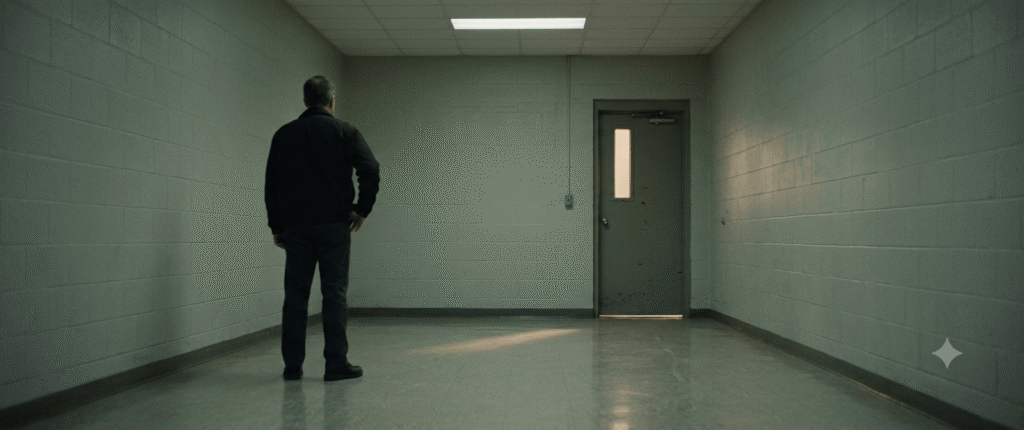
Azim Khamisa needed five years to reach one door. He recalls meditating for several thousand hours to gather the courage to walk into the visiting room at Folsom State Prison, where the boy who had killed his son was now a young man serving a sentence (The Forgiveness Project, 2021).1 2
He had made one request beforehand. Ples Felix, the young man’s grandfather and guardian, was to make the introduction and then leave them alone. Felix did, and father and prisoner talked face to face for about an hour and a half, perhaps longer (The Forgiveness Project, 2021).1 Azim had gone in expecting to look into the eyes of a murderer. What he saw, by his account, was someone polite, articulate, and remorseful.1
Years later Tony Hicks said something people rarely expect from a story about mercy. “Your forgiveness was heavy on me,” he told Azim (NPR, 2021).3 Gratitude would have been easier to report. Weight is a strange word to attach to a gift, and it may be the most accurate one in the whole account.
Historical Case
Two households and one January night
The door exists because of January 21, 1995. That day in San Diego, Tariq Khamisa, a twenty-year-old college student who was delivering pizza, was shot and killed by Tony Hicks, a fourteen-year-old gang member, during a robbery (StoryCorps).2 Tariq studied at San Diego State University. His father remembers a good writer and photographer who hoped to become a journalist and to work someday for National Geographic (The Forgiveness Project, 2021).1 Tony became the youngest person in California to be charged as an adult, and he was sentenced to twenty-five years to life (Tariq Khamisa Foundation).4
A second household sits at the edge of the story. Tony had been raised by his grandfather, Ples Felix, and on the morning of the killing he had run away from Felix’s home after an argument about skipping school and drinking (TODAY, 2024).5 Azim has said that he lost a son and Felix lost Tony, who was like a son to him.5 The two griefs are joined, but they are not the same. One family buried a young man who had been doing his job. The other watched a boy it loved be sentenced as an adult for a killing he carried out.
At the trial, Felix pledged to befriend the Khamisa family and to help them in any way he could (NPR, 2021).3 Soon afterward word came through the district attorney’s office that Azim wanted to meet him (Tariq Khamisa Foundation).4 Azim, who believed there were “victims at both ends of the gun,” founded the Tariq Khamisa Foundation that same year and asked Felix to join him a month later.4 Felix became one of the first people he hired.5 The foundation describes itself as a restorative justice organization, and it says it has reached about half a million students.4
Tony, for his part, has said he did not feel he deserved the forgiveness he was offered (TODAY, 2024).5 From prison he began volunteering for the foundation (NPR, 2021).3 Ahead of his first parole hearing, scheduled for November 2018, the foundation announced that it supported his release (KPBS, 2018).6 At a parole hearing Tony asked Azim’s forgiveness aloud (The Forgiveness Project, 2021).1 He left prison in April 2019 after twenty-four years, and he now works as a plumber while volunteering with the foundation (StoryCorps).2
Biblical Lens
Three old accounts of mercy that carry a price
Each of these accounts shows mercy doing a different work, and none of them describes it as forgetting.
When Jacob dies, Joseph’s brothers panic, convinced that years of kindness were only waiting for the funeral to end, and they send word begging for mercy (Genesis 50:15–21). Joseph weeps, declines to stand in God’s place, and says aloud what they did, that they intended harm, before he says what became of it. Then he does something concrete: he promises to provide for them and for their children.
Joseph’s mercy names the harm and refuses the revenge.
Paul tells the Christians in Rome not to repay evil with evil, to leave vengeance with God, and to live at peace with everyone only so far as it depends on them (Romans 12:17–21). The instruction arrives with practical weight attached: feed the enemy who is hungry, give water to the one who is thirsty.
Paul’s mercy gives up the right to retaliate and puts something in its place, a concrete good done for the one who did the harm. It is an instruction about what the injured person’s hands will do, and it is careful about how much of the outcome belongs to the injured person.
On the cross, Jesus asks forgiveness for the men carrying out his execution and says they do not know what they are doing (Luke 23:34).7 Stephen, stoned for his faith, prays in similar terms as he dies (Acts 7:60).
Here mercy is asked for before any sign of repentance appears, and nothing in the prayer pretends the pain is small. It is the widest of the three and the least comparable to the Khamisa case, since Azim says he found Tony remorseful once they met.
Taken together, the passages do not make forgiveness a denial of harm. They ask a harder question: once harm has been named, what will the injured person do with the power to answer it?
Nothing in these accounts asks us to hear a young man’s death as a sentence pronounced from heaven. They keep their attention elsewhere, on how a community answers its grief, since the answers, repeated over years, record the moral conditions it chose to live under.
Pattern Insight
What the numbers leave out
Four numbers hold the outline of this story, and each shows something different. Five years shows that the decision to forgive and the courage to face someone do not move at the same speed. About an hour and a half shows how much one meeting can hold. Twenty-four years shows that forgiveness and legal consequence can sit side by side. Half a million students shows how a private ordeal can turn into public work.
Those figures could be arranged into a tidy account of healing, and the arrangement would leave out the weight. Joseph’s story does not hurry either. His brothers’ fear outlasts years of evident kindness and flares up again at their father’s funeral, so the reconciliation has to be offered a second time, to people who cannot quite believe it. Tony has said that Azim’s forgiveness gave him room to work on understanding that he was worth being forgiven (StoryCorps).2 Read beside Joseph’s brothers, his remark about heaviness looks less like guilt alone than like the weight of a new obligation, to become someone the forgiveness was not wasted on. That reading is mine, and Tony has not said it.
What does forgiveness ask of the person who was harmed, and what does it leave alone? In this story it asked Azim to give up revenge and to stop letting the killing be the only thing he knew about Tony. It did not ask him to call the killing small, to pretend the sentence away, or to trust a young man before there was reason to.
Three things are easy to confuse here. Forgiveness is the injured person’s own work, a decision about revenge and about what the wrong will be allowed to do to the rest of a life. Repentance is the other person’s work, the admission of the wrong and the effort to change. Reconciliation needs both people, and it needs trust, which can only be rebuilt slowly. Azim says he had already forgiven Tony before Tony asked for it, and that the asking still meant a great deal to him (The Forgiveness Project, 2021).1 Forgiveness began on one side, the asking arrived later, and the friendship that followed took both men years. Miroslav Volf, who has written at length about forgiving after violence, treats forgiveness as something that begins by naming the wrong rather than looking away from it, and as a gift that can be offered before the offender has repented (Volf, 2005).8
The sentence, too, was not waived. Tony served twenty-four years before a parole board released him, with Azim supporting the request. A pardon that cancels a verdict is one thing. A person who declines to let the verdict be the last word on another person is doing something else. Forgiveness does not cancel the court’s judgment, and the judgment does not settle everything about the person it was passed on. Joseph’s speech keeps the two apart, and so does this story.
Joseph’s forgiveness also arrives with provision, and the story told here has its own version. When Azim sat across from Tony, he told him he could join the foundation and would have a job there (The Forgiveness Project, 2021).1 In this story, forgiveness came with work to do.
Forgiveness does not always restore a relationship, and it need not require renewed contact. These two men chose a shared life of service, and the choice is remarkable because it cannot be demanded of everyone. Paul’s plea in Philippians 2 for humility and for regard for the interests of others, which we took up in an earlier essay on humility and love, is easy to admire from a distance. Azim and Felix practiced something close to it as co-workers for years. None of this makes forgiveness a debt owed on a schedule. Many parents in Azim’s position never walk through that door, and nothing in the three passages is addressed to a grieving parent as a deadline.
Closing
The long walk toward a door
In the previous installment, we followed a farmer who made a record because no one would look at what he had to show. Azim Khamisa’s story is also about looking, of a different kind. It is the story of a father who needed five years of preparation to look at the young man who had killed his son.
What happened in the visiting room was small, an hour and a half or so of a father and a young man talking. Almost everything afterward grew from it, a foundation, a friendship between two men who share a loss, a job, and eventually a release. Not everyone who is wronged will stand at a door like this one, and the story does not count them as failures. Families carry loss in many ways, and we followed one such family through decades of it in our essay on the 1933 film Cavalcade.
Azim has said he left that room with more bounce in his stride, sure that he had finished his own part of the journey (The Forgiveness Project, 2021).1 Tony, long afterward, called what he received heavy. Neither response erased what had happened. A door that took five years to reach does not open onto a finished peace. It opens onto a room where two people have to keep talking.
1. The Forgiveness Project, “Azim Khamisa on the importance of asking for forgiveness,” January 20, 2021 (interview).
2. StoryCorps, “Both Ends of the Gun: How Two Men Were Brought Together in Tragedy and Forgiveness.”
3. NPR/StoryCorps, “‘Worth Being Forgiven’: A Father And His Son’s Killer Bring Past And Present Together,” February 26, 2021.
4. Tariq Khamisa Foundation, profiles of Azim Khamisa and Ples Felix, homepage, and press release on Tony Hicks’s release.
5. TODAY, “Dad Azim Khamisa forgave the man who murdered his son.”
6. KPBS, “Tariq Khamisa Foundation Supports Parole For Killer,” September 13, 2018.
7. Some early manuscripts omit the first sentence of Luke 23:34, and scholars debate whether it belongs to the Gospel’s original text. The parallel in Acts 7:60 does not depend on that debate.
8. Miroslav Volf, Free of Charge: Giving and Forgiving in a Culture Stripped of Grace (Zondervan).
New essays every week. Delivered quietly.