Hook
Counted, Not Called
On Friday, October 2, CBS News relayed a United Nations Population Fund update on the fighting in Yemen: more than 145,000 people displaced, a figure that had doubled in two weeks (UNFPA, 2026; CBS News, 2026). Inside that total the agency counted smaller groups. About 35,000 of the displaced were women of childbearing age, and more than 3,200 of them were pregnant.
Nothing here is cold. Counting is how tents get ordered and clinics get funded, and an agency that cannot count cannot help. Yet “women of childbearing age” is a phrase no mother has ever used about herself. Numbers tell us the scale of a catastrophe; names tell us what a community believes must not disappear inside that scale.
War is reported in arithmetic because arithmetic travels well. It crosses desks, budgets, and borders in a single line. Names do not travel that way, and so they are the first thing a count leaves behind, however carefully the count is kept.
How does a community remember its people after a catastrophe? Scripture gives one answer at the moment it begins to rebuild. In the previous installment, we saw Chronicles retell the fall of Judah as a second telling.
Its opening move is not a tally of the lost but nine chapters of names, which most readers cross as quickly as a customs hall. Read aloud, they slow the voice, because each name needs its own breath.
Historical Case
The Register Nobody Could Find
The returning community described in the Book of Ezra took its paperwork seriously. Some families from Tel-melah and Tel-harsha could not prove that their fathers’ houses belonged to Israel, and priests who searched the genealogical records for their entries did not find them. Those priests were excluded from the priesthood, and the governor ruled that the matter would wait until a priest could consult the Urim and Thummim (Ezra 2:59–63). In a community rebuilding from almost nothing, a missing name could cost a person a vocation.
That is the world Chronicles was written into. There, a lineage was not sentiment: it could determine whether a priest might serve and whether a family could establish its place among the returned. The Old Testament scholar Robert Wilson observed that ancient genealogies did real work in households, in politics, and in worship, and that they shifted as a society’s relationships shifted (Wilson, 1977). A genealogy was not simply an archive; it also reflected the relationships and claims a community needed to preserve.
Now look at where Chronicles chooses to begin. It does not begin with Abraham, or Moses, or David. It begins with Adam, and only after the nations does it arrive at Israel (1 Chronicles 1:1–2:1). The book does not start by asking who belongs to Israel; it starts by placing Israel inside humanity.
The first chapters read like a chain: Adam, the nations, Israel, Judah, David, and finally the people who had come back. Each link narrows the circle without cutting the one before it. By the time the reader reaches the returnees of chapter nine, they have been placed inside a story that began with the first human being. To a community living under Persian rule, a family story that starts at Adam implies roots older than any empire, though the text never says so.
The circle is broader than Israel’s later political history might lead us to expect. Chapter one includes the line of Ishmael, the sons of Keturah, and Edom, the line of Esau, and it names Edom’s kings (1 Chronicles 1:28–54). Why would a book written for a struggling community keep remembering people it has no need to flatter?
After that the lists narrow, and they narrow on purpose. Judah, the royal tribe, receives the most room, and Levi, the priestly one, receives a chapter of its own, which even names the men David set over the service of song (1 Chronicles 6:31–48). Those were the two lines a returning community most needed to establish, and the book establishes them in public.
The lists also run through the catastrophe itself. The kings of Judah appear in order, including Josiah, whose reforms we followed in an earlier installment, and his sons Jehoiakim and Zedekiah (1 Chronicles 3:14–15). Then the line continues past the fall of Jerusalem, through the sons of Jehoiachin, the king who ate at Babylon’s table in the previous installment, and on to the generation of Zerubbabel (1 Chronicles 3:17–19). In these verses the throne is empty and the family is not.
The kingdom has fallen, the throne is vacant, and the temple lies in ruins. The line remains. A political catastrophe, the register suggests, does not erase belonging.
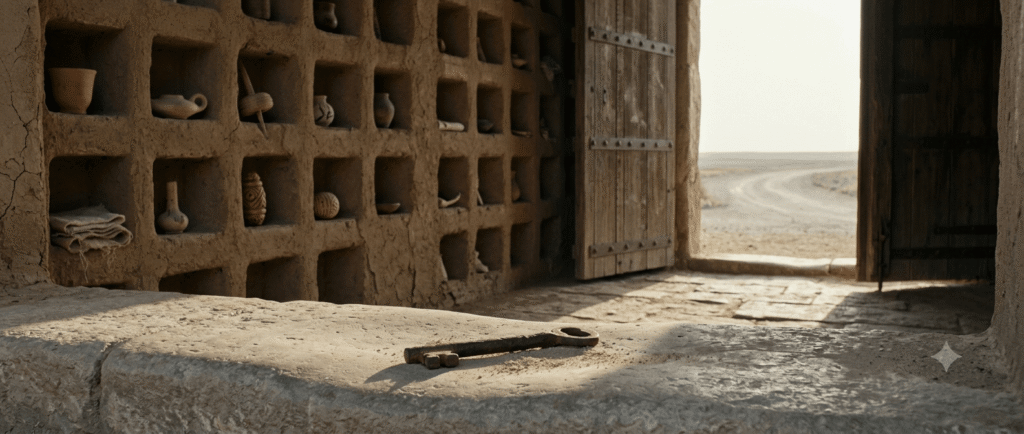
The account of the returnees pauses at a door. Chapter nine states plainly that Judah went into exile because of unfaithfulness, and then it names the first to settle again in their old holdings: Israelites, priests, Levites, and temple servants (1 Chronicles 9:1–2). Among the Levites are the gatekeepers, who are said to have spent the night near the house of God because the duty of opening it each morning fell to them (1 Chronicles 9:17–27). In the list of the resettled city, the keys belong to named people.
Biblical Lens
1 Chronicles 1:1–4; 9:1 · The record remembers The book opens with a bare list, Adam, Seth, Enosh and onward, with no sentence to carry the names. Nine chapters later it states plainly that Judah went into exile in Babylon because of unfaithfulness.
1 Chronicles 2:7; 5:1–2 · The record does not sanitize It keeps Achan, called the troubler of Israel, and Reuben, who lost the firstborn’s place by defiling his father’s bed. Neither name is removed.
Ezra 2:62–63 · The record can also close a door Priests who cannot find their entries in the registers are excluded from the priesthood until a priest can consult the Urim and Thummim.
Nothing here requires us to call every loss a sentence handed down from heaven. What the record does show is that a community, over time, becomes legible in what it chooses to keep.
Pattern Insight
Remembered Without Being Reduced
The lists are less tidy than they look. Judah’s own line passes through Tamar, whose story in Genesis is one a family might prefer to tell more carefully, and the register does not delete it (1 Chronicles 2:3–4). Genesis itself has Judah concede that Tamar was more in the right than he was (Genesis 38:26).
Reuben was the firstborn, and the list says plainly that his birthright passed to the sons of Joseph because he defiled his father’s bed (1 Chronicles 5:1–2). The loss is recorded, and Reuben’s line still receives its own list (1 Chronicles 5:3–10). Achan appears in Judah’s line as the troubler of Israel (1 Chronicles 2:7). The final form of the genealogy does not erase either man.
A smaller detail points the same way. David’s wife, whom Chronicles never names in a story, appears in its list as Bath-shua daughter of Ammiel (1 Chronicles 3:5), usually identified with the Bathsheba of Samuel, whose father is called Eliam there. She is the mother of Solomon, and the line of kings runs through him. The story is absent from the book; the person is not.
The lists also reach beyond kings and priests. Sheerah, a woman, appears as a builder of towns (1 Chronicles 7:24), and in a list built mostly from fathers and sons, hers is one of the few lines that records what a daughter did. Singers and gatekeepers are named alongside the royal line. Several tribal lists add counts of fighting men (1 Chronicles 7), but the counts sit inside the names instead of replacing them.
Even a single prayer interrupts the register. Jabez, whose mother named him for pain, asks to be kept from it, and the text says God granted his request (1 Chronicles 4:9–10). A name, it seems, sometimes arrives with a story no list can carry.
Together these cases make one claim. The Bible can remember a person’s failure without making failure the whole of that person’s identity. To keep a name is not to excuse the deed, and to remember the deed is not to reduce the person to it.
That is the difference between a register and a verdict. A verdict asks what was done. A register asks who remains part of the record. Chronicles needs both questions, but it begins with the second.
Kings asked the first question with unsparing honesty. The second telling begins by asking who is still here, and it answers by reading the family aloud, including the members a family might rather not read.
Closing
Read the Names First
Return to the figure from Yemen. It will be revised, as such figures always are, and the revision will be as necessary as the first count. It will also be unable to hold any one displaced person, and it was never meant to. The question it cannot answer is the one Chronicles takes up: how a community remembers its people after catastrophe.
What Scripture offers is not a replacement for the count but an order of operations. Chronicles begins its work of rebuilding with three names and no verbs, and only afterward reaches the temple, the kings, and the wars. The register comes before the reconstruction: before the book rebuilds institutions it restores continuity, and before it tells the community what to do it reminds the community who has survived.
Only after the names does the narrative begin, and it begins with a defeat: the death of Saul on Mount Gilboa (1 Chronicles 10). A community that has just been told who it is can now be told what happened to it. The names do not soften the story that follows; they give the reader somewhere to stand while it is told.
Taken together, Kings and Chronicles gave survivors two accounts, one that refuses to hide what happened and one that refuses to let it become the whole story. The register is where the second begins. It is the hinge between them, the place where a people stops explaining its fall and starts counting its family.
Rebuilding, in this book, is not first a matter of stone. It depends on someone being known well enough to be handed the keys. The nine chapters a modern reader crosses like a customs hall were, for those who had come home, closer to a threshold. A family record that includes its failures is harder to write than one that polishes them, and it is the only kind that can be trusted after a catastrophe.
- UNFPA, “Flash Update on the Hostilities in Yemen (15–28 September 2026),” as reported in CBS News live updates, October 2, 2026.
- Robert R. Wilson, Genealogy and History in the Biblical World (Yale University Press, 1977).
New essays every week. Delivered quietly.