Opening
An Army Can Be Lost Without Being Left
Who is standing at your shoulder when the decision that matters most has to be made, and when did you last wonder what that person wants?
In the previous installment, we examined a commander who sailed away while his legions waited on a Greek shore. That failure was an absence. The general was gone, and the army waited.
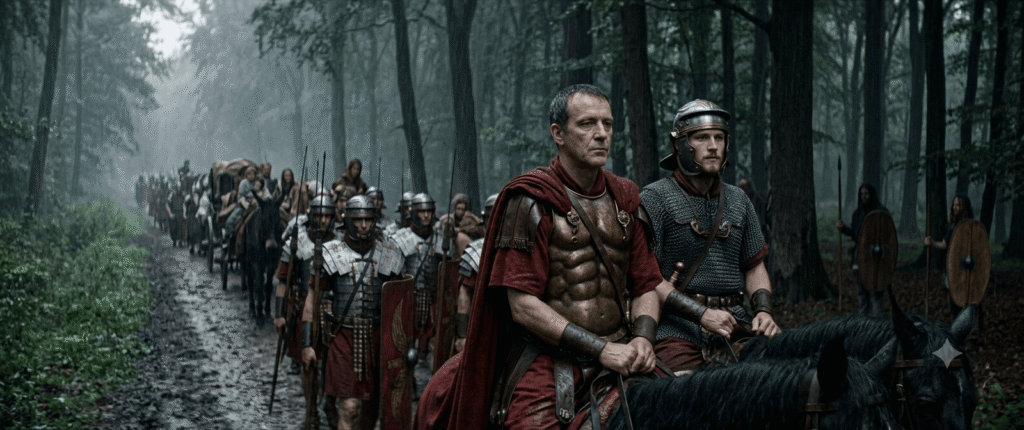
Teutoburg is its mirror. Publius Quinctilius Varus did not leave. He rode at the head of his column, among his staff, with a trusted man at his shoulder. The intimacy itself was the hazard.
I reread Velleius Paterculus twice this week, and what stayed with me was not the slaughter. It was the praise. Velleius, writing about AD 30, describes Arminius, a young Cheruscan noble, as quick of mind, a veteran of Roman service who held Roman citizenship and equestrian rank (Velleius, c. AD 30). Read before the ambush, it is a character reference. Read after, it is an epitaph for a general’s judgment.
Historical Case
September, AD 9
Varus governed a region Rome had not finished bringing under its control. He was an experienced administrator, a former governor of Syria, and he treated the land east of the Rhine as a place for courts, taxes and roads. But the appearance of Roman order concealed loyalties Rome did not fully understand.
In late summer the army set out from its summer quarters toward the Rhine. According to Cassius Dio, who wrote in the early third century, a report arrived of a revolt in a distant district, and Varus left the safe route to put it down (Cassius Dio, early third century, 56.19). On Dio’s telling, the report was false, and Arminius and his fellow conspirators were behind it.
The column that turned into the forest was not a tidy battle line. It was three legions, the XVII, XVIII and XIX, with auxiliary horse and cohorts, followed by a long train of wagons, women, children and servants. Dio describes the weather turning, with rain and wind and a wet forest floor that pulled the formation apart (56.20–21).
The attacks came first as skirmishes, then as a running fight over several days. Archaeologists have identified Kalkriese, near Osnabrück, as the likely site of the final fighting, an identification that is widely though not universally accepted (Wells, 2003). Varus died by his own sword, and the legions’ eagles were taken. So far as the surviving record shows, Rome never again raised legions under those three numbers.
What troubles me most is that Varus was told. Both Velleius and Dio report that Segestes, a Germanic chieftain who had stayed loyal to Rome, warned him of the plot and urged him to arrest Arminius and the others (Velleius 2.118; Dio 56.19). Varus dismissed it.
It is easy to call him a fool, and I distrust that reading. Segestes was Arminius’s personal enemy, so the warning looked like a feud. Arminius had served beside Varus and sat near the center of his command. On Dio’s account, he and his fellow conspirators were constant companions of the governor and often shared his table (56.18–19). I take that table as evidence of a closeness, not as a stage trick.
Varus weighed one man’s word against another’s, picked the one he knew, and concluded that the man he knew had no reason to betray him. That is how trust fails, and it is rarely simple blindness. It is a reasonable judgment, made from inside a relationship, about someone whose loyalties have not been understood correctly.
Biblical Lens
The Counselor at the King’s Table
The books of Samuel know this structure. After David lingers at Jerusalem while his army besieges Rabbah, the narrative turns to a man who sat closer to the king than any general.
Ahithophel was David’s counselor, and 2 Samuel measures his advice against the highest standard it knows.
“…as if a man had enquired at the oracle of God…” (2 Samuel 16:23, KJV)
When Absalom’s rebellion came, Ahithophel went over to Absalom, and when his counsel was finally rejected, he went home and took his own life (2 Samuel 17:23). Some interpreters have linked his bitterness to the Bathsheba story through the name Eliam (2 Samuel 11:3; 23:34), but the text never says so.
What the text does say is stranger: the wisest voice in the court became the most dangerous. Superior insight, once turned, knows exactly where the weakness is. A generation later, David’s son would face a quieter form of the same problem, which we traced in a king’s divided heart.
Psalm 41, which Christian tradition has long read as a lament of betrayal, puts the wound in the language of a shared meal.
“…mine own familiar friend, in whom I trusted, which did eat of my bread…” (Psalm 41:9, KJV)
Centuries later, Matthew’s Gospel places the same intimacy around a Passover table (Matthew 26:20–25).
“And forthwith he came to Jesus, and said, Hail, master; and kissed him.” (Matthew 26:49, KJV)
In each story the betrayer is not an outsider. He is a man at the table.
Han Fei, writing in the third century BC, named the cost of that closeness bluntly.
“To trust others is to be governed by them.” (Han Feizi, “Bei Nei&rdquo)
I do not read this as a counsel of paranoia. No command can operate without trusting someone, which is exactly why trust creates a vulnerability.
Scripture does not treat every ambush as a verdict from heaven. What it records, again and again, is that communities show the terms on which they were willing to trust one another.
Pattern Insight
Whose Betrayal Is It?
Here the comparison with Ahithophel and Judas stops being useful, and I think it should. Those men betrayed inside a shared covenant. Arminius carried two loyalties, and which one was the “real” one is exactly what the Roman and Germanic traditions answer differently.
For Rome he became the model of a traitor, a citizen, an officer and a guest who turned on his hosts. In later German memory he became a liberator, remade as “Hermann” by nineteenth-century nationalists, who raised a monument to him in the Teutoburg region in 1875. Both traditions preserve something real about the conflict, and neither tells the whole story.
Rome had raised him partly within its orbit. He knew its drill, its supply habits and the way its officers thought, because Rome had given him that education as an instrument of integration. He used it as an instrument of resistance.
An empire that trains the sons of the peoples it has subdued may also be training those who will one day resist it, and what counts as betrayal depends on which claim to loyalty you recognize first. I’m not sure this resolves cleanly. Perhaps it shouldn’t.
Set the two stories together and the pattern is clear. Antony failed by leaving his army. Varus failed while remaining at its head, trusting the wrong man beside him. A commander can abandon his army by leaving it, or by never looking closely at the person at his shoulder. The second is my interpretation, not the sources’ verdict, but it is the one the evidence keeps pointing toward.
Closing
The Warning We Refuse to Hear
Six years later, in AD 15, Germanicus led an army back to the site. Tacitus, writing in the early second century, describes the ground Germanicus’s soldiers found, still marked by the disaster (Tacitus, early second century, Annals 1.61). Rome recovered two of the three eagles in the campaigns that followed, and, according to Dio, a third only in AD 41 (60.8).
It never again tried to hold the land east of the Rhine in earnest, and the river became a frontier that lasted for centuries. Suetonius records that Augustus was heard calling out to Varus to give him back his legions (Suetonius, early second century, Divus Augustus 23).
Arminius lived about twelve more years. By Tacitus’s account he was killed in AD 21 by his own kinsmen, when his hold on power began to look to them like kingship (Annals 2.88). Their endings are different, and I will not pretend they add up to a single lesson.
I began with a question about the person at your shoulder, and it is not an accusation. It is a discipline of attention, one worth holding beside the patience of trusting God’s timing. The harder discipline is to ask whom we trust because it is comfortable, and to listen when a warning comes from someone we like less. History cannot identify our traitors for us. It asks only whether we are willing to hear the warning when it comes from someone we would rather distrust.
- Velleius Paterculus, Compendium of Roman History 2.117–120.
- Cassius Dio, Roman History 56.18–24; 60.8.
- Tacitus, Annals 1.55–62; 2.88.
- Suetonius, Divus Augustus 23.
- Han Feizi, “Bei Nei&rdquo.
- Peter S. Wells, The Battle That Stopped Rome (W. W. Norton, 2003). Independent cross-check on the Kalkriese identification.
- The Bible (KJV): 2 Samuel 11:3; 16:23; 17:23; 23:34; Psalm 41:9; Matthew 26:20–25, 49.
New essays every week. Delivered quietly.