Hook
One Staircase, One-Tenth of the Budget
In 1936, MGM reportedly spent $220,000 on a single musical number built around a staircase.
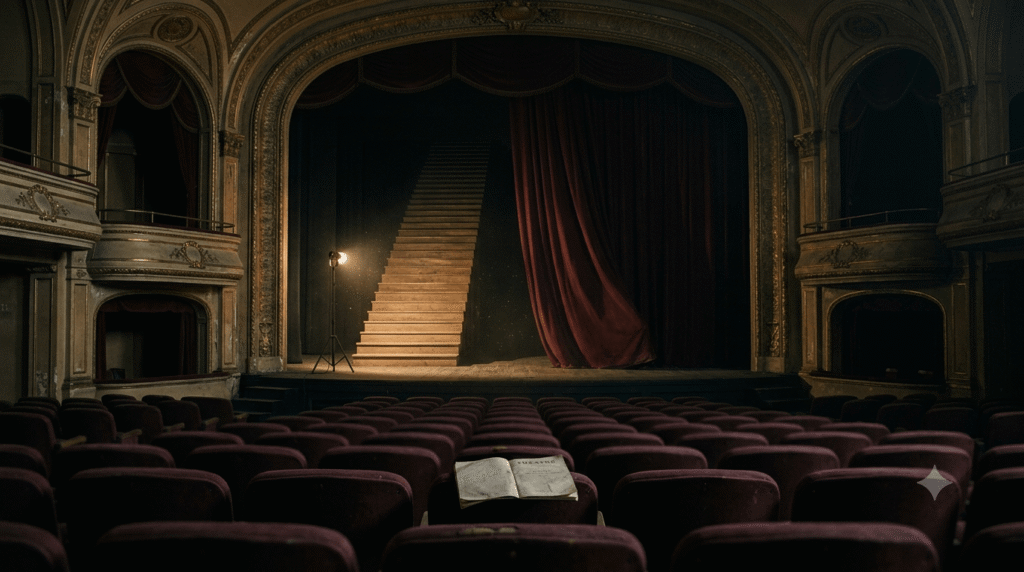
It was not an ordinary set piece. A vast revolving structure of steps stood at its center, as many as 180 performers circled it, and the camera mostly stood back and watched.1 Time‘s review that spring described a huge revolving staircase and a sequence of about twenty minutes (Time, 1936). By the reported figures, that one number consumed roughly a tenth of a budget of about $2.2 million.
The film went on to win Best Picture at the ceremony honoring 1936’s pictures (Academy of Motion Picture Arts and Sciences, 1937).2 It is a three-hour story about a man who could never stop adding steps. The question it leaves behind is quieter than its spectacle: what does a person own when every wish he ever had was built to scale?
In the previous installment, we followed twenty pounds through a single night in Dublin and watched a payment fail to buy what it was meant to buy. This week’s film turns the question around. It asks what becomes of a man who spent a lifetime buying exactly what he wanted.
Historical Case
The Showman and His Stage
Florenz Ziegfeld Jr. was a Chicago-born showman who turned the stage revue into an American institution. His Follies opened in 1907 and returned, edition after edition, until 1931. William Powell plays him in the film as charm in motion, a man whose every conversation is also a pitch.
The picture follows the arc audiences expected from a studio biography: the young promoter, the marriage to the French performer Anna Held (Luise Rainer), the invention of the Follies, the divorce, and the marriage to the actress Billie Burke (Myrna Loy). Its high-water mark is four Ziegfeld hits running on Broadway at the same time.
The scale was part of the point. Time reported that the production took two years and about $2 million and ran three hours, and its reviewer judged the staircase sequence grander than anything the real Follies had put on a stage (Time, 1936). The film’s subject was extravagance, and the film was built to match.
The film arrived in the spring of 1936, in the middle of the Depression, and its story includes the crash that began it. What drew people to the staircase is a question for film historians. That they came in large numbers is on the ledger.
The ending is where the film and the record part ways. On screen, the crash of 1929 ruins him, and he dies in an apartment overlooking his own theater, half-delirious, replaying his hits and calling for steps higher than the last. In life, Ziegfeld did lose much of his fortune in the crash, but he died in Hollywood in July 1932 and left his widow with substantial debts.
The theater in that deathbed view had its own history. The Ziegfeld Theatre opened in February 1927 at a cost of about $2.5 million, built partly on money borrowed from William Randolph Hearst, who took control of it after Ziegfeld’s death (Mordden, 2008).3 Billie Burke went back to acting to meet the debts.
Biblical Lens
Three Passages From a King’s Experiment
Ecclesiastes 2 reads like a laboratory notebook. The Preacher, who presents himself as a king in Jerusalem, announces that he will test pleasure and see what it yields.
Ecclesiastes 2:4–8 · paraphrase
He made great works. He built houses, planted vineyards, laid out gardens and parks, and dug pools to water the groves. He gathered silver and gold and the treasure of kings, and he hired singers for his own delight.
Notice how many of those verbs return to the builder: he built for himself, made himself gardens, made himself pools, and gathered for himself.
Ecclesiastes 2:10–11 · paraphrase
Whatever his eyes wanted, he did not withhold from them. Then he considered everything his hands had made and the labor it had cost, and saw that it was all breath and chasing wind, with nothing left over to show for it.4
Ecclesiastes 2:18–19, 21 · paraphrase
He came to resent his labor, because he would have to leave it to whoever came after him, who might be wise or a fool, and who would be master of everything he had built. Sometimes the heir had never worked for any of it.
Ecclesiastes does not teach that every collapse is a sentence handed down from above. The passage does give the reader a question for reading a culture: over time, what does a society’s applause reveal about what it has decided is worth wanting?
Ziegfeld is not the Preacher, and Leonard’s film is not Ecclesiastes. One is a historical impresario seen through a studio’s biography; the other is a narrator who keeps asking what the work was for. The resemblance is narrower, and therefore more useful: both stories follow a man who refused to withhold what he wanted from himself, and both leave a reader to ask what it added up to.
Pattern Insight
Who Inherits the Staircase
The numbers around the film sit side by side uneasily. According to MGM’s own records, it cost about $2.18 million to make and brought in about $4.67 million worldwide (Glancy, 1992).5 The spectacle did not merely consume money. It was part of what the film had to sell.
Ziegfeld’s own building met a different fate. Hearst took control of his theater, and his debts fell to his widow. The Preacher saw this arrangement long before Broadway had a name: what a person builds under the sun is handed, under the sun, to someone else (Ecclesiastes 2:18–21).
There is an irony the Preacher would recognize. He observes that neither the wise nor the fool is remembered for long (Ecclesiastes 2:16, paraphrased), and Ziegfeld has been the exception: a three-hour studio biography made sure of it. But what the film preserved is the spectacle. It kept the staircase and moved his deathbed. Remembrance, too, turns out to be something a person builds, and something that is handed to whoever comes after.
When achievement itself becomes the appetite, there is no height at which the climbing stops. That is why the deeper difference between the two men lies in a single verb. In Ecclesiastes 2:11, the Preacher looks back and weighs what he made. In the film’s last scene, the dying showman does the opposite. He looks forward, half-delirious, and asks for more steps and higher ones.
The Preacher’s gesture is a reckoning; Ziegfeld’s is a request.
A spectacle exists only for the moment in which it is seen. Then the question returns: what comes next? In the film, the answer is always another step.
Closing
What the Staircase Could Not Hold
The Preacher does not leave the reader in despair. After the long inventory of ruin, he lands somewhere humbler than any stage set: to eat, to drink, to find some good in the work itself, and to receive even that as something given (Ecclesiastes 2:24–25, paraphrased). Receiving is a slower posture than building, and it is one we have written about before, in trusting God’s timing when you feel overlooked. It is a smaller promise than a staircase, and it can be kept.
A staircase is a promise about elevation. The one in Leonard’s film turns in place, which suits a book that says the wind goes around and around (Ecclesiastes 1:6, paraphrased). That is what the reported $220,000 bought: a long, spectacular motion that returned the audience to where it had started.
If there is an answer to the question the film leaves open, the Preacher’s is that a person keeps what he can receive more surely than what he can build. The film does not condemn its subject, and neither does Scripture. What they share is the observation that someone can build the tallest thing in the room and still be unable to say what it was for. For the other kind of work, the kind that never needed an audience, see our piece on being faithful when no one is watching.
Applause can tell a man he is seen. It cannot tell him what he built.
Notes
- The $220,000 cost and the performer count are as reported by the AFI Catalog from the production’s contemporary pressbook. “Cinema: The New Pictures,” Time, April 20, 1936.
- Academy of Motion Picture Arts and Sciences, “The 9th Academy Awards | 1937,” Oscars.org. The category was then officially named Outstanding Production.
- Ethan Mordden, Ziegfeld: The Man Who Invented Show Business (New York: St. Martin’s Press, 2008).
- The Hebrew word usually translated “vanity” is hebel, literally “breath” or “vapor.” See Tremper Longman III, The Book of Ecclesiastes (Grand Rapids: Eerdmans, 1998).
- H. Mark Glancy, “MGM Film Grosses, 1924–1948: The Eddie Mannix Ledger,” Historical Journal of Film, Radio and Television 12, no. 2 (1992): 127–144.
New essays every week. Delivered quietly.