Opening
A Safeguard Made of Paper
Some documents seek protection by naming the one party strong enough to refuse it. Prasutagus, king of the Iceni in the flat fields of what is now East Anglia, wrote such a document around AD 60. According to Tacitus, he named the emperor Nero and his two daughters as joint heirs, thinking the arrangement would keep his kingdom and household clear of injury (Tacitus, early second century, Annals 14.31).
Rome did not always need to annex a kingdom outright. It could keep a local ruler whose dependence made imperial power cheaper to exercise, and a ruler in that position had every reason to write the emperor into his will. It was a prudent document. Within weeks it was tested by men who felt no obligation to its terms.
In the previous installment, we examined a governor who trusted the wrong man at his shoulder. That failure happened inside the circle of trust. This one begins on its outer rim, with a family that had done what the empire asked and then learned what the asking was worth.
What is a safeguard worth when the only party who can honor it is the party you were afraid of?
Historical Case
While the Governor Looked West
When Prasutagus died, Tacitus reports, centurions stripped the kingdom and slaves ransacked the household, as though both had been taken in war. His widow, Boudica, was flogged and her daughters were violated, and the leading men of the tribe lost their ancestral estates (Annals 14.31). Tacitus gives the worst of it a single sentence, and I will not enlarge on his restraint. It is enough to know that the household the will was meant to protect was treated as spoil.
The grievance was wider than one family. To the south, the Trinovantes had watched Rome settle retired legionaries at Camulodunum (modern Colchester) and drive local people off their land to feed the colony. The Britons chosen as priests of the temple to the deified Claudius were being bled of their fortunes, and Tacitus says the temple looked to them like a fortress of permanent rule (Annals 14.31). Cassius Dio, writing a century and a half later, adds money to the ledger. He reports that large loans to British nobles were suddenly called in and names the philosopher Seneca among the lenders (Cassius Dio, early third century, 62.2). Modern historians handle that detail cautiously.
The revolt did not begin with one insult. It became possible because several kinds of dependence failed together: political, financial, legal and military.
The men who could have answered were elsewhere, or were part of the problem. The governor, Suetonius Paulinus, was far to the northwest on the island of Mona (Anglesey), campaigning against the Druid stronghold. The procurator, Catus Decianus, whose office handled both money and complaint, stood among the accused. When the rising came, he sent two hundred half-armed men and then fled to Gaul (Annals 14.32).
Everything that survives to us about Boudica was written by the other side. No British word of hers remains, only Latin and Greek. Dio describes a tall woman with a harsh voice, a mass of tawny hair falling past her hips and a heavy gold torque at her throat (62.2). Tacitus has her remind her followers that Britons had often gone to war under women (Annals 14.35). His father-in-law, Agricola, was a young officer in Britain in those years (Agricola 5). What we cannot know is how much of the story Tacitus inherited from such memories.
Colchester fell, though the soldiers sheltering in the temple held out for two days. The Ninth Legion, marching to relieve it, was caught on the road, and its infantry was cut down while its commander escaped with the cavalry. Paulinus rode hard to London, weighed what he had against what was coming, and chose to give up the town to save the province (Annals 14.33). Archaeologists still find a thin reddish band of burned debris beneath Colchester, London and St Albans, a stripe of ash two thousand years deep (Hingley & Unwin, 2005).
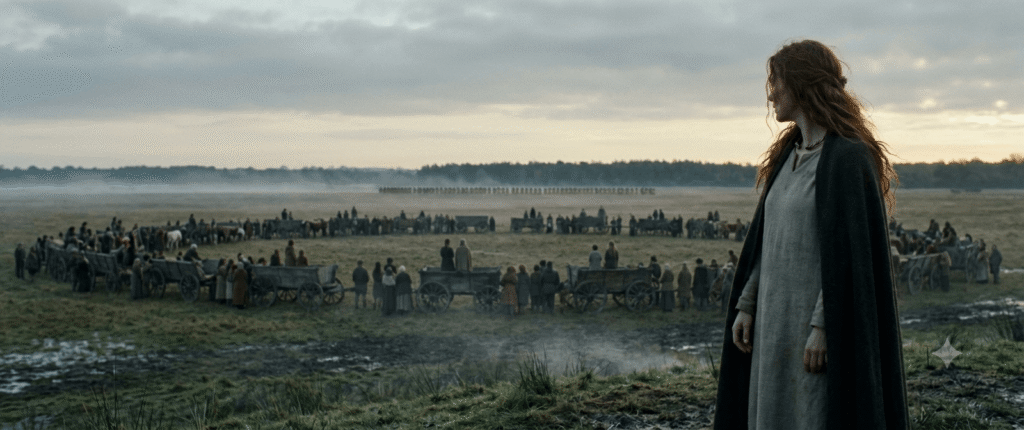
The last battle was fought with the smallest Roman army the story allows. Tacitus counts roughly ten thousand men, drawn up in a narrow defile with woodland at their backs and open plain before them (Annals 14.34). The Britons arrived in such numbers, he says, that they stationed their wives and children in wagons around the edge of the field, to watch the victory. Tacitus does not say whose decision that was. The whole nation stood on one plain with its own household at its back.
The Roman javelins went first, then the wedge. The ring of wagons meant to frame a triumph closed off the road out (Annals 14.37). The traditional setting is Watling Street, the Roman road running northwest from London, but Tacitus names no place. Mancetter in Warwickshire is a long-favored candidate, and the field has never been confirmed (Mattingly, 2006).
Biblical Lens
What Tamar Asked For
The books of Samuel hold an older story about a wrong that was known and not answered. The stories are not equivalents. Tamar is not Boudica, and David’s court is not Rome. But both narratives ask what follows when no judgment comes.
Amnon, David’s firstborn, violated his half-sister Tamar, and the narrative does not look away from the aftermath (2 Samuel 13:14–19). What it records first is that she spoke before she was silenced, and that she spoke in the language of law.
“…no such thing ought to be done in Israel…” (2 Samuel 13:12, KJV)
Tamar does not plead for mercy. She appeals to a standard above any single household, and she names the place where it should be applied: speak to the king (13:13). In Israel, the king is that court. When the news reaches him, the text gives it one sentence.
“But when king David heard of all these things, he was very wroth.” (2 Samuel 13:21, KJV)
Anger is not a verdict. Some ancient textual witnesses, the Greek Septuagint and a Samuel scroll from Qumran, preserve an explanation absent from the received Hebrew text: David held back because Amnon was his firstborn and he loved him. Whichever reading we follow, the structure is the same. David was both the father and the court of last resort, and the father closed the court.
“And Absalom spake unto his brother Amnon neither good nor bad…” (2 Samuel 13:22, KJV)
Absalom, Tamar’s full brother, takes her into his house and says nothing. The verse goes on to say that he hated Amnon for what had been done to his sister. Two full years pass before he acts, at a sheep-shearing feast (2 Samuel 13:23–29). Meanwhile Tamar lives “desolate” under his roof (13:20).
The sequence is the point: an appeal to law, anger without a verdict, a grievance kept patient, and then blood.
Nothing in the text insists that an uprising is a sentence handed down from above. It does insist, in story after story, that a people left to its own choices will finally show how it treated those who had no one to speak for them.
Pattern Insight
Where an Unanswered Wrong Goes
Tacitus counts seventy thousand Romans and allies dead in the three towns, and about eighty thousand Britons on the final field against roughly four hundred Romans (Annals 14.33, 14.37). Dio’s summary puts the rebel host at some 230,000. These figures are almost certainly rhetorical, and no modern historian builds on them (Mattingly, 2006). What the numbers cannot tell us is how long the grievance sat before anyone had to count.
Samuel gives the interval as two years. Britain gives something less tidy: grievances accumulating across households, estates, money and power. Tacitus, in a later work, lets the Britons describe Rome’s arrangement in a single image: one governor to drain their blood, one procurator to drain their goods (Agricola 15). When the only court available is staffed by the offenders, the injured do not stop being injured. They find a leader instead.
Samuel notices this too. Years after Tamar, Absalom stands at the city gate each morning and tells petitioners that no one has been appointed by the king to hear them (2 Samuel 15:3). He does not need to invent the grievance, only to occupy the silence where a hearing should have been. A wrong that finds no court does not disappear; it waits for a banner.
Neither story lets the avenger off. Absalom’s rising ends in his own death and a kingdom torn open. Boudica’s host was scattered, and Tacitus adds that the Britons, who had abandoned their sowing for war, then faced famine (Annals 14.38). The traders and settlers who burned in London had flogged no one. A grievance can be entirely real, and the army it raises can still fall on people who had no part in it. I am not sure the sources let us settle whether her cause was just. They are clearer about what it cost.
The Roman line held on the plain. The older line, the one meant to stand between a household and its powerful protector, had given way long before.
Closing
The Hearing That Came Too Late
After the battle, Rome punished. Reinforcements arrived from the Rhine, and the countryside was burned again (Annals 14.38). Then something quieter happened. A new procurator, Julius Classicianus, replaced Catus Decianus and let it be known in Rome that peace would not come while the governor kept up his vengeance. Tacitus adds that old enmity with Paulinus may have sharpened his words, so the first hearing the province received was not a disinterested one.
Nero sent a freedman named Polyclitus to survey the island and reconcile the two officials. Tacitus says the Britons, who still had their freedom, were amused that a general and an army who had won such a war should defer to a former slave. Paulinus was soon replaced by a man thought more lenient (Annals 14.38–39). Fragments of Classicianus’s tombstone, found in London, are in the British Museum.
I mean by a hearing something plain: a place where someone can speak, someone with authority listens, and that someone is able to decide. The Iceni needed one in AD 60. It was convened a year or two later, after the burned layer had settled into the ground. It was not an acquittal, and it was not compensation. The sources I know record no restitution for the dead or the stripped estates. A hearing is a beginning of justice, not its completion, and this one came after the cost had already been paid.
Boudica did not live to see it. Tacitus says she took poison, while Dio says she fell ill and was buried with great expense (Annals 14.37; Dio 62.12). The sources disagree, and I will leave it so.
Prasutagus’s will sits at the other end of the story. A sheet of writing had been asked to do the work of a court. It could keep a household safe only as long as the stronger party chose to honor it, which means it kept nothing. It recorded a hope.
What the record leaves us is neither a hero nor a villain, but a question of design. In a household, a congregation, a firm or a nation, the person with the least power needs somewhere to be heard before anyone has to raise a banner. That place is not a luxury of peaceful times; it is what makes them peaceful.
- Tacitus, Annals 14.29–39; Agricola 5, 15–16.
- Cassius Dio, Roman History 62.1–12 (the 230,000 figure is at 62.8).
- The Bible (KJV): 2 Samuel 13:12–14, 19–23, 28–29; 15:3. The Septuagint and 4QSama add the explanation after 13:21.
- David Mattingly, An Imperial Possession: Britain in the Roman Empire (Penguin, 2006).
- Richard Hingley and Christina Unwin, Boudica: Iron Age Warrior Queen (Hambledon, 2005).
New essays every week. Delivered quietly.