Hook
A Blueprint Waiting on Permission
Sixty-six projects. Two and a half billion dollars. Six months.
On September 23, at the U.N. General Assembly in New York, the U.S.-backed Board of Peace unveiled that plan to begin rebuilding Gaza. It put the cost of repairing the physical damage at roughly $35.2 billion over the medium term and $71.4 billion over ten years. The Associated Press noted that reconstruction had not yet begun, and listed what was still open: a timeline for the international force and the new government, plans for disarmament, and the entry of building materials (AP, 2026). Each is a permission that someone with the power to withhold it must grant.
A ceasefire took effect on October 10, 2025, and this rebuilding was meant to follow it. This essay is not about whether the plan will work. It is about the question underneath it, which Scripture took up long before any of these parties existed: what does it mean to rebuild a ruined place when the money, the materials, the records, and the permission belong to someone else?
The comparison is one of structure only. The two situations differ in almost every particular, and Ezra’s builders were a community returning under a decree, not the subjects of someone else’s blueprint. What carries over is the question of who holds the permission.
In the previous installment, Chronicles began rebuilding with nine chapters of names. The Book of Ezra begins with a document.
Historical Case
The Decree Was the Easy Part
The proclamation reads like a government notice. Cyrus of Persia announces that the Lord has charged him with building a house in Jerusalem, and that any of the people who wish to go up may do so, with their neighbors helping them with silver, gold, goods, and livestock (Ezra 1:2–4). The temple vessels Nebuchadnezzar had carried off are counted out to Sheshbazzar, a prince of Judah (Ezra 1:7–11). Ezra’s own tally of those who return comes to 42,360 (Ezra 2:64).
Ezra reads this as the Lord stirring Cyrus’s spirit (Ezra 1:1), and Isaiah had already called the Persian king the Lord’s “anointed” (Isaiah 45:1). Persian evidence offers a context for that reading, not a rival to it. Cyrus’s clay cylinder, found at Babylon, speaks of returning gods to their sanctuaries and displaced peoples to their settlements, but it names Mesopotamian cities and never mentions Jerusalem (British Museum). An Egyptian official named Udjahorresnet, on a statue now in the Vatican (Vatican Museums, Inv. 22690), credits the Persian king Cambyses with purifying and restoring the temple of Neith at Sais (Kuhrt, 2007; Archaeology, 2023). Taken together, these suggest that the Persian crown had its own reasons for attending to local sanctuaries. That makes a decree for Jerusalem intelligible without making it ordinary.
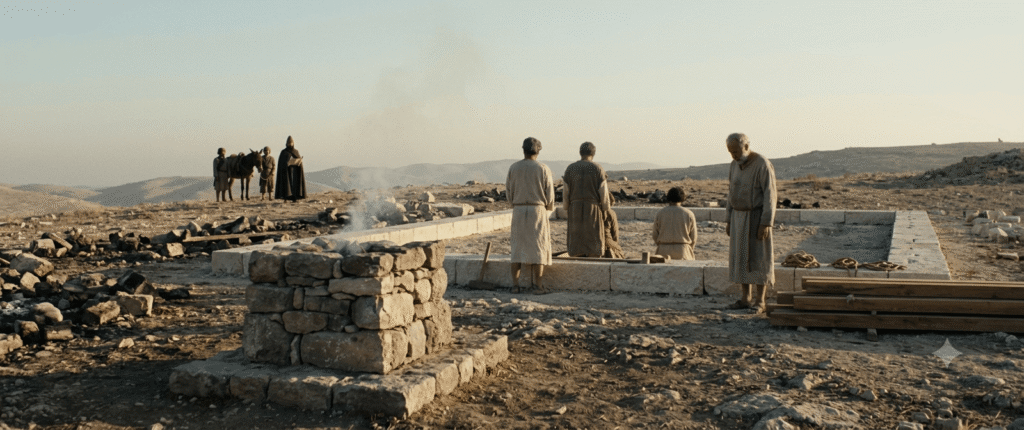
The first thing the returnees build is not the temple. It is an altar. They set it on its old foundation although they are afraid of the surrounding peoples, and they begin offering sacrifices before a single stone of the temple is laid (Ezra 3:2–6). The text gives no sign that they waited for the project to be secure before they worshiped. Cedar comes down from Lebanon through Sidon and Tyre under the grant Cyrus had given (Ezra 3:7). When the foundation is finally laid, the older people who remember the first temple weep aloud while others shout for joy, and the two sounds blend until no one can tell them apart (Ezra 3:10–13).
Then the work stops. Neighbors who offer to help are refused (Ezra 4:1–3), and the people of the land spend the rest of Cyrus’s reign and part of Darius’s discouraging, frightening, and bribing the builders (Ezra 4:4–5). We read this dispute in the builders’ own account, and only from their side.
The rest of the chapter stacks later episodes, arranged by theme rather than by date. Under Xerxes and Artaxerxes, officials write to the throne that Jerusalem is a rebellious city that will stop paying tribute if its walls rise, and they urge the king to search the records of his predecessors (Ezra 4:12–16). The search turns up a history of revolt. The king orders the work stopped “until a decree is made by me,” a clause that marks the order itself as provisional (Ezra 4:21), and the officials enforce it by force (Ezra 4:23).
The opposition in this chapter never needs an army to begin. It needs a clerk, a letter, and a filing system. Work on the temple itself sits idle until the second year of Darius (Ezra 4:24), around 520 BCE, roughly sixteen years after the foundation by the usual dating.
The text does not narrate those years. Haggai, who speaks at their end, suggests what they cost. The people say the time has not come to rebuild, and the prophet asks whether it is time for them to live in paneled houses while the Lord’s house lies in ruins (Haggai 1:2–4). By then the unfinished house had become background and private comfort had moved to the front. Some of those who had wept at the foundation (Ezra 3:12) were sixteen years older.
Then Haggai and Zechariah speak, and Zerubbabel and Jeshua pick up the tools again (Ezra 5:1–2). Soon the regional governor Tattenai arrives with the question every project under an empire eventually meets: who authorized this? The builders keep working while the inquiry travels to the king (Ezra 5:3–5). They answer plainly, including that their ancestors’ sins had brought Nebuchadnezzar down on them (Ezra 5:11–12), and Tattenai writes to Darius asking for a search of the royal archives (Ezra 5:17).
The search begins at Babylon and ends at Ecbatana, in Media, where a scroll turns up (Ezra 6:1–2). Its memorandum records Cyrus’s order: the house is to be rebuilt, its dimensions are fixed, and the cost is to be paid from the royal treasury (Ezra 6:3–4). Darius confirms it and goes further. Tattenai is to keep away, the expenses are to be paid promptly and in full from provincial revenue, the priests’ daily needs for sacrifice are to be supplied, and the priests are to pray for the life of the king and his sons (Ezra 6:6–10). Anyone who alters the order is to be punished severely (Ezra 6:11–12).
The temple is finished in the spring of 515 BCE by the usual reckoning (Ezra 6:15). At its dedication a hundred bulls, two hundred rams, four hundred lambs, and twelve goats are offered, one goat for each tribe (Ezra 6:17). Then comes Passover (Ezra 6:19–22).
Biblical Lens
Ezra 1:1–4; Isaiah 45:1 · The permit is credited to God’s hand without sanctifying the throne. Ezra reads Cyrus’s decree as the Lord stirring a king’s spirit, and Isaiah calls him “anointed.” Neither text says the empire is good.
Ezra 4:12–16; 6:1–2 · The archive cuts both ways. Imperial records are searched twice, once to condemn the builders and once to vindicate them.
Ezra 6:8–10 · Provision does not end dependence. The treasury pays in full, and the priests are asked to pray for the king and his sons.
The text acknowledges imperial power without handing its moral judgment over to it. It declines the easy stories: Cyrus the liberator, Persia the oppressor, Israel the helpless victim. It records a sanctuary built with imperial permission and imperial money, and a community willing to say so in writing.
Pattern Insight
The Archive Cuts Both Ways
Read side by side, chapters 4 and 6 describe the same machinery run in opposite directions. In chapter 4, officials ask the king to search the old records, and what the records contain is used to stop a building. In chapter 6, a governor asks for a search, and what the records contain is used to finish one. The empire did not change its filing system. It changed the question put to it, and the document that answered. Records do not govern themselves. Institutions decide which record counts.
The archive remembers. An official interprets. The throne decides. Ezra grants all three, and then credits the Lord with turning the king’s heart toward the builders (Ezra 6:22). The throne is not the last party consulted.
Jesus told his disciples they would hear of wars and rumors of wars, and told them not to be alarmed (Matthew 24:6). A letter that says “rebellion” can end a building project before a single soldier moves.
The strangest fact in these chapters is that the Persian treasury pays for a Jewish temple. To a modern reader that looks like a contradiction. Within the pattern above, it looks like administration. Ezra neither apologizes for it nor celebrates it. A community rebuilds its sacred center with resources supplied by the very political order from which it must remain spiritually distinct, and the book keeps both facts on the page: the money, and the prayer for the king. That is a harder idea than “God can use unbelieving rulers,” because it does not let either side off.
A permit is also a leash. The throne that funded the temple under Darius had halted the city’s walls under Artaxerxes, and nothing in Ezra suggests the community could have forced either decision. Even the best decree in the book carries a penalty for anyone who changes it (Ezra 6:11–12), a clause that tells us such orders could be changed.
Centuries later Augustine wrote of a people who, as long as the two cities remain intermingled, also make use of “the peace of Babylon” (City of God 19.26), drawing on Jeremiah’s instruction to the exiles to seek the welfare of the city where they had been sent (Jeremiah 29:7). He is not interpreting Ezra, and he writes of a different empire. But he supplies a later Christian vocabulary for a community that takes part in an earthly order without treating it as its final home.
Closing
May We, Can We, Will We
Return to the blueprint. Whatever becomes of it, it will face a question that survives any political cycle: who gets to rebuild, who gets to authorize the rebuilding, and what happens when those are different people?
Ezra’s chapters sort that question into three. May we? A decree answers it: a document, sealed, filed, found, and honored. Can we? Resources answer it: cedar from Lebanon, silver from the treasury. Will we? Nothing answers that one but the builders themselves: an altar raised in fear, a foundation laid with weeping and shouting at once, sixteen years of silence, and a restart that began before the verdict was in (Ezra 3:3; 3:13; 4:24; 5:1–5).
The empire can authorize the rebuilding. It cannot supply the will to rebuild.
A decree answers may we. A treasury answers can we. Only a foundation answers will we.
1. Associated Press, “Trump’s Board of Peace proposes $2.45 billion blueprint to begin Gaza reconstruction,” September 23, 2026.
2. The Cyrus Cylinder (British Museum, London).
3. “Vatican Naophorous” (statue of Udjahorresnet), Vatican Museums, Museo Gregoriano Egizio, Inv. 22690; inscription translated in Amélie Kuhrt, The Persian Empire: A Corpus of Sources from the Achaemenid Period (Routledge, 2007), pp. 117–22. Overview: Archaeology magazine, May/June 2023.
4. Augustine, The City of God 19.26. The Latin reads utimur et nos pace Babylonis (“we too make use of the peace of Babylon”); Marcus Dods renders the verb “enjoy.”