Hook
Some warnings arrive looking like good news
The line that slowed me down in the Chinese account of Red Cliffs is not about fire. It is about spectators.
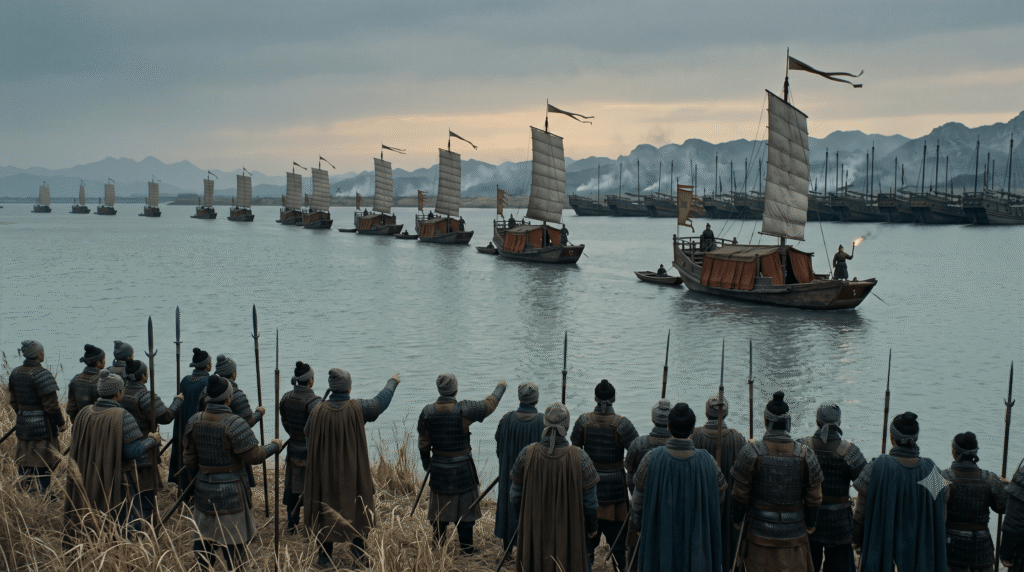
In the winter of 208, a squadron of warships came down the Yangtze toward Cao Cao’s camp, sails raised, a torch lit, the crews shouting that they had come to surrender. The Sanguozhi’s biography of Zhou Yu says that Cao Cao’s officers and men craned their necks to watch and told one another that Huang Gai was defecting.[1] The text describes no alarm at that moment. What it describes is an audience, reading an approaching squadron as the defection they had reason to welcome.
That small scene is the whole mechanism, and it is humbler than the legend. Popular memory gives us a strategist who calls up the wind. The earliest histories give us a letter, a squadron, and a crowd that was ready to believe what it was seeing.
In the previous installment, we followed seven unnamed survivors out of Masada, people the record kept by number and lost by name. This time the man at the center is named, and his name is the instrument: Huang Gai, a veteran officer of the Sun family, whose reputation became the signal an enemy chose to read.
Historical Case
What the early sources say, and what came later
By the autumn of 208, Cao Cao had taken Jing Province almost without a fight. Its ruler’s son had submitted, and the fleet came with the land.[2] A letter preserved in the Jiang Biao Zhuan has him telling Sun Quan that he commanded eight hundred thousand men and looked forward to a “hunt” together in Wu territory.[3] The court at Wu was divided between surrender and resistance.
Zhou Yu, the commander at the front, was outnumbered and knew it. According to the Sanguozhi, his officer Huang Gai, who had served under Sun Jian, Sun Ce, and Sun Quan in turn, pointed out that Cao Cao’s ships lay bow to stern, and that what is joined together can be burned together.[1] Huang Gai filled a squadron with dry brush and oil, covered the hulls with curtains, set command banners on the decks, and towed small fast boats behind. Then he wrote to Cao Cao.
The text of that letter comes from the Jiang Biao Zhuan, quoted in Pei Songzhi’s fifth-century commentary. In it, Huang Gai says that Wu cannot stand against the north, that every officer knows it, and that surrender is his considered plan.[4] The same account has Cao Cao questioning the messenger in private, saying he fears a trick, though if Huang Gai is sincere the reward will exceed any before it.
On the chosen night a southeast wind was blowing. In the Jiang Biao Zhuan’s telling, the lead ships raised their sails at midriver while the crews cried out that they were surrendering. About two li from the northern camp, less than a kilometer, they lit the vessels and dropped into the boats behind, and the unmanned ships ran before the wind into the moored fleet. The Sanguozhi adds that the flames reached the camps on the bank and that Cao Cao withdrew to Nan Commandery.[1] The sources are brief about the cost, and so is this essay.
Later tradition improved on all of this. The fourteenth-century novel Romance of the Three Kingdoms adds a staged flogging to make the defection convincing, a strategist who summons the wind, and a harvest of arrows from a fog-covered river, none of which appears in the early accounts in that form (Luo, trans. Roberts, 1991).[5] Cao Cao told a different story as well. A letter attributed to him blames an epidemic, says he burned his own ships and withdrew, and complains that Zhou Yu won a name for nothing.[6] Its authenticity has been questioned, yet an epidemic among his troops is recorded independently in his own annals. Whether or not the letter is genuine, it preserves a rival account: the ships burned, but not necessarily by Huang Gai’s hand. Even the location is disputed, since several sites along the river have claimed the name Red Cliffs.
Biblical Lens
A camp that did not know it was overheard
Judges 7 is, among other things, a campaign fought on information. Gideon’s army has been pared from thirty-two thousand to three hundred (Judges 7:3–8). On the last night, God tells him that if he is afraid, he may go down to the enemy camp with his servant and listen, and his hands will be strengthened afterward (Judges 7:9–11). The listening is not a technique Gideon devises. It is offered to a frightened man as mercy.
What he hears at the edge of the camp is not a plan but a dream. A Midianite soldier describes a loaf of barley bread tumbling into the camp and flattening a tent, and his comrade supplies the interpretation unprompted:
“God has given into his hand Midian and all the camp.” (Judges 7:14, ESV)
The enemy’s own fear has written the message. Then comes the strike: three hundred men ringing the camp with trumpets in one hand and torches hidden inside clay jars in the other. The jars break all at once, and the concealed fire shows.
“A sword for the LORD and for Gideon!” (Judges 7:20, ESV)
The camp, woken into panic by something it cannot measure, turns on itself (Judges 7:22).
Joshua 9 shows the pattern from the receiving end. Envoys from Gibeon arrive in worn clothes with dry, crumbling bread, claim to have come from a distant land, and ask for a treaty. Israel’s men do not neglect to look, since they examine the provisions. The narrator’s verdict falls elsewhere:
“but did not ask counsel from the LORD” (Joshua 9:14, ESV)
Three days later it comes out that the envoys are neighbors (Joshua 9:16).
Nothing in these texts obliges us to read a burned fleet, or a deceived assembly, as a sentence handed down from heaven. What they do record, steadily and without comment, is that communities come to show the kind of ground they chose to stand on, including whom they were willing to believe.
Pattern Insight
The check that ran through the claim
The numbers on offer are claims and estimates, not headcounts. Cao Cao’s letter spoke of eight hundred thousand. In the same source, Zhou Yu tells Sun Quan privately that the real figure is far lower: some 150,000 to 160,000 northern troops, already worn down, plus perhaps 70,000 to 80,000 newly acquired Jing soldiers who were still undecided where they stood.[7] A figure written to frighten and a figure offered in a private briefing are different kinds of evidence, and what interests me is what each was meant to do to its listener. Zhou Yu’s count is the discipline we met at Zama, where Hannibal counted the odds aloud before the fight rather than after it.
An earlier essay here followed lies that find a fear already waiting, at Salamis and at Ai. Red Cliffs asks what comes next, which is what happens when the target does check.
Cao Cao did try to check. The account has him question the messenger in private, with suspicion already on his lips. But the messenger belonged to the instrument, so the check ran through the channel that carried the claim. Israel’s men did something similar when they examined the provisions the Gibeonites brought. Both inspected evidence inside a frame the other party had built. Checking a claim with the one who made it is a ceremony of verification, not verification.
The sources do not say what independent check Cao Cao could have made from a riverbank in wartime, and the point is not that he should have found one. It is that the kind of check he chose could only confirm what the letter had already said. Pressure makes such checks easy to shortchange. An earlier essay on Nicias and the eclipse showed how a commander in a corner can seize on any signal that ends the not-knowing. The sources do not say Cao Cao felt that pull, but a letter promising the enemy’s defection would have offered the same relief.
Gideon’s night is a contrast, though not a contrast of intelligence. He heard a man who did not know he was being heard, so what reached him came from outside any frame built for his eyes. What the hearing gave him was less a fact about Midian than the courage to act.
That puts a heavier weight on the man in the lead ship. His name was the credential. For the letter to work, Cao Cao had to believe that a veteran of three Sun lords could be pried loose. Whatever Huang Gai felt about it, the plan required him to lend a lifetime’s reputation to a falsehood. He did not send the lie by proxy, since in the Jiang Biao Zhuan’s telling it is Huang Gai who raises the torch at midriver. The early histories give him no flogging and no staged quarrel, so his credibility rested on nothing but Cao Cao’s readiness.
The Wu shu, a history of the Wu state that Pei Songzhi quotes, adds a detail no one would invent for a hero. Struck by a stray arrow, Huang Gai fell into the cold river. The men who pulled him out did not recognize him and set him down in a latrine, where he lay until he called out the name of a fellow officer, Han Dang. Han Dang knew the voice and came to him weeping.[8] The man who had spent the night as a false voice was found by his true one.
Scripture holds both sides of this in view. Gibeon’s envoys also lent their names to a lie, in their case to save a city, and the text neither praises nor erases it. Israel was deceived, and Israel was bound: when the truth came out the assembly grumbled, but the leaders held to the oath they had sworn (Joshua 9:18–20). A mistaken judgment did not dissolve the promise made on its strength. None of this makes a commander’s stratagem equivalent to a doomed city’s plea, since their purposes and consequences differ. What the stories share is smaller: people judging on incomplete evidence and then living with the verdict.
Closing
Where a person stands when they look
Return to the men on the north bank, standing outside their lines. They were not fools by any ordinary measure. They had been winning all autumn, they were watching a defector come in, and a defector is welcome. They saw sails, a torch, and a cry of surrender, and recognized a scene their recent months had taught them to expect. Anyone who has ever “confirmed” a report by asking the person who wrote it will know the feeling.
Gideon went to the edge of a camp that did not know it was being heard. Cao Cao questioned a messenger whose errand was to persuade him. The difference was not simply intelligence. It was the kind of evidence each man could reach, and the assumptions each brought to it.
None of this counsels distrust. An army, a town, or a congregation cannot live without taking people at their word. The lesson is narrower and harder, which is to notice what one’s trust is standing on. The question was never whether Cao Cao checked, but where he stood when he did. Huang Gai’s fire was real, but it was the welcome that carried it across the water.
The fire was hidden inside the ships. The welcome was hidden inside the watchers.
[1] Chen Shou, Sanguozhi (Records of the Three Kingdoms), Wu zhi 9 (“Zhou Yu”) and Wu zhi 10 (“Huang Gai”).
[2] Sanguozhi, Wei zhi 1 (“Taizu”) and Wu zhi 9; Rafe de Crespigny, Imperial Warlord: A Biography of Cao Cao, 155–220 CE (Brill, 2010).
[3] Jiang Biao Zhuan, quoted in Pei Songzhi’s annotation to Sanguozhi, Wu zhi 2 (“Sun Quan”).
[4] Jiang Biao Zhuan, quoted in Pei Songzhi’s annotation to Sanguozhi, Wu zhi 9.
[5] Luo Guanzhong, Three Kingdoms: A Historical Novel, trans. Moss Roberts (University of California Press, 1991).
[6] Jiang Biao Zhuan, quoted in Pei Songzhi’s annotation to the Sanguozhi; on the epidemic, compare Sanguozhi, Wei zhi 1 (“Taizu”).
[7] Jiang Biao Zhuan, quoted in Pei Songzhi’s annotation to Sanguozhi, Wu zhi 9.
[8] Wu shu, quoted in Pei Songzhi’s annotation to Sanguozhi, Wu zhi 10; de Crespigny, A Biographical Dictionary of Later Han to the Three Kingdoms (Brill, 2007), s.v. “Huang Gai.”
New essays every week. Delivered quietly.