Hook
A story told by people no one thought to name
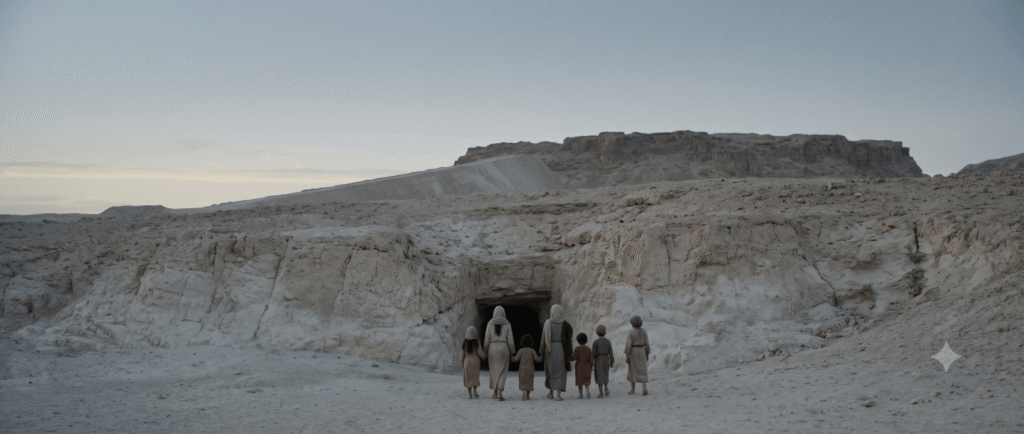
I keep returning to one detail that never makes it into the headlines. Josephus gives us the number of the dead at Masada (960) and the number who lived (seven: two women and five children), but he does not give us a single name for any of the seven.[1]
He names Eleazar ben Yair, the commander who delivers the speeches. He names the Roman governor, Flavius Silva. The people who walked out of the dark and told the soldiers what had happened remain, on his pages, an elderly woman, a relative of Eleazar’s, and five children.
That is the whole of their identity in the record. The ones who stayed alive became the channel through which the story reached us, and the channel has no face. Whatever else is true of Masada, the account we inherit passed through people whose names nobody preserved.
In the previous installment, we followed the unanswered injustice behind Boudica’s revolt, another provincial people meeting the same empire. Six weeks ago, we stood at this same fortress in front of the inscribed pottery fragments Yigael Yadin recovered there. This time we stay with the seven, and with an older text that keeps a similar silence.
Historical Case
What the survivors could and could not have seen
By the spring of 73 (some scholars say 74), the Tenth Legion under Lucius Flavius Silva had walled in the fortress and raised a great ramp against its western face.[2] Inside were the Sicarii, a militant faction led by Eleazar ben Yair, along with their families.
Josephus had no sympathy for them. He records that they raided the oasis of Engedi, and that they fought other Jews as readily as they fought Romans.[3] Anyone who wants to make saints of these people will have to argue with the historian who supplied their story.
On Josephus’s telling, Eleazar gave two speeches urging his people to die free rather than live as Roman slaves, and the community did as he proposed. I will not retrace what followed. Josephus describes it in detail, and detail is the one thing this essay can do without.
By his account, the Romans advanced at dawn into a silence they could not read. Then the women came out of hiding and explained everything that had been said and done. The soldiers at first doubted them, and when they made their way in and found the dead, they could take no pleasure in it. Josephus says they could not help marveling at the courage of so settled a resolve.[4]
Here the record asks for care. People already hiding underground when the killing began could have known very little of what took place above them, a point Shaye Cohen pressed hard (Cohen, 1982).[5] Cohen also argued that Eleazar’s speech served a literary purpose, answering the one Josephus says he gave at Jotapata, where he argued against the very act Eleazar defends.[6]
The irony is hard to miss. By his own account, Josephus survived a pact of that kind, spoke against it, and then gave the opposing arguments to Eleazar.
None of this cancels his account. It tells us how to hold it. He wrote years later, far from the mountain, under Roman patronage, and every reader since has had to decide how much of that night he could have known.
What survives, then, is a layered thing: a historian at a distance, a few people who had been hiding, and a night nobody could fully see. At the center of it sit seven people whose names, by whatever accident of memory, were never written down.
Biblical Lens
The valiant men who are never named
Scripture keeps a similar silence at the end of 1 Samuel, a book whose wider arc we traced in our reading of the whole book. After Saul’s death on Mount Gilboa, the Philistines display the bodies of the king and his sons on the wall of Beth-shan. The chapter could end there, on the shame of the defeat. It does not.
Instead it turns to Jabesh-gilead, a town Saul had once rescued from a besieging Ammonite king (1 Samuel 11:1–11). Years later, when its people heard what had been done to his body, a company of them set out:
“all the valiant men arose and went all night” (1 Samuel 31:12, ESV)
They took down the bodies, carried them home, buried the bones, and then did the quietest thing in the chapter:
“fasted seven days” (1 Samuel 31:13, ESV)
Nothing in the text says who these men were. The chapter names the king and each of his sons, and it leaves the carriers anonymous. (The Chronicler’s retelling in 1 Chronicles 10 adds a theological assessment of Saul’s reign in verses 13–14, but the account in 1 Samuel closes without one.)
Scripture never insists that every ruin be read as a verdict from heaven. What it does keep showing is that a people, in the quiet after the noise, reveals the moral conditions it had chosen to live under.
Pattern Insight
The named die, and the unnamed carry
Set the two scenes side by side and the numbers are small and specific. At Masada: 960 dead, seven living, and not one of the seven named. At Gilboa: a king and three sons dead (1 Samuel 31:2), and a company of men from a single town, also unnamed. Both accounts begin where the fighting stops, and in both the names go to the dead while the work goes to people who have none.
That symmetry should not be pushed far. These are not the same kind of event, and no moral equivalence is meant.
Gilboa is a battlefield defeat recorded in Scripture. Masada is a story whose only detailed account comes from a single author writing at a distance. The comparison here is narrower, and it concerns only what happens afterward.
After the end, the work that remains is carried by the unnamed. At Gilboa they carry with their bodies: a night’s march, a burial, a week without food. At Masada the seven carry with their voices.
They walk out and speak to the very soldiers who had besieged them. Neither act is a triumph, and neither carries the glamour we assign to a last stand. The ending of a last stand is a fact; what gets carried afterward is a choice, made by someone without a name.
The afterlife of Masada makes the point from another side. For long stretches of Jewish history the story seems to have been largely absent. Scholars such as Yael Zerubavel have traced how it was recovered in the twentieth century and made into a national emblem (Zerubavel, 1995).[7]
That recovery rested on Josephus, and so on the seven. Whoever they were, they handed over a record that later generations could pick up, reshape, and carry in directions the seven never chose.
Closing
What was carried, and by whom
Return to the detail this essay began with. Seven people walked out of the dark at Masada and spoke, and the one thing the record preserved about them is their number. The men of Jabesh-gilead crossed the Jordan in the night, and the one thing the record preserved about them is that they were valiant. Neither text gives us what we might want, a face or a name to set beside the fallen.
Perhaps that is part of what such texts are for. The story of the great ending belongs to the one who ends it. The unglamorous labor after it, the carrying, the telling, the fasting, belongs to people history rarely bothers to name. A people’s character shows less in how a last stand ends than in who bears what is left.
[1] Flavius Josephus, The Jewish War, Book 7, chs. 8–9, esp. 7.399 (trans. H. St. J. Thackeray, Loeb Classical Library, 1928).
[2] Jodi Magness, Masada: From Jewish Revolt to Modern Myth (Princeton University Press, 2019).
[3] Josephus, The Jewish War, Book 4 (the raid on Engedi).
[4] Josephus, The Jewish War, 7.402–406.
[5] Shaye J. D. Cohen, “Masada: Literary Tradition, Archaeological Remains, and the Credibility of Josephus,” Journal of Jewish Studies 33 (1982): 385–405.
[6] Josephus, The Jewish War, Book 3 (the cave at Jotapata); cf. Cohen (1982).
[7] Yael Zerubavel, Recovered Roots: Collective Memory and the Making of Israeli National Tradition (University of Chicago Press, 1995).
New essays every week. Delivered quietly.