Hook
Belonging Granted Through Another Can Be Withdrawn Through Another
Six decrees appeared in Kuwait’s official gazette on October 5. Together they withdrew citizenship from 415 people, and the reporting says most of the decrees also reach those who held nationality as dependants of the named holders (The New Arab, 2026; Times Kuwait, 2026).
Authorities say the review, begun in 2024, targets fraud, including dual nationality and citizenship acquired through marriage (The New Arab, 2026). Rights groups estimate that at least 50,000 people have lost citizenship since 2024, and Amnesty International reports that tens of thousands, mostly women, lost it through the retroactive application of amended law (The New Arab, 2026; Amnesty International, 2026). The 415 is one day’s count and the 50,000 is a rights-group estimate over two years, so the two are not measured the same way.
A state may set the terms of its own citizenship. How it withdraws what it has already granted, and what that does to relatives who held nationality through someone else, are separate questions, and the second is the one that matters here. “Dependants” is the reporting’s word, and it does a great deal of quiet work. It names a person whose standing exists because another person’s does.
Ezra 10 and Nehemiah 13 are not Kuwait’s nationality law, and this essay does not treat them as one institution. They share a structure: standing derived from someone else and settled by the decisions of others. In the previous installment, we examined a wall finished in fifty-two days and a city still waiting to be filled (One Hand on the Trowel). The last pages of the book turn to who gets to live inside.
Historical Case
The Remedy Came From the Crowd
Ezra is a priest and a scribe, trained in the Law of Moses, and the book places his arrival in the seventh year of an Artaxerxes, a king scholars still argue over (Ezra 7:6–7). Soon after he reaches Jerusalem, officials report that the people, the priests, and the Levites have not kept apart from the peoples of the surrounding lands. They have taken wives from among them for themselves and for their sons, and the leaders, the officials add, went first (9:1–2).
The list of peoples is curious. It names Canaanites, Hittites, Perizzites, Jebusites, Ammonites, Moabites, Egyptians, and Amorites, a combination of names drawn from Deuteronomy 7 and 23, and many of them no longer existed in Ezra’s day (Noss and Thomas, 2005). The officials’ complaint is that the “holy seed” has mixed with them (9:2). Christine Hayes has argued that Ezra took the idea of the priests as holy seed and extended it to the whole people (Hayes, 2002). The ESV prints “holy race” and footnotes the literal Hebrew, offspring, and scholars still debate whether the target is lineage, worship, or both (Southwood, 2012).
Lineage was never an abstraction in this world. Priests who could not find their names in the registers were barred from priestly service until a priest could consult the Urim and Thummim (Ezra 2:59–63), a stake we followed in Nine Chapters of Names.
The concern deserves its due. The returned exiles were a small community under imperial rule, with a temple freshly rebuilt and a Law that warned, in Deuteronomy 7:3–4, that foreign marriages could turn children away from the LORD. Ezra’s own prayer shows the fear. He thanks God for a remnant and a small secure foothold, then asks whether, if the people break the commandments again, anyone will be left to escape (9:8–9, 14). The question is what the remedy cost, and who paid.
Ezra’s response is physical before it is legal. He tears his garment and his cloak, pulls hair from his head and his beard, and sits appalled until the evening sacrifice (9:3–4). His prayer speaks in the plural, our guilt and our faithlessness, though nothing in the report points at him (9:6–15).
Then comes a detail that is easy to pass over: Ezra does not propose the remedy. A man named Shecaniah, of the clan of Elam, speaks from the weeping crowd. We have broken faith, he says, yet there is hope, so let us covenant to send away all these wives and their children (10:2–3). Ezra rises and has the leaders swear (10:5).
A man named Jehiel, of the sons of Elam, turns up later among those listed as having married foreign women (10:26). The text does not say whether he is related to Shecaniah, and the coincidence is best left as the text leaves it.
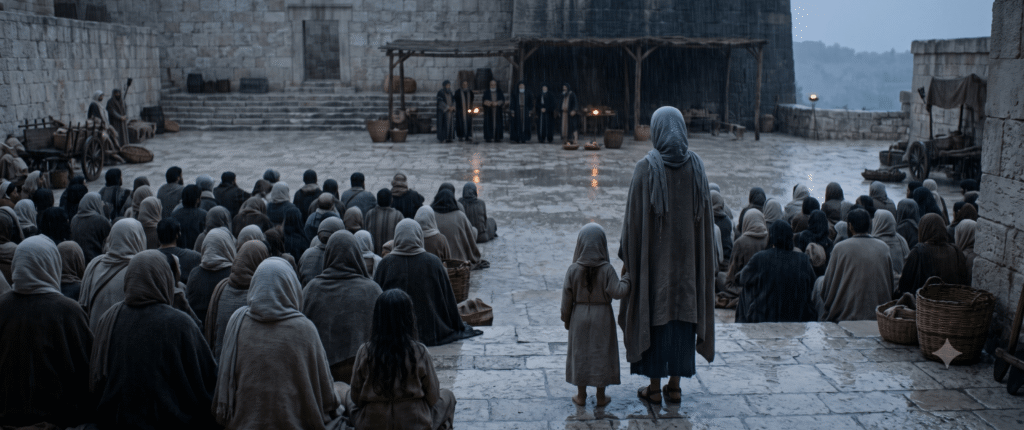
What follows reads like the minutes of a committee. A summons goes out: come to Jerusalem within three days, or forfeit your property and be cut off from the assembly (10:7–8). The people sit in the open square in the ninth month, trembling over the matter and over the heavy rain (10:9). The crowd itself asks for a slower method, since it is the rainy season and the work is too large for a day or two (10:13), and a commission of elders and judges sits until the first day of the first month (10:16–17).
One verse preserves dissent, or perhaps help. Jonathan son of Asahel and Jahzeiah son of Tikvah took a position on the matter, with two others standing behind them (10:15). The Hebrew is ambiguous: most modern translations read opposition, while the King James Version reads the men as helping to carry it out (Noss and Thomas, 2005).
The final verse needs three things kept apart: what the text says, what translators dispute, and what it leaves unsaid. The text lists the men by family and says all had married foreign women (10:18–44). Translators divide over the rest of the last verse: the ESV says some of the women had borne children, and a footnote offers a reading in which the men sent the women away together with their children.
The text does not say what became of the women or the children. That silence is not evidence of how many left, or of what any of them wished.
Nehemiah 13 supplies the sequel, years later. Back from the king’s court, the governor finds that the priest Eliashib has given Tobiah, the same Tobiah whose family ties ran through the nobles’ correspondence in chapter 6, a large storeroom in the temple courts (13:4–9). Nehemiah throws Tobiah’s household furniture out of the chamber (13:8).
Then he turns to marriage. He finds Judeans with wives from Ashdod, Ammon, and Moab, and half their children speak the language of Ashdod and cannot speak the language of Judah (13:23–24). The first complaint is about speech, not purity. A community that lives by a book needs children who can follow it, and Nehemiah 8 had shown the Levites explaining the Law so that the people understood (Neh 8:8).
A language is also how a memory is handed down, so a generation that cannot speak it may not be able to receive what came before. The aim, a living language, is one thing; the means that follow are another.
Nehemiah’s method is not the committee’s. He argues with the men, curses them, strikes some, and pulls out their hair, then makes them swear never to give or take their children in marriage with those peoples (13:25). Ezra had pulled out his own hair. He cites Solomon (13:26), chases off a priest’s son who had married Sanballat’s daughter (13:28), and ends the book with a prayer that God remember the offenders and then, in the next breath, himself (13:29–31).
Biblical Lens
Ezra 10:2–3 — Evidence of who decides and who is decided about. A man whose clan appears on the list proposes sending away wives and children, and the record preserves the proposal, the oath, and the names, but not a word from the women or the children.
Nehemiah 13:23–25 — Evidence of an aim and a means held side by side. The fear is about the children’s speech, and the response is an argument, a curse, and an oath about future marriages; the text records no mass departure here.
Ruth 4:13–17 — Evidence of a different imagination inside the same canon. A Moabite widow marries into Bethlehem, bears Obed, and the women of the town name the child whose line runs to David.
Scripture does not ask anyone to read every wound as a sentence handed down from heaven. It asks for something less comfortable: attention to the rules a community writes while it is afraid, because those rules are the clearest portrait of the conditions it chose to live under.
Pattern Insight
The Calm of a Committee Room
Take the numbers as the reports give them. Six decrees on one day withdrew citizenship from 415 people, the largest of them, Decree 156, covering 286 (Times Kuwait, 2026). AFP reported in 2025 that the campaign abolished naturalization by marriage, a route that applied only to women, and revoked citizenship granted to wives since 1987 (AFP, 2025). The counts establish scale. They cannot separate the files that held real fraud from the files that held only a marriage.
That is where an older pattern becomes useful, with its limits stated. Aristotle’s account dates Pericles’ law, restricting Athenian citizenship to the children of two Athenian parents, to 451 BCE (Constitution of the Athenians 26.3–4). Later sources report that in 445/4, after a gift of grain from Egypt, the citizen lists were reviewed and several thousand names were struck off (Plutarch, Pericles 37; Philochorus, fr. 119), and historians still dispute the law’s date and reach.
Athens was a city dividing privileges and Judah was a covenant community, so the comparison is loose and proves nothing about Ezra’s motives. It shows only that membership tends to be policed most closely when it is worth something, and that the review can reach backward.
Daniel Smith-Christopher reads the post-exilic period as a time when exclusion and inclusion of the foreigner pulled against each other, setting Ezra beside Isaiah, and he treats Ezra 9–10 as the behavior of a small returned minority under an empire (Smith-Christopher, 1996). Two questions can stand side by side without cancelling each other. Why did this community feel it had to strengthen its boundary? And what did it ask of others in order to keep it?
Notice who speaks. Shecaniah speaks, Ezra speaks, the officials speak; the foreign wives and their children are the objects of the verb send away (10:3). The text records proposals, oaths, and lists, not the women’s or the children’s words. That is a gap in the record and not evidence of what they thought.
A status that arrives through someone else can leave through someone else, and the holder is rarely at the table.
Miroslav Volf, whom we met in an essay on forgiving a child’s killer, wrote Exclusion and Embrace in the shadow of the Yugoslav wars. He does not argue against boundaries; identity needs them. His charge is against the boundary that cuts the bonds between people, and he names its forms: elimination, assimilation, domination, and abandonment (Volf, 1996). His vocabulary was not Ezra’s, and it is offered here as a question a modern reader may bring to the text and not as a verdict on Ezra’s intent.
Keeping a boundary and severing a bond are different acts, and the text leaves us to ask which one the verb send away names.
The canon holds the tension without resolving it. Deuteronomy 23:3 barred Moabites from the assembly, and Nehemiah 13:1–2 reads that very text aloud. The Book of Ruth tells of a Moabite widow who binds herself to Naomi’s people and Naomi’s God, and it ends in David’s genealogy (Ruth 4:17–22). A prophet tells the foreigner who has joined himself to the LORD not to say he will be excluded (Isa 56:3).
Whether Ruth was written to answer Ezra is only a proposal, since its date is disputed. The rabbinic tradition preserves a ruling that the ban fell on Moabite men and not on Moabite women (m. Yevamot 8:3; b. Yevamot 76b–77a), which shows how hard later readers worked to keep both texts standing, though it is not the original sense of either. Ruth is not a verdict against Ezra. She is the other voice in the same room.
The two stories differ in who gets to speak. Ruth states her own loyalty aloud (Ruth 1:16–17). The women of Ezra 10 are given a verb instead, and it is done to them.
Closing
A Decree Settles a Status, Not a Childhood
Return to the six decrees of October 5 and the word the reporting used for those attached to the named holders: dependants. Their arithmetic is tidy, so many holders and so many more who held standing through them, and Ezra 10 keeps the same tidy sums.
Nehemiah 13 interrupts the tidiness with children who half-speak the language of Ashdod and cannot speak the language of Judah. A community that lives by a book has a real stake in what its children can say, and a language is also how a memory is handed down. A decree can change a status, but it cannot say what a household has already lived.
Ruth’s own standing in Bethlehem ran through Naomi’s family and then Boaz’s, and the scroll that carries her name ends in the ancestry of a king. It does not cancel Deuteronomy 23, and Ezra 10 does not mention her. The canon keeps both and leaves the reader holding the tension.
Ezra and Nehemiah feared that a people so recently restored would be lost, and the fear was not foolish. The harder reading is that the cost of answering it fell first on households with no seat where it was decided. The reporting’s word for such households was dependants, and the book of Nehemiah ends on a governor who has noticed which language those children speak, and on a prayer asking God to remember.
- Sarah Khalil, “Kuwait strips 415 of citizenship, including billionaire,” The New Arab, Oct. 5, 2026, newarab.com; “Kuwait issues six decrees, revokes citizenship of 415 people,” Times Kuwait, Oct. 5, 2026, timeskuwait.com.
- Amnesty International, “Kuwait,” Amnesty International Report 2025/26, amnesty.org.
- Agence France-Presse, “‘Stateless overnight’: Kuwait strips tens of thousands of citizenship,” 2025, via The New Arab, newarab.com.
- Philip A. Noss and Kenneth J. Thomas, A Handbook on Ezra and Nehemiah (United Bible Societies, 2005), notes on Ezra 9:1 and 10:15.
- Christine E. Hayes, Gentile Impurities and Jewish Identities: Intermarriage and Conversion from the Bible to the Talmud (Oxford University Press, 2002); Katherine E. Southwood, Ethnicity and the Mixed Marriage Crisis in Ezra 9–10 (Oxford University Press, 2012).
- Daniel L. Smith-Christopher, “Between Ezra and Isaiah: Exclusion, Transformation, and Inclusion of the ‘Foreigner’ in Post-Exilic Biblical Theology,” in Ethnicity and the Bible, ed. Mark G. Brett (Brill, 1996), 117–142.
- Miroslav Volf, Exclusion and Embrace: A Theological Exploration of Identity, Otherness, and Reconciliation (Abingdon Press, 1996).
- Mishnah Yevamot 8:3; Babylonian Talmud Yevamot 76b–77a.
- Aristotle, Constitution of the Athenians 26.3–4; Plutarch, Pericles 37; Philochorus, fragment 119 (Jacoby, FGrH 328).
New essays every week. Delivered quietly.