S1 · Hook
The Sea Was Close, and the Emperor Was Listening
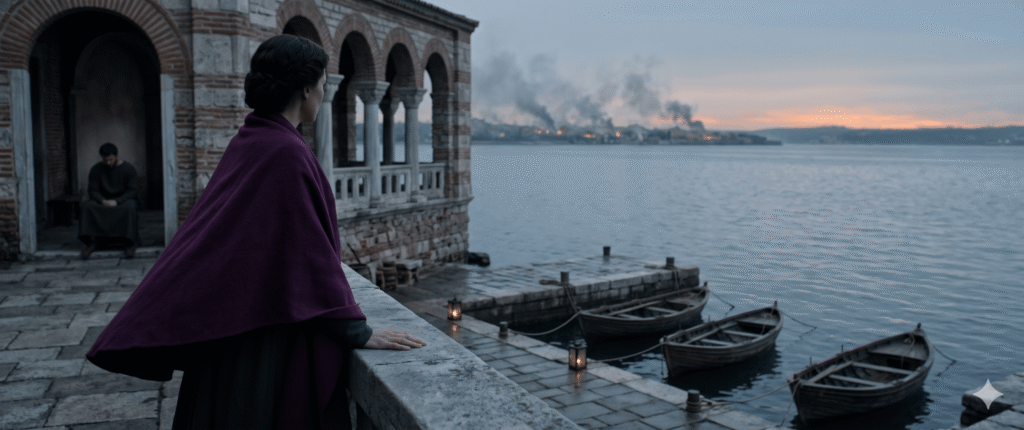
The harbor is the part of this story that rarely makes it into the retelling. In January 532, while the center of Constantinople burned around the Hippodrome and its great church, the emperor of the Romans had a way out. The palace complex stood by the water, and boats were to hand. What remained uncertain was whether leaving would preserve the office he hoped to save.
According to Procopius, Justinian’s council spent that day weighing exactly this. Money was available, the sea was a short distance off, and no one in the room lacked a reason to go.
In the previous installment, we examined Attila’s pyre of saddles and the uneasy allies who held the Roman line at the Catalaunian Plains. Eighty-one years later, the Western half of that empire was gone, and the Eastern half came within a single council meeting of losing its emperor to the sea.
S2 · Historical Case
A City That Had Run Out of Patience
Sixth-century Constantinople was organized, in part, around its chariot teams. The Blues and the Greens were supporters’ factions, but they were also neighborhood networks with a voice that reached the palace, and in January 532 the two groups, usually rivals, found a shared grievance. The chroniclers point to heavy taxation under the prefect John the Cappadocian and to a legal administration under Tribonian that many saw as corrupt. Modern historians add factional politics and senatorial ambition, and read the revolt as a convergence of pressures, not as sports hooliganism that got out of hand (Greatrex, 1997).
The spark, in the chroniclers’ account, was a botched execution. Two condemned men, one from each faction, survived when the gallows failed, and monks carried them into sanctuary. When the races opened a few days later, the crowd took up the cry that named the revolt, Nika, “conquer,” the shout of the racecourse turned against the throne. Justinian dismissed the officials the crowd had named, and it changed nothing. Fires spread through the city center, and the great church burned. Over roughly a week the crowd crowned a rival emperor, Hypatius, a nephew of the late Anastasius who, in some tellings, did not want the honor.
Then comes the scene that survives in Procopius’s Wars, and it needs a caution first. Procopius is our principal narrator of the council, and ancient historians composed speeches to fit what they believed had been said (Kaldellis, 2004). We cannot know how closely his words reproduce what Theodora actually spoke. In his account, Justinian’s advisers were weighing flight, and the empress turned the question of escape into a question of what imperial office can survive. The same Procopius, in his Secret History, paints her in the harshest colors available, and that hostile pamphlet is also our source for her origins as the daughter of a Hippodrome bear-keeper and an actress. The admiring speech and the savage portrait come from one pen, which is reason enough to hold both at arm’s length.
Her argument, as the Wars renders it, was brief. If the emperor wished to save his life, nothing prevented it, since there was money and there was the sea. But she would stay, because one who has worn the crown cannot bear to live as a fugitive. She closed with an old saying: “royalty is a good burial-shroud” (Procopius, trans. Dewing). Procopius says the room recovered its nerve and began to plan.
The counterstroke came from two generals, Belisarius and Mundus. Belisarius rode out at the head of Goths and Heruls, and Mundus commanded a Herulian force (Bury, 1923). Eighty-one years after the saddles went unlit, Rome was again defended partly by foreign arms it did not wholly trust. What followed in the Hippodrome is the part of this story I will not narrate. The sources are lurid, their figure for the dead is a number I have chosen not to repeat, and the lesson does not live there.
S3 · Biblical Lens
Two Refusals and a Flight
Scripture keeps a recurring figure, a person with standing and an exit available. Three short lines show what that person does with the exit.
“…and who knoweth whether thou art come to the kingdom for such a time as this?” (Esther 4:14, KJV)
“Should such a man as I flee?” (Nehemiah 6:11, KJV)
“…and the king went the way toward the plain.” (2 Kings 25:4, KJV)
A court, a city, or a household shows what it has chosen to stand on by what happens when the exits open. None of these texts claims that the fire itself is heaven’s verdict, and this essay does not either.
The three lines carry three different movements. Esther, urged by Mordecai, risks her own position to plead for a people threatened by royal power, the walk I traced in a recent essay on Esther. Nehemiah, a royal cupbearer, declines a retreat into the temple that would abandon the work entrusted to him, and the wall he stays to build is finished in fifty-two days (Nehemiah 6:15; I followed that work in How Did Nehemiah Rebuild the Wall in 52 Days?). Zedekiah, the last king of Judah, is the contrast. When the city wall was breached, he went out by night, and his pursuers overtook him in the plains of Jericho (2 Kings 25:4–5). Esther offers the courage of intervention, Nehemiah the endurance of a task kept, and Zedekiah the plainest picture of an exit taken.
Theodora is none of these. She faces no hostile decree, and the one tempted to flee is her husband. What she urges is that a sovereign not surrender a throne. The comparison has limits, and those limits matter. Her refusal may have preserved the state, but the survival of a state is not proof that its government has become just.
The biblical question, then, is not simply whether a person stays. It is what the person is staying for, whom that decision protects, and who will bear its cost.
S4 · Pattern Insight
What the Dates Say, and What They Leave Out
The dates are easy to set in a row. The revolt unfolded over about a week in January 532. Work on the new Hagia Sophia began that February, and the building was dedicated in December 537, less than six years after the old church burned. Theodora died in 548, sixteen years after the council. Justinian reigned until 565, thirty-three years past the day he nearly sailed.
Dates are easier to admire than to interpret. The council scene rests on Procopius alone, and if Theodora did not speak these words, someone in that room still said stay, and the sentence outlived its speaker’s name.
What matters more is what the revolt did not repair. By most accounts, the officials the crowd had demanded returned to high office, John soon after the suppression and Tribonian within about three years. The administration survived the crisis, and the underlying questions of taxation and government did not simply disappear. Political survival can create the conditions for repair; it cannot stand in for repair itself.
Three distinctions follow, and each is easy to blur. Preventing an emperor’s flight is not the same as answering the grievances that brought the city to revolt. Crushing a rebellion is not the same as resolving its causes. A capital that can be rebuilt has not thereby answered those who were lost in it. Theodora’s words, as Procopius preserves them, helped turn a question of escape into a decision to resist, but resistance is not justice, and an institution’s survival cannot by itself establish the worth of what it does next.
That is where the biblical cases ask for care. Scripture records the staying and the wall it built, and it records the flight, but it never says every staying is righteous. The cost of this counsel was paid by people who had no purple to die in, and the story cannot be told honestly with only one of those facts.
S5 · Closing
What the Purple Could Not Carry
The boats at the quay were never launched, and I find them the most revealing objects in this story. They stand for the option the council refused: survival without the city, at least for a time.
I cannot say whether Theodora spoke from courage, pride, or some mixture of both. Procopius gives us a memorable speech, not access to her conscience, and what followed was neither a clean victory nor a settlement of the grievances that had set the city on fire. The purple she would not leave behind was a shroud or a banner, depending on who wore it that week and who was paying for it.
The harbor, meanwhile, went on doing what harbors do. The water below the palace stayed quiet.
- Procopius, History of the Wars 1.24 (trans. H. B. Dewing, Loeb Classical Library, 1914). The Secret History, a separate and hostile work, is the source for Theodora’s origins.
- Geoffrey Greatrex, “The Nika Riot: A Reappraisal,” Journal of Hellenic Studies 117 (1997).
- Anthony Kaldellis, Procopius of Caesarea: Tyranny, History, and Philosophy at the End of Antiquity (2004).
- J. B. Bury, History of the Later Roman Empire (1923), vol. 1, ch. 15. On Belisarius’s Gothic and Herulian troops and Mundus’s force.
- John Malalas, Chronicle, and Chronicon Paschale, for the chronology of January 532.
- Scripture quotations are from the King James Version.
New essays every week. Delivered quietly.